
The major product of the following reaction is
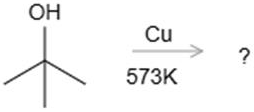
The major product of the following reaction is
Solution
✅ Correct Option: 3
Copper at 573 K dehydrogenates primary and secondary alcohols, giving aldehydes and ketones. A tertiary alcohol such as has no hydrogen on the carbon bearing OH, so it cannot be dehydrogenated. It loses water instead, giving the alkene.
The product is 2-methylprop-1-ene (isobutene).
Option 1: 2-methylpropanal would form from the primary alcohol 2-methylpropan-1-ol by dehydrogenation, not from a tertiary alcohol.
Option 2: "prop-2-ene" is not a valid name, because the double bond must get the lowest locant, which is 1.
Memory trick: with hot Cu, 1° gives aldehyde, 2° gives ketone, 3° gives alkene.
Related questions:
2025: 3 June Shift 2
2026: 20 May Shift 2
2025: 14 May Shift 2
2025: 21 May Shift 2