Q1:

d & f Block Elements

Medium

KMnO4\mathrm{KMnO_4} and K2Cr2O7\mathrm{K_2Cr_2O_7} share some similarities.

(A) Both are strong oxidizing agents.

(B) Both can oxidize iodides to iodine in acidified solution.

(C) Both compounds are highly soluble in water.

(D) Chromates and permanganate ions share a tetrahedral structure.

Answer options
Option 4
Correct Answer
Explanation for 2026: 12 May Shift 2 CHE question 1

Q2:

Amines

Easy

What will be the product of the following reaction?

R−C∥O−NH2→(ii) H2O(i) LiAlH4?\mathrm{R{-}\overset{O}{\overset{\Vert}{C}}{-}NH_2 \xrightarrow[\text{(ii) } H_2O]{\text{(i) } LiAlH_4} ?}

Answer options
Option 2
Correct Answer
Explanation for 2026: 12 May Shift 2 CHE question 2

Q5:

d & f Block Elements

Easy

Match List-I with List-II

List-IList-II
(A) Ziegler Natta Catalyst(I) Alloy of Lanthanoids
(B) Mischmetall(II) Diamagnetic
(C) Cu2+^{2+}(III) TiCl4\mathrm{TiCl_4} and Al(CH3)3\mathrm{Al(CH_3)_3}
(D) repelled by the applied field(IV) Paramagnetic
Answer options
Option 4
Correct Answer
Explanation for 2026: 12 May Shift 2 CHE question 5

Q7:

Biomolecules

Easy

Which of the two monosaccharide units are bonded by glycosidic linkage in sucrose disaccharide?

Answer options
Option 3
Correct Answer
Explanation for 2026: 12 May Shift 2 CHE question 7

Q8:

Solutions

Medium

Which of the following cause and facts are true about positive deviations from ideal behavior of solutions?

(A) A-B interactions are weaker than those between A-A and B-B

(B) CS2_2 - Acetone solution shows positive deviation.

(C) Minimum boiling azeotrope is observed in positive deviation,

(D) Maximum boiling azeotrope is observed in positive deviation

Answer options
Option 3
Correct Answer
Explanation for 2026: 12 May Shift 2 CHE question 8

Q9:

d & f Block Elements

Medium

Arrange the following divalent ions in decreasing order of their spin only magnetic moment:

(A) Ti2+^{2+}

(B) Zn2+^{2+}

(C) Mn2+^{2+}

(D) Fe2+^{2+}

Answer options
Option 2
Correct Answer
Explanation for 2026: 12 May Shift 2 CHE question 9

Q10:

Electrochemistry

Easy

An electrolytic cell has cell potential of approximately 1.35 V and remains constant during its life. Its overall reaction is represented by

Zn(Hg)+HgO(s)→ZnO(s)+Hg(l)\mathrm{Zn(Hg) + HgO(s) \rightarrow ZnO(s) + Hg(l)}

Find out the reducing and oxidizing agents in the above given cell reaction.

Answer options

Q11:

Amines

Medium

Aliphatic and aromatic amines are basic in nature. The following amines are in aqueous state.What is the decreasing order of their basic strength?

(A) NH3\mathrm{NH_3}

(B) (C2H5)2NH\mathrm{(C_2H_5)_2NH}

(C) C2H5NH2\mathrm{C_2H_5NH_2}

(D) (C2H5)3N\mathrm{(C_2H_5)_3N}

Answer options

Q12:

Amines

Medium

Match List-I with List-II

List-IList-II
Chemical reactionsProducts
(A) Acylation of N-ethylethanamine(I) Quaternary ammonium salt
(B) Benzoylation of methanamine with benzoyl chloride(II) N,N-Diethylethanamide
(C) Alkylation of tertiary amines(III) N-Ethylbenzenesulphonamide
(D) Hinsberg's reagent with ethylamine(IV) N-Methylbenzamide
Answer options

Q13:

Haloalkanes & Haloarenes

Easy

A pair of enantiomers differs from which of the following property ?

Answer options

Q14:

Alcohols, Phenols & Ethers

Easy

Match List-I (Name of reaction)with List-II (End product)

List-IList-II
Name of reactionEnd product
(A) Reimer Tiemann reaction(I) Aspirin
(B) Nitration of phenol by conc. HNO3_3(II) Salicylic acid
(C) Acetylation of salicylic acid(III) Salicylaldehyde
(D) Kolbe reaction(IV) Picric Acid
Answer options

Q17:

Solutions

Easy

Which way of expressing concentration is commonly used in industrial chemical applications?

Answer options

Q19:

Chemical Kinetics

Easy

Inversion or hydrolysis of cane sugar (in presence of excess of water) i.e.

C12H22O11+H2O→C6H12O6+C6H12O6\mathrm{C_{12}H_{22}O_{11} + H_2O \rightarrow C_6H_{12}O_6 + C_6H_{12}O_6}

Cane Sugar Glucose Fructose

is a pseudo first order reaction with Rate = k [C12H22O11][\mathrm{C_{12}H_{22}O_{11}}]

Which of the following statements is correct about this pseudo-first order reaction?

Answer options

Q21:

Solutions

Medium

0.02 g of the following substances (assuming non-electrolytes) are dissolved in 500 mL of water. Arrange them in increasing order of their elevation of boiling point of solution.

Given: Molar mass of H, C, N, O and Cl are 1, 12, 14, 16 and 35.5 g mol−1^{-1} respectively.

(A) C6H12O6\mathrm{C_6H_{12}O_6}

(B) NH2CONH2\mathrm{NH_2CONH_2}

(C) C12H22O11\mathrm{C_{12}H_{22}O_{11}}

(D) C3H7Cl\mathrm{C_3H_7Cl}

Answer options

Q22:

Electrochemistry

Easy

What would be molar conductivity at infinite dilution Λm∞\Lambda_m^{\infty} of MgSO4\mathrm{MgSO_4} if λm∞\lambda_m^{\infty} of Mg2+\mathrm{Mg^{2+}} is 104.0 S cm2^2 mol−1^{-1} and λm∞\lambda_m^{\infty} of SO42−\mathrm{SO_4^{2-}} is 166.0 S cm2^2 mol−1^{-1}?

Answer options

Q23:

Chemical Kinetics

Easy

Which of the following statement is incorrect in regards to variation of rate of reaction with respect to temperature?

Answer options

Q24:

Alcohols, Phenols & Ethers

Easy

What will be the major product in the following reaction?

Figure

Answer options

Q25:

Electrochemistry

Hard

Which of the following statements are true in accordance with Nernst equation for the cell in which the following reaction takes place at 298K?

Ni(s)+2Ag+(aq)→Ni2+(aq)+2Ag(s)\mathrm{Ni(s) + 2Ag^+(aq) \rightarrow Ni^{2+}(aq) + 2Ag(s)}.

E(cell)0E^0_{(cell)} is given 2.97 V and the concentration of Ag+^+ ion is 0.001 M and Ni2+^{2+} is 0.2 M.

Given: log 2 = 0.30

(A) Ecell=E(cell)0−RT/2Fln⁡[Ni2+]/[Ag+]2E_{cell} = E^0_{(cell)} - RT/2F \ln [\mathrm{Ni}^{2+}] / [\mathrm{Ag}^+]^2

(B) The electrode potential of the cell is 2.81V.

(C) Equilibrium constant Kc can be calculated from the given data.

(D) Ecell=E(cell)0−RT/2Fln⁡[Ag+]2/[Ni+]E_{cell} = E^0_{(cell)} - RT/2F \ln [\mathrm{Ag}^+]^2 / [\mathrm{Ni}^+]

Answer options

Q28:

Haloalkanes & Haloarenes

Easy

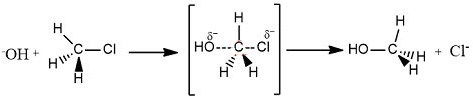
Read the statements related to the following reaction and choose the correct statements

Figure

(A) It is SN1\mathrm{S_N1} reaction

(B) This process follows inversion of configuration.

(C) It follows second order kinetics.

(D) It is SN2\mathrm{S_N2} reaction.

Answer options

Q29:

Solutions

Easy

Match List-I with List-II

List-IList-II
(Constants)(Used directly in the expressions of)
(A) Ebullioscopic constant(I) Depression in freezing point.
(B) Henry's Law constant(II) Osmotic pressure.
(C) Cryoscopic constant(III) Elevation in boiling point.
(D) Gas constant(IV) The solubility of gas
Answer options

Q30:

Alcohols, Phenols & Ethers

Easy

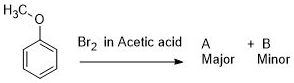
Bromination of phenol with bromine water gives product A while bromination of phenol with Br2_2-CS2_2 and at low temeprature gives product B as a major product. Identity the products A and B in the reaction.

Answer options

Q31:

Chemical Kinetics

Easy

Which of the following can be the rate constant of a first order reaction?

Answer options

Q32:

Chemical Kinetics

Medium

A first order reaction has the rate constant of 90 s−1^{-1}. How much time will it take to reduce the initial concentration of the reactant to its 1/20th value? (log 2 = 0.3010)

Answer options

Q33:

d & f Block Elements

Easy

d-Block elements make interstitial compounds with H, C or N trapped inside the crystal lattices of metals. Identify the incorrect property of interstitial compounds from the following:

Answer options

Q34:

Electrochemistry

Easy

Match List-I (Types of cell/battery) with List-II (Applications)

List-IList-II
Types of cell/batteryApplications
(A) Leclanche cell(I) Space Programme
(B) Mercury cell(II) Automobiles and inverters
(C) Fuel cell(III) Transistors/ clocks
(D) Lead storage battery(IV) Hearing aids and watches
Answer options

Q35:

Chemical Kinetics

Easy

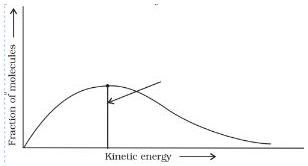
Following is the Maxwell Boltzmann distribution curve (gaseous molecules)

Figure

The peak of this curve corresponds to.

Answer options

Q36:

Haloalkanes & Haloarenes

Easy

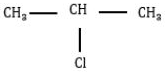
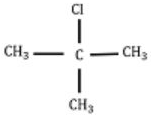
In SN2\mathrm{S_N2} reaction, predict the increasing order of reactivity of the following alkyl halides

(A) CH3-Cl\mathrm{CH_3\text{-}Cl}

(B) CH3-CH2-Cl\mathrm{CH_3\text{-}CH_2\text{-}Cl}

(C) Figure

(D) Figure

Answer options

Q37:

Haloalkanes & Haloarenes

Easy

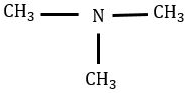
Which of the following is an ambident nucleophile?

Answer options

Q38:

Electrochemistry

Easy

Standard Electrode Potential (E0E^0) of following redox couples are given below at 298K. What will be the correct increasing order of the reducing strength of the metals?

(A) Mg2+/Mg\mathrm{Mg^{2+}/Mg} = -2.36 V

(B) Al3+/Al\mathrm{Al^{3+}/Al} = -1.66 V

(C) Cr3+/Cr\mathrm{Cr^{3+}/Cr} = -0.74 V

(D) Ni2+/Ni\mathrm{Ni^{2+}/Ni} = - 0.25 V

Answer options

Q39:

Alcohols, Phenols & Ethers

Medium

Williamson synthesis is an important method for the preparation of ethers.

R−X+R′−O¨ˉNa+⟶R−O¨−R′+Na X\mathrm{R{-}X + R'{-}\bar{\ddot{O}}\overset{+}{Na} \longrightarrow R{-}\ddot{O}{-}R' + Na\,X}

Consider the following statments and identify the correct statements

(A) This method is not applicable for preparation of symmetrical ethers.

(B) This method is used for the preparation of both symmetrical and unsymmetrical ethers .

(C) This involves SN1\mathrm{S_N1} attack of an alkoxide on primary alkyl halide.

(D) Ethers containing substituted alkyl groups (secondary or tertiary ) can also be prepared by this method.

Answer options

Q40:

Haloalkanes & Haloarenes

Easy

Unimolecular nucleophilic substitution (SN1\mathrm{S_N1}) is generally carried out in

Answer options

Q41:

Coordination Compounds

Easy

Coordination compounds

The coordination compounds are very importants in biological systems (like human, plant and animal's body), metallurgy, analytical chemistry, medicine etc. Chlorophyll, Hemoglobin, vitamin B12_{12} etc. are coordination compounds of various metals. They are also called complex compounds and formed by two main entities, metal and ligands. Some ligands are Poly-dentate, like EDTA, which is used in the estimation of hardness of water with Ca2+^{2+} and Mg2+^{2+} ions. Gold and silver make [Au(CN)2]−[\mathrm{Au(CN)_2}]^- and [Ag(CN)2]−[\mathrm{Ag(CN)_2}]^- type complex ions in aqueous solution during extraction of metals. In photography, developing film form a complex ion [Ag(S2O3)2]3−[\mathrm{Ag(S_2O_3)_2}]^{3-}. A complex compound of platinum (Pt), cis-platin is used in the treatment of cancer. Some metals can be refined by making their complex compounds, like impure Nickle is converted to [Ni(CO)4][\mathrm{Ni(CO)_4}] complex. All these coordination compounds may be colored or colorless, paramagnetic or diamagnetic, low spin or high spin, and arranged in particular geometry and hybridization. Isomerism is shown by these complexes due to different arrangement of ligands around the central metal atom.

ligand (EDTA)4−^{4-} is.........

Answer options

Q42:

Coordination Compounds

Easy

Coordination compounds

The coordination compounds are very importants in biological systems (like human, plant and animal's body), metallurgy, analytical chemistry, medicine etc. Chlorophyll, Hemoglobin, vitamin B12_{12} etc. are coordination compounds of various metals. They are also called complex compounds and formed by two main entities, metal and ligands. Some ligands are Poly-dentate, like EDTA, which is used in the estimation of hardness of water with Ca2+^{2+} and Mg2+^{2+} ions. Gold and silver make [Au(CN)2]−[\mathrm{Au(CN)_2}]^- and [Ag(CN)2]−[\mathrm{Ag(CN)_2}]^- type complex ions in aqueous solution during extraction of metals. In photography, developing film form a complex ion [Ag(S2O3)2]3−[\mathrm{Ag(S_2O_3)_2}]^{3-}. A complex compound of platinum (Pt), cis-platin is used in the treatment of cancer. Some metals can be refined by making their complex compounds, like impure Nickle is converted to [Ni(CO)4][\mathrm{Ni(CO)_4}] complex. All these coordination compounds may be colored or colorless, paramagnetic or diamagnetic, low spin or high spin, and arranged in particular geometry and hybridization. Isomerism is shown by these complexes due to different arrangement of ligands around the central metal atom.

What is IUPAC name of complex ion [Ag(CN)2]−[\mathrm{Ag(CN)_2}]^- ?

Answer options

Q43:

Coordination Compounds

Medium

Coordination compounds

The coordination compounds are very importants in biological systems (like human, plant and animal's body), metallurgy, analytical chemistry, medicine etc. Chlorophyll, Hemoglobin, vitamin B12_{12} etc. are coordination compounds of various metals. They are also called complex compounds and formed by two main entities, metal and ligands. Some ligands are Poly-dentate, like EDTA, which is used in the estimation of hardness of water with Ca2+^{2+} and Mg2+^{2+} ions. Gold and silver make [Au(CN)2]−[\mathrm{Au(CN)_2}]^- and [Ag(CN)2]−[\mathrm{Ag(CN)_2}]^- type complex ions in aqueous solution during extraction of metals. In photography, developing film form a complex ion [Ag(S2O3)2]3−[\mathrm{Ag(S_2O_3)_2}]^{3-}. A complex compound of platinum (Pt), cis-platin is used in the treatment of cancer. Some metals can be refined by making their complex compounds, like impure Nickle is converted to [Ni(CO)4][\mathrm{Ni(CO)_4}] complex. All these coordination compounds may be colored or colorless, paramagnetic or diamagnetic, low spin or high spin, and arranged in particular geometry and hybridization. Isomerism is shown by these complexes due to different arrangement of ligands around the central metal atom.

What is geometry, hybridization, and the magnetic nature of complex [Ni(CO)4][\mathrm{Ni(CO)_4}]?

Answer options

Q44:

Coordination Compounds

Medium

Coordination compounds

The coordination compounds are very importants in biological systems (like human, plant and animal's body), metallurgy, analytical chemistry, medicine etc. Chlorophyll, Hemoglobin, vitamin B12_{12} etc. are coordination compounds of various metals. They are also called complex compounds and formed by two main entities, metal and ligands. Some ligands are Poly-dentate, like EDTA, which is used in the estimation of hardness of water with Ca2+^{2+} and Mg2+^{2+} ions. Gold and silver make [Au(CN)2]−[\mathrm{Au(CN)_2}]^- and [Ag(CN)2]−[\mathrm{Ag(CN)_2}]^- type complex ions in aqueous solution during extraction of metals. In photography, developing film form a complex ion [Ag(S2O3)2]3−[\mathrm{Ag(S_2O_3)_2}]^{3-}. A complex compound of platinum (Pt), cis-platin is used in the treatment of cancer. Some metals can be refined by making their complex compounds, like impure Nickle is converted to [Ni(CO)4][\mathrm{Ni(CO)_4}] complex. All these coordination compounds may be colored or colorless, paramagnetic or diamagnetic, low spin or high spin, and arranged in particular geometry and hybridization. Isomerism is shown by these complexes due to different arrangement of ligands around the central metal atom.

What is IUPAC name of the complex [Ag(S2O3)2]3−[\mathrm{Ag(S_2O_3)_2}]^{3-}

Answer options

Q45:

Coordination Compounds

Easy

Coordination compounds

The coordination compounds are very importants in biological systems (like human, plant and animal's body), metallurgy, analytical chemistry, medicine etc. Chlorophyll, Hemoglobin, vitamin B12_{12} etc. are coordination compounds of various metals. They are also called complex compounds and formed by two main entities, metal and ligands. Some ligands are Poly-dentate, like EDTA, which is used in the estimation of hardness of water with Ca2+^{2+} and Mg2+^{2+} ions. Gold and silver make [Au(CN)2]−[\mathrm{Au(CN)_2}]^- and [Ag(CN)2]−[\mathrm{Ag(CN)_2}]^- type complex ions in aqueous solution during extraction of metals. In photography, developing film form a complex ion [Ag(S2O3)2]3−[\mathrm{Ag(S_2O_3)_2}]^{3-}. A complex compound of platinum (Pt), cis-platin is used in the treatment of cancer. Some metals can be refined by making their complex compounds, like impure Nickle is converted to [Ni(CO)4][\mathrm{Ni(CO)_4}] complex. All these coordination compounds may be colored or colorless, paramagnetic or diamagnetic, low spin or high spin, and arranged in particular geometry and hybridization. Isomerism is shown by these complexes due to different arrangement of ligands around the central metal atom.

Choose the chelating ligand from the following:

Answer options

Q46:

Aldehydes, Ketones & Carboxylic Acids

Easy

Relative acidic strength of Carboxylic acids and their derivatives

Carboxylic acids are weak acids. Mineral acids like HCl or HNO3_3 are very strong acids and non-edible, but many carboxylic acids are edible acids. Carboxylic acids are more acidic than phenol. The conjugate base of carboxylic acid is stabilized by two equivalent resonating structures in which the negative charge is at the more electronegative oxygen atom. Electron withdrawing group (EWG) increases the acidity of carboxylic acids while electron donating group (EDG) decreases the acidic strength of carboxylic acids. The acidic nature of carboxylic acid is also affected by direct attachment of groups such as phenyl or vinyl to the carboxylic acid. They increase the acidity of corresponding carboxylic acids.

It is due to the greater electronegativity of sp2^2 hybridized carbon to which carboxylic carbon is attached. This acidic character of carboxylic acid is based on its pKa values. The smaller the pka values, the stronger the acid. The effect of the following groups in increasing acidic order is

Ph < I < Br < Cl < F < CN < NO2_2 < CF3_3

Among the following acids, which acid is the strongest acid ?

CF3COOH\mathrm{CF_3COOH}, CCl3COOH\mathrm{CCl_3COOH}, CH3COOH\mathrm{CH_3COOH}, HCOOH

Answer options

Q47:

Aldehydes, Ketones & Carboxylic Acids

Medium

Relative acidic strength of Carboxylic acids and their derivatives

Carboxylic acids are weak acids. Mineral acids like HCl or HNO3_3 are very strong acids and non-edible, but many carboxylic acids are edible acids. Carboxylic acids are more acidic than phenol. The conjugate base of carboxylic acid is stabilized by two equivalent resonating structures in which the negative charge is at the more electronegative oxygen atom. Electron withdrawing group (EWG) increases the acidity of carboxylic acids while electron donating group (EDG) decreases the acidic strength of carboxylic acids. The acidic nature of carboxylic acid is also affected by direct attachment of groups such as phenyl or vinyl to the carboxylic acid. They increase the acidity of corresponding carboxylic acids.

It is due to the greater electronegativity of sp2^2 hybridized carbon to which carboxylic carbon is attached. This acidic character of carboxylic acid is based on its pKa values. The smaller the pka values, the stronger the acid. The effect of the following groups in increasing acidic order is

Ph < I < Br < Cl < F < CN < NO2_2 < CF3_3

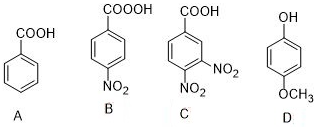
Among the following aromatic acids, which one is the least acidic in nature?

Figure

Answer options

Q48:

Aldehydes, Ketones & Carboxylic Acids

Easy

Relative acidic strength of Carboxylic acids and their derivatives

Carboxylic acids are weak acids. Mineral acids like HCl or HNO3_3 are very strong acids and non-edible, but many carboxylic acids are edible acids. Carboxylic acids are more acidic than phenol. The conjugate base of carboxylic acid is stabilized by two equivalent resonating structures in which the negative charge is at the more electronegative oxygen atom. Electron withdrawing group (EWG) increases the acidity of carboxylic acids while electron donating group (EDG) decreases the acidic strength of carboxylic acids. The acidic nature of carboxylic acid is also affected by direct attachment of groups such as phenyl or vinyl to the carboxylic acid. They increase the acidity of corresponding carboxylic acids.

It is due to the greater electronegativity of sp2^2 hybridized carbon to which carboxylic carbon is attached. This acidic character of carboxylic acid is based on its pKa values. The smaller the pka values, the stronger the acid. The effect of the following groups in increasing acidic order is

Ph < I < Br < Cl < F < CN < NO2_2 < CF3_3

Identify the strongest acid among, 4-methoxy benzoic acid, benzoic acid, acetic acid and 4-nitrobenzoic acid

Answer options

Q49:

Aldehydes, Ketones & Carboxylic Acids

Medium

Relative acidic strength of Carboxylic acids and their derivatives

Carboxylic acids are weak acids. Mineral acids like HCl or HNO3_3 are very strong acids and non-edible, but many carboxylic acids are edible acids. Carboxylic acids are more acidic than phenol. The conjugate base of carboxylic acid is stabilized by two equivalent resonating structures in which the negative charge is at the more electronegative oxygen atom. Electron withdrawing group (EWG) increases the acidity of carboxylic acids while electron donating group (EDG) decreases the acidic strength of carboxylic acids. The acidic nature of carboxylic acid is also affected by direct attachment of groups such as phenyl or vinyl to the carboxylic acid. They increase the acidity of corresponding carboxylic acids.

It is due to the greater electronegativity of sp2^2 hybridized carbon to which carboxylic carbon is attached. This acidic character of carboxylic acid is based on its pKa values. The smaller the pka values, the stronger the acid. The effect of the following groups in increasing acidic order is

Ph < I < Br < Cl < F < CN < NO2_2 < CF3_3

Which of the following conditions will not result in esterification ?

Answer options

Q50:

Aldehydes, Ketones & Carboxylic Acids

Easy

Relative acidic strength of Carboxylic acids and their derivatives

Carboxylic acids are weak acids. Mineral acids like HCl or HNO3_3 are very strong acids and non-edible, but many carboxylic acids are edible acids. Carboxylic acids are more acidic than phenol. The conjugate base of carboxylic acid is stabilized by two equivalent resonating structures in which the negative charge is at the more electronegative oxygen atom. Electron withdrawing group (EWG) increases the acidity of carboxylic acids while electron donating group (EDG) decreases the acidic strength of carboxylic acids. The acidic nature of carboxylic acid is also affected by direct attachment of groups such as phenyl or vinyl to the carboxylic acid. They increase the acidity of corresponding carboxylic acids.

It is due to the greater electronegativity of sp2^2 hybridized carbon to which carboxylic carbon is attached. This acidic character of carboxylic acid is based on its pKa values. The smaller the pka values, the stronger the acid. The effect of the following groups in increasing acidic order is

Ph < I < Br < Cl < F < CN < NO2_2 < CF3_3

What is the IUPAC name of the following acid?

CH3−CH2−CH(Br)−COOH\mathrm{CH_3{-}CH_2{-}CH(Br){-}COOH}

Answer options

CUET Chemistry 2026 12 May Shift 2 Past Year Question Paper

Every question from the CUET Chemistry 2026 12 May Shift 2 paper is here in full, with the correct answer and a step by step solution for each one. It is completely free, there is no login and no paywall, and you can read the whole paper online or download it to revise offline.

You can also attempt it instead of only reading it. Take the paper as a full length mock under exam conditions, or filter it by topic and attempt just that topic as a topic test. Both are free, and you get a breakdown of your accuracy, your timing and your weak areas once you submit.

CUET Chemistry past year questions (PYQs) are the closest thing to the real exam, so working through them is the quickest way to learn the paper pattern, the marking scheme and the level of difficulty to expect on the day.