Skip to main contentSkip to solution

Rate of Chemical Reaction

Chemical reactions are the simplest way to convert one substance into the other substance. The feasibility of a chemical reaction is decided by the concepts of chemical thermodynamics under a defined set of conditions. The extent of a chemical reaction is determined by the principles of chemical equilibrium. But the information that remains undisclosed is the speed or rate of a chemical reaction, path or mechanism of a chemical reaction, time taken for a reaction to attain a state of equilibrium, factors controlling the rate of reaction etc. This information pertaining to the study of a chemical reaction is very pivotal, and it helps in understanding the nature (slow or fast nature) of a chemical reaction. The kinetics of a chemical reaction can be understood with the help of average rate of reaction or a differential rate law or an integrated rate law. There are various factors on which the rate of a chemical reaction depends viz. nature of reactants, temperature, catalyst, pressure and concentration of reactants and products (rate law expression).

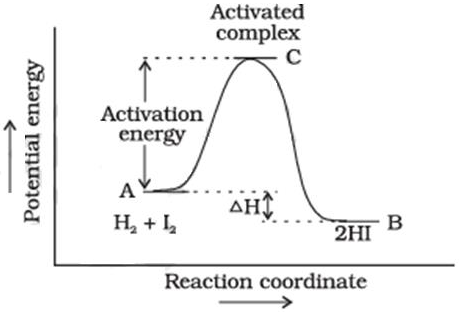
The figure given below shows a plot of potential energy vs reaction coordinate. Which of the following option is true in regard to the reaction represented by the given diagram?
Figure

Solution

✅ Correct Option: 1

The products (2HI, point B) lie at a lower potential energy than the reactants (H2_2 + I2_2, point A), so ΔH<0\Delta H < 0 and the reaction is exothermic.

The peak at C is the activated complex. It is an unstable, high-energy species that exists only for a very short time before forming the products.


Option 2: the products are lower in energy than the reactants, so the reaction cannot be endothermic.

Option 3: the activated complex is unstable and short-lived, not stable with a long half-life. It is also not a separate stable intermediate.

Option 4: the diagram shows a clear ΔH\Delta H gap between reactants and products, so the enthalpy does change.

Keyboard Shortcuts

  • Left arrow: Previous question
  • Right arrow: Next question
  • S key: Jump to solution
  • Q key: Jump to question