Q1:

Electrochemistry

Easy

Which of the following factors affect the electrolytic conductance of a solution?

A. Nature of electrode

B. Nature of solvent

C. Number of valence electrons

D. Concentration of electrolyte

Answer options
Option 3
Correct Answer
Explanation for 2026: 14 May Shift 2 CHE question 1

Q2:

Haloalkanes & Haloarenes

Easy

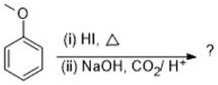
The reagent which does not generate haloalkane when heated with alcohol:

Answer options
Option 3
Correct Answer
Explanation for 2026: 14 May Shift 2 CHE question 2

Q3:

Haloalkanes & Haloarenes

Easy

Friedel Crafts alkylation of chlorobenzene is an example of

Answer options
Option 4
Correct Answer
Explanation for 2026: 14 May Shift 2 CHE question 3

Q4:

Biomolecules

Easy

Which of the following reaction conditions confirm the presence of six carbons and five hydroxyl groups in glucose, respectively?

Answer options
Option 4
Correct Answer
Explanation for 2026: 14 May Shift 2 CHE question 4

Q6:

Haloalkanes & Haloarenes

Easy

Arrange the following haloalkanes in increasing order of carbon-halogen ( C-X) bond enthalpies.

A. CH3CH_3-Br

B. CH3CH_3-Cl

C. CH3CH_3-I

D. CH3CH_3-F

Answer options
Option 4
Correct Answer
Explanation for 2026: 14 May Shift 2 CHE question 6

Q7:

Solutions

Medium

Match the LIST-I with LIST-II.

LIST-I (Salt/ Complex in aqueous solution)LIST-II (van't Hoff Factor)
A.K2[HgI4]K_2[HgI_4]I.7
B.Fe4[Fe(CN)6]3Fe_4[Fe(CN)_6]_3II.5
C.Mg3(PO4)2Mg_3(PO_4)_2III.3
D.Na3PO4Na_3PO_4IV.4
Answer options
Option 3
Correct Answer
Explanation for 2026: 14 May Shift 2 CHE question 7

Q8:

Coordination Compounds

Easy

Which of the following complexes can show facial and meridional isomerism?

Answer options
Option 2
Correct Answer
Explanation for 2026: 14 May Shift 2 CHE question 8

Q9:

Aldehydes, Ketones & Carboxylic Acids

Easy

Benzaldehyde cannot be prepared by

Answer options
Option 1
Correct Answer
Explanation for 2026: 14 May Shift 2 CHE question 9

Q10:

Aldehydes, Ketones & Carboxylic Acids

Easy

Match the LIST-I with LIST-II.

LIST-I (Name Reaction)LIST-II (Transformation)
A.Rosenmund reductionI.Benzonitrile to benzaldehyde
B.Etard reactionII.Benzene to benzaldehyde
C.Gatterman-Koch reactionIII.Benzoyl chloride to benzaldehyde
D.Stephen reactionIV.Toluene to benzaldehyde
Answer options

Q11:

Solutions

Medium

20 g of a non-volatile and non-electrolytic solute dissolved in 100 g of water produces the relative lowering of vapor pressure of 0.1. The molar mass of solute in g mol−1mol^{-1} is:

Assume n2<<n1n_2 << n_1

Answer options

Q12:

Alcohols, Phenols & Ethers

Medium

Arrange the following alcohols in the increasing order of their reactivity with HBr.

A. Benzyl alcohol

B. p-nitrobenzyl alcohol

C. p-methylbenzyl alcohol

D. p-chlorobenzyl alcohol

Answer options

Q13:

Coordination Compounds

Medium

Consider the magnetic properties of the following complexes and select the correct statements:

[NiCl4]2−[NiCl_4]^{2-}, [Ni(CN)4]2−[Ni(CN)_4]^{2-} and [Ni(CO)4][Ni(CO)_4].

A. [Ni(CN)4]2−[Ni(CN)_4]^{2-} is paramagnetic but [Ni(CO)4][Ni(CO)_4] is diamagnetic.

B. Both [Ni(CN)4]2−[Ni(CN)_4]^{2-} and [Ni(CO)4][Ni(CO)_4] are diamagnetic.

C. Both [Ni(CN)4]2−[Ni(CN)_4]^{2-} and [NiCl4]2−[NiCl_4]^{2-} are diamagnetic.

D. [NiCl4]2−[NiCl_4]^{2-} is paramagnetic.

Answer options

Q14:

Alcohols, Phenols & Ethers

Hard

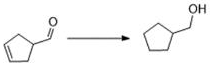
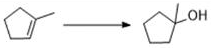
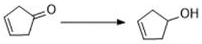
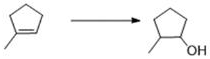
Match the reactions (List-I) with reagents (List-II) used to get the product.

LIST-I (Reactions)LIST-II (Reagents)
A.FigureI.H+/H2OH^+/H_2O
B.FigureII.BH3/H2O2,OH−BH_3/H_2O_2, OH^-
C.FigureIII.Lithium aluminum hydride/ H2OH_2O
D.FigureIV.Sodium borohydride
Answer options

Q15:

Alcohols, Phenols & Ethers

Easy

Which of the following are not ethers?

A. Anisole

B. Cumene hydroperoxide

C. Ethylene oxide

D. Sodium phenoxide

Answer options

Q16:

Chemical Kinetics

Medium

Consider the given reaction: X+Y→ZX + Y \rightarrow Z; Rate = k[X]a[Y]bk[X]^a[Y]^b. The initial concentration of X and Y are given below:

[X]/ mol L−1L^{-1}[Y]/ mol L−1L^{-1}Rate of formation of Z/ mol L−1s−1L^{-1}s^{-1}
0.20.24.36×10−24.36 \times 10^{-2}
0.40.28.72×10−28.72 \times 10^{-2}
0.20.417.44×10−217.44 \times 10^{-2}

The overall order of reaction for the formation of product Z is:

Answer options

Q17:

Chemical Kinetics

Hard

Two radioactive substances X and Y simultaneously undergo decay in a vessel. The 50% decay of both X and Y occurs in 20 and 10 minutes, respectively. If the initial concentration of Y is 8 times that of X, how much time will it take for the concentration of Y to be half of X ?

Answer options

Q18:

Electrochemistry

Easy

Match the LIST-I with LIST-II.

LIST-I PropertyLIST-II Unit
A.ConductivityI.m−1m^{-1}
B.ResistivityII.S m2 mol−1S\ m^2\ mol^{-1}
C.Cell constantIII.Ω m\Omega\ m
D.Molar conductivityIV.S m−1S\ m^{-1}
Answer options

Q19:

Chemical Kinetics

Easy

For a reaction aA→bBaA \rightarrow bB, when [A] = 0.56 M, the rate was found to be 4.8 M s−1s^{-1}. On reducing the concentration of A to 50%, the rate changes to 1.2 M s−1s^{-1}. The order of reaction with respect to A is:

Answer options

Q20:

Haloalkanes & Haloarenes

Medium

The haloarene can not be prepared by

Answer options

Q21:

Biomolecules

Easy

Match the LIST-I with LIST-II.

LIST-I VitaminLIST-II Deficiency disease
A.ThiamineI.Cheilosis
B.Ascorbic acidII.Beri beri
C.PyridoxineIII.Scurvy
D.RiboflavinIV.Convulsions
Answer options

Q22:

Biomolecules

Easy

Which of the followings statement is incorrect ?

Answer options

Q23:

Coordination Compounds

Easy

Potassium tetraiodomercurate(II) is the IUPAC name of which of the following complex?

Answer options

Q24:

Electrochemistry

Easy

For the cell Zn(s)∣Zn2+(aq)∥Ag+(aq)∣Ag(s)Zn(s)\lvert Zn^{2+}(aq)\Vert Ag^{+}(aq)\rvert Ag(s), the correct Nernst equation is:

Answer options

Q25:

Haloalkanes & Haloarenes

Easy

The hybridization of allylic and benzylic carbon in allylic chloride and benzylic chloride, respectively, is:

Answer options

Q27:

Alcohols, Phenols & Ethers

Medium

When benzene diazonium chloride is heated with water, it gives the compound P which on further reaction with chloroform and aqueous sodium hydroxide /H3O+H_3O^+ gives the compound Q. Identify the compounds P and Q, respectively.

A. Benzene

B. Phenol

C. Salicylic acid

D. Salicylaldehyde

Answer options

Q30:

Electrochemistry

Easy

Arrange the following in the decreasing order of reducing power of the metal:

A. E(Fe2+/Fe)∘=−0.44 VE^\circ_{(Fe^{2+}/Fe)} = -0.44\ V

B. E(Cu2+/Cu)∘=+0.34 VE^\circ_{(Cu^{2+}/Cu)} = +0.34\ V

C. E(Ag+/Ag)∘=+0.80 VE^\circ_{(Ag^{+}/Ag)} = +0.80\ V

D. E(Sn2+/Sn)∘=−0.14 VE^\circ_{(Sn^{2+}/Sn)} = -0.14\ V

Answer options

Q31:

Chemical Kinetics

Medium

If a first order reaction takes 15 minutes for 90% completion, then time required for 50% completion is:

Answer options

Q32:

Electrochemistry

Medium

The potential for the given cell Cr(s)∣Cr3+(0.1M)∥Fe2+(0.01M)∣Fe(s)Cr(s)\lvert Cr^{3+}(0.1M)\Vert Fe^{2+}(0.01M)\rvert Fe(s) at 298 K, is:

(Given Ecell0=0.30VE^0_{cell} = 0.30V)

Answer options

Q33:

Coordination Compounds

Hard

Arrange the following complexes in increasing order of spin only magnetic moment (in BM):

A. [CoF6]3−[CoF_6]^{3-}

B. [MnBr4]2−[MnBr_4]^{2-}

C. [Co(NH3)6]3+[Co(NH_3)_6]^{3+}

D. [Mn(CN)6]4−[Mn(CN)_6]^{4-}

Answer options

Q34:

Solutions

Medium

A mixture of two volatile liquids A and B has a vapor pressure of 350 mm Hg at 300 K. The vapor pressure of B is 150 mm Hg. If the mole fraction of A is 0.4, its vapor pressure at same temperature will be:

Answer options

Q35:

Biomolecules

Easy

Choose the correct statements with respect to nucleic acids.

Answer options

Q36:

Aldehydes, Ketones & Carboxylic Acids

Medium

Propionitrile when treated with phenyl magnesium bromide followed by acidic hydrolysis gives (P) which further undergoes Clemmensen reduction to give

Answer options

Q37:

Coordination Compounds

Easy

The number of ligand donor atoms to which the metal is directly bonded in the complexes [Cr(en)2(ox)]+[Cr(en)_2(ox)]^{+}, [Zn(en)Cl2][Zn(en)Cl_2], and [Co(C2O4)2(OH)2]3−[Co(C_2O_4)_2(OH)_2]^{3-}, respectively are:

Answer options

Q38:

Solutions

Medium

Arrange the following aqueous solutions in increasing order of their boiling points.

Given: Molar mass (in g mol−1mol^{-1}) of H, C, N, O, S and K are 1, 12, 14, 16, 32 and 39, respectively.

A. 5% K2SO4K_2SO_4

B. 10 % Urea

C. 5% Urea

D. 10% K2SO4K_2SO_4

Answer options

Q39:

Chemical Kinetics

Medium

Which of the following statements are correct?

A. Order and the molecularity of a reaction can be fractional.

B. Catalyst affects the activation energy of reaction but not rate of reaction.

C. For complex reactions, order of reaction is determined by the slowest step.

D. The decomposition of gaseous ammonia on a hot platinum surface is a zero order reaction.

Answer options

Q41:

Amines

Easy

Organic chemistry (Amines)

An organic compound (A) with the molecular formula C8H9NOC_8H_9NO when treated with bromine in aqueous solution of sodium hydroxide gives a new compound (B) having the molecular formula C7H9NC_7H_9N. The compound (B) on heating with chloroform and ethanolic potassium hydroxide forms a compound (C ) having foul-smelling. Further, the compound (B) gives an alkali soluble sulphonamide on reacting with benzenesulfonyl chloride.

Moreover, a thermally unstable compound (D) is obtained when the compound (B) reacts with sodium nitrite in concentrated hydrochloric acid at very low temperature. Further, the compound (D) on heating with water yields a compound which gives colour with neutral ferric chloride solution.

Answer the following questions on the basis of this passage.

The name of the reaction converting compound A to B is

Answer options

Q42:

Amines

Easy

Organic chemistry (Amines)

An organic compound (A) with the molecular formula C8H9NOC_8H_9NO when treated with bromine in aqueous solution of sodium hydroxide gives a new compound (B) having the molecular formula C7H9NC_7H_9N. The compound (B) on heating with chloroform and ethanolic potassium hydroxide forms a compound (C ) having foul-smelling. Further, the compound (B) gives an alkali soluble sulphonamide on reacting with benzenesulfonyl chloride.

Moreover, a thermally unstable compound (D) is obtained when the compound (B) reacts with sodium nitrite in concentrated hydrochloric acid at very low temperature. Further, the compound (D) on heating with water yields a compound which gives colour with neutral ferric chloride solution.

Answer the following questions on the basis of this passage.

The foul-smelling compound obtained by heating compound B with CHCl3CHCl_3 and ethanolic KOH is a

Answer options

Q43:

Amines

Easy

Organic chemistry (Amines)

An organic compound (A) with the molecular formula C8H9NOC_8H_9NO when treated with bromine in aqueous solution of sodium hydroxide gives a new compound (B) having the molecular formula C7H9NC_7H_9N. The compound (B) on heating with chloroform and ethanolic potassium hydroxide forms a compound (C ) having foul-smelling. Further, the compound (B) gives an alkali soluble sulphonamide on reacting with benzenesulfonyl chloride.

Moreover, a thermally unstable compound (D) is obtained when the compound (B) reacts with sodium nitrite in concentrated hydrochloric acid at very low temperature. Further, the compound (D) on heating with water yields a compound which gives colour with neutral ferric chloride solution.

Answer the following questions on the basis of this passage.

The name of the test that yields an alkali-soluble sulfonamide upon heating with compound B is

Answer options

Q44:

Amines

Medium

Organic chemistry (Amines)

An organic compound (A) with the molecular formula C8H9NOC_8H_9NO when treated with bromine in aqueous solution of sodium hydroxide gives a new compound (B) having the molecular formula C7H9NC_7H_9N. The compound (B) on heating with chloroform and ethanolic potassium hydroxide forms a compound (C ) having foul-smelling. Further, the compound (B) gives an alkali soluble sulphonamide on reacting with benzenesulfonyl chloride.

Moreover, a thermally unstable compound (D) is obtained when the compound (B) reacts with sodium nitrite in concentrated hydrochloric acid at very low temperature. Further, the compound (D) on heating with water yields a compound which gives colour with neutral ferric chloride solution.

Answer the following questions on the basis of this passage.

Identify the compound (D):

Answer options

Q45:

Amines

Medium

Organic chemistry (Amines)

An organic compound (A) with the molecular formula C8H9NOC_8H_9NO when treated with bromine in aqueous solution of sodium hydroxide gives a new compound (B) having the molecular formula C7H9NC_7H_9N. The compound (B) on heating with chloroform and ethanolic potassium hydroxide forms a compound (C ) having foul-smelling. Further, the compound (B) gives an alkali soluble sulphonamide on reacting with benzenesulfonyl chloride.

Moreover, a thermally unstable compound (D) is obtained when the compound (B) reacts with sodium nitrite in concentrated hydrochloric acid at very low temperature. Further, the compound (D) on heating with water yields a compound which gives colour with neutral ferric chloride solution.

Answer the following questions on the basis of this passage.

When compound (D) is heated with water, it gives:

Answer options

Q46:

d & f Block Elements

Medium

Transition elements (d-block)

The d-block occupies the large middle section of the periodic table flanked between s- and p-blocks in the modern periodic table. These elements have a general electronic configuration (n−1)d1−10 ns2(n-1)d^{1-10}\ ns^2 (except Pd). These elements possess a partially filled penultimate d-subshell in their ground state. Most of the transition element compounds are colored in solid or in solution state which arise due to excitation of electrons from lower energy d-orbitals to higher energy d-orbitals. The transition metal ions which have completely filled d-orbitals are colorless due to lack of excitation within d-orbitals. Most of the transition metals and their compounds exhibit paramagnetic behavior (attracted by a magnetic field) which is attributed to an incomplete d-subshell and the presence of unpaired electrons. An element or ion having no unpaired electron shows diamagnetic behavior (repelled by a magnetic field). The magnetic moment of transition elements arises due to spin and orbital motion in ions or molecules. The magnetic moment is determined by the number of unpaired electrons (n) and is calculated by using the spin-only formula μ=[n(n+2)]1/2\mu = [n(n+2)]^{1/2} Bohr megneton (BM). The magnetic moment increases with the increasing number of unpaired electrons. Thus, the observed magnetic moment gives a useful indication about the number of unpaired electrons present in the transition metal or its ions. Transition elements exhibit certain important characteristic properties such as variable oxidation state, complex formation, colored ion formation, catalytic activity and metallic properties like high tensile strength, ductility, malleability etc. Transition metals are hard and have high melting points (with exceptions of Zn, Cd, Hg).

The electronic configuration of a transition element X in +1 oxidation state is [Ar] 3d53d^5. The atomic number of the element X is:

Answer options

Q47:

d & f Block Elements

Easy

Transition elements (d-block)

The d-block occupies the large middle section of the periodic table flanked between s- and p-blocks in the modern periodic table. These elements have a general electronic configuration (n−1)d1−10 ns2(n-1)d^{1-10}\ ns^2 (except Pd). These elements possess a partially filled penultimate d-subshell in their ground state. Most of the transition element compounds are colored in solid or in solution state which arise due to excitation of electrons from lower energy d-orbitals to higher energy d-orbitals. The transition metal ions which have completely filled d-orbitals are colorless due to lack of excitation within d-orbitals. Most of the transition metals and their compounds exhibit paramagnetic behavior (attracted by a magnetic field) which is attributed to an incomplete d-subshell and the presence of unpaired electrons. An element or ion having no unpaired electron shows diamagnetic behavior (repelled by a magnetic field). The magnetic moment of transition elements arises due to spin and orbital motion in ions or molecules. The magnetic moment is determined by the number of unpaired electrons (n) and is calculated by using the spin-only formula μ=[n(n+2)]1/2\mu = [n(n+2)]^{1/2} Bohr megneton (BM). The magnetic moment increases with the increasing number of unpaired electrons. Thus, the observed magnetic moment gives a useful indication about the number of unpaired electrons present in the transition metal or its ions. Transition elements exhibit certain important characteristic properties such as variable oxidation state, complex formation, colored ion formation, catalytic activity and metallic properties like high tensile strength, ductility, malleability etc. Transition metals are hard and have high melting points (with exceptions of Zn, Cd, Hg).

Which d-block metal pair does not exhibit variable oxidation state?

Answer options

Q48:

d & f Block Elements

Medium

Transition elements (d-block)

The d-block occupies the large middle section of the periodic table flanked between s- and p-blocks in the modern periodic table. These elements have a general electronic configuration (n−1)d1−10 ns2(n-1)d^{1-10}\ ns^2 (except Pd). These elements possess a partially filled penultimate d-subshell in their ground state. Most of the transition element compounds are colored in solid or in solution state which arise due to excitation of electrons from lower energy d-orbitals to higher energy d-orbitals. The transition metal ions which have completely filled d-orbitals are colorless due to lack of excitation within d-orbitals. Most of the transition metals and their compounds exhibit paramagnetic behavior (attracted by a magnetic field) which is attributed to an incomplete d-subshell and the presence of unpaired electrons. An element or ion having no unpaired electron shows diamagnetic behavior (repelled by a magnetic field). The magnetic moment of transition elements arises due to spin and orbital motion in ions or molecules. The magnetic moment is determined by the number of unpaired electrons (n) and is calculated by using the spin-only formula μ=[n(n+2)]1/2\mu = [n(n+2)]^{1/2} Bohr megneton (BM). The magnetic moment increases with the increasing number of unpaired electrons. Thus, the observed magnetic moment gives a useful indication about the number of unpaired electrons present in the transition metal or its ions. Transition elements exhibit certain important characteristic properties such as variable oxidation state, complex formation, colored ion formation, catalytic activity and metallic properties like high tensile strength, ductility, malleability etc. Transition metals are hard and have high melting points (with exceptions of Zn, Cd, Hg).

The maximum spin only magnetic moment is shown by:

Answer options

Q49:

d & f Block Elements

Easy

Transition elements (d-block)

The d-block occupies the large middle section of the periodic table flanked between s- and p-blocks in the modern periodic table. These elements have a general electronic configuration (n−1)d1−10 ns2(n-1)d^{1-10}\ ns^2 (except Pd). These elements possess a partially filled penultimate d-subshell in their ground state. Most of the transition element compounds are colored in solid or in solution state which arise due to excitation of electrons from lower energy d-orbitals to higher energy d-orbitals. The transition metal ions which have completely filled d-orbitals are colorless due to lack of excitation within d-orbitals. Most of the transition metals and their compounds exhibit paramagnetic behavior (attracted by a magnetic field) which is attributed to an incomplete d-subshell and the presence of unpaired electrons. An element or ion having no unpaired electron shows diamagnetic behavior (repelled by a magnetic field). The magnetic moment of transition elements arises due to spin and orbital motion in ions or molecules. The magnetic moment is determined by the number of unpaired electrons (n) and is calculated by using the spin-only formula μ=[n(n+2)]1/2\mu = [n(n+2)]^{1/2} Bohr megneton (BM). The magnetic moment increases with the increasing number of unpaired electrons. Thus, the observed magnetic moment gives a useful indication about the number of unpaired electrons present in the transition metal or its ions. Transition elements exhibit certain important characteristic properties such as variable oxidation state, complex formation, colored ion formation, catalytic activity and metallic properties like high tensile strength, ductility, malleability etc. Transition metals are hard and have high melting points (with exceptions of Zn, Cd, Hg).

Identify the species which is paramagnetic as well as colored:

Answer options

Q50:

d & f Block Elements

Easy

Transition elements (d-block)

The d-block occupies the large middle section of the periodic table flanked between s- and p-blocks in the modern periodic table. These elements have a general electronic configuration (n−1)d1−10 ns2(n-1)d^{1-10}\ ns^2 (except Pd). These elements possess a partially filled penultimate d-subshell in their ground state. Most of the transition element compounds are colored in solid or in solution state which arise due to excitation of electrons from lower energy d-orbitals to higher energy d-orbitals. The transition metal ions which have completely filled d-orbitals are colorless due to lack of excitation within d-orbitals. Most of the transition metals and their compounds exhibit paramagnetic behavior (attracted by a magnetic field) which is attributed to an incomplete d-subshell and the presence of unpaired electrons. An element or ion having no unpaired electron shows diamagnetic behavior (repelled by a magnetic field). The magnetic moment of transition elements arises due to spin and orbital motion in ions or molecules. The magnetic moment is determined by the number of unpaired electrons (n) and is calculated by using the spin-only formula μ=[n(n+2)]1/2\mu = [n(n+2)]^{1/2} Bohr megneton (BM). The magnetic moment increases with the increasing number of unpaired electrons. Thus, the observed magnetic moment gives a useful indication about the number of unpaired electrons present in the transition metal or its ions. Transition elements exhibit certain important characteristic properties such as variable oxidation state, complex formation, colored ion formation, catalytic activity and metallic properties like high tensile strength, ductility, malleability etc. Transition metals are hard and have high melting points (with exceptions of Zn, Cd, Hg).

Which element does not satisfy the characteristics of transition metals?

Answer options

CUET Chemistry 2026 14 May Shift 2 Past Year Question Paper

Every question from the CUET Chemistry 2026 14 May Shift 2 paper is here in full, with the correct answer and a step by step solution for each one. It is completely free, there is no login and no paywall, and you can read the whole paper online or download it to revise offline.

You can also attempt it instead of only reading it. Take the paper as a full length mock under exam conditions, or filter it by topic and attempt just that topic as a topic test. Both are free, and you get a breakdown of your accuracy, your timing and your weak areas once you submit.

CUET Chemistry past year questions (PYQs) are the closest thing to the real exam, so working through them is the quickest way to learn the paper pattern, the marking scheme and the level of difficulty to expect on the day.