Identify the most appropriate alkene for synthesis of the following alcohol.
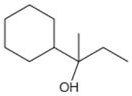
Identify the most appropriate alkene for synthesis of the following alcohol.
Solution
The target alcohol is 2-cyclohexylbutan-2-ol, a tertiary alcohol with OH on the carbon bonded to cyclohexyl, and .
Acid-catalysed hydration (or oxymercuration-demercuration) of an alkene follows Markovnikov's rule: adds to the carbon, giving a tertiary carbocation that picks up . This happens with 2-cyclohexylbut-1-ene, , which gives exactly the required alcohol.
Option 3 (1-sec-butylcyclohexene): hydration puts OH on the ring carbon, giving 1-(sec-butyl)cyclohexanol, a different tertiary alcohol.
Option 4 (3-cyclohexylbut-1-ene): Markovnikov hydration gives a secondary alcohol, 3-cyclohexylbutan-2-ol, with OH on a different carbon.
Option 1 (3-sec-butylcyclohexene): hydration gives a ring alcohol, not the required one.
Related questions:
2026: 11 May Shift 1
2026: 31 May Shift 2
2025: 29 May Shift 2
2026: 21 May Shift 1
2025: 30 May Shift 1