Q1:

2026: 7 June Shift 2

Amines

Medium

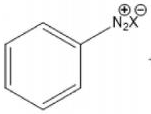
Which of the following statements is correct for benzene diazonium salts ?

(A) Diazonium salt does not decomposes easily.

(B) In Gattermann reaction diazonium group is replaced by chlorine using Cu(I) ion and HCl.

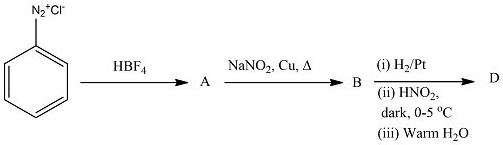
(C) When Diazonium fluoroborate is heated with aqueous sodium nitrite solution in the presence of copper, the diazonium group is replaced by −NO2-NO_2.

(D) Azo dye is formed via coupling reaction of benzene diazonium salt.

Answer options
Option 2
Correct Answer
Explanation for 2026: 7 June Shift 2 CHE question 1

Q4:

2026: 7 June Shift 2

Amines

Medium

Nitration of aniline with a mixture of nitric acid and sulphuric acid gives a mixture of products. This is because

Answer options
Option 3
Correct Answer
Explanation for 2026: 7 June Shift 2 CHE question 4

Q6:

2026: 6 June Shift 1

Amines

Easy

Amines

Amines are important class of organic compounds which are basic in nature. They are generally derived by replacing one or more hydrogen atoms of ammonia molecule by alkyl / aryl group(s). In nature, they are generally found in proteins, vitamins, alkaloids and hormones. Two biologically active compounds namely adrenaline and ephedrine contain secondary amino group and are used to increase blood pressure.

Like ammonia, nitrogen atom of amines is trivalent and carries an unshared pair of electrons. Nitrogen orbitals in amines are therefore, sp3sp^3 hybridized and the geometry of amine is pyramidal. Due to the presence of unshared pair of electrons, the angle C-N-E (where E is C or H) is less than 109.50109.5^0.

Inductive effects, solvation effects, steric effects etc. affect the basic strength of amines. Amines are classified as primary (1°), secondary (2°), and tertiary (3°) depending upon the number of hydrogen atoms replaced by alkyl or aryl groups in ammonia molecule. Amines can be prepared from various compounds like reduction of nitro, nitriles, amides etc. compounds. Amines are engaged in intermolecular hydrogen bonding. Aliphatic and aromatic primary amines show positive carbylamine reaction. A colourless crystalline solid benzene diazonium chloride can be obtained from aniline by reacting with sodium nitrite and hydrochloric acid at 273-278 K.

Identify the tertiary amine (3°) from the following compounds.

Answer options
Option 2
Correct Answer
Explanation for 2026: 6 June Shift 1 CHE question 6

Q7:

2026: 6 June Shift 1

Amines

Medium

Amines

Amines are important class of organic compounds which are basic in nature. They are generally derived by replacing one or more hydrogen atoms of ammonia molecule by alkyl / aryl group(s). In nature, they are generally found in proteins, vitamins, alkaloids and hormones. Two biologically active compounds namely adrenaline and ephedrine contain secondary amino group and are used to increase blood pressure.

Like ammonia, nitrogen atom of amines is trivalent and carries an unshared pair of electrons. Nitrogen orbitals in amines are therefore, sp3sp^3 hybridized and the geometry of amine is pyramidal. Due to the presence of unshared pair of electrons, the angle C-N-E (where E is C or H) is less than 109.50109.5^0.

Inductive effects, solvation effects, steric effects etc. affect the basic strength of amines. Amines are classified as primary (1°), secondary (2°), and tertiary (3°) depending upon the number of hydrogen atoms replaced by alkyl or aryl groups in ammonia molecule. Amines can be prepared from various compounds like reduction of nitro, nitriles, amides etc. compounds. Amines are engaged in intermolecular hydrogen bonding. Aliphatic and aromatic primary amines show positive carbylamine reaction. A colourless crystalline solid benzene diazonium chloride can be obtained from aniline by reacting with sodium nitrite and hydrochloric acid at 273-278 K.

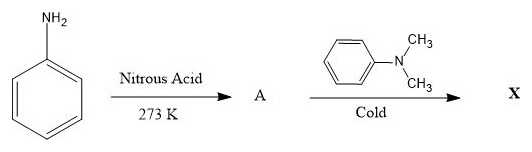
What would be the structure of final product X in the following chemical reaction?

Figure

Answer options
Option 3
Correct Answer
Explanation for 2026: 6 June Shift 1 CHE question 7

Q8:

2026: 6 June Shift 1

Amines

Easy

Amines

Amines are important class of organic compounds which are basic in nature. They are generally derived by replacing one or more hydrogen atoms of ammonia molecule by alkyl / aryl group(s). In nature, they are generally found in proteins, vitamins, alkaloids and hormones. Two biologically active compounds namely adrenaline and ephedrine contain secondary amino group and are used to increase blood pressure.

Like ammonia, nitrogen atom of amines is trivalent and carries an unshared pair of electrons. Nitrogen orbitals in amines are therefore, sp3sp^3 hybridized and the geometry of amine is pyramidal. Due to the presence of unshared pair of electrons, the angle C-N-E (where E is C or H) is less than 109.50109.5^0.

Inductive effects, solvation effects, steric effects etc. affect the basic strength of amines. Amines are classified as primary (1°), secondary (2°), and tertiary (3°) depending upon the number of hydrogen atoms replaced by alkyl or aryl groups in ammonia molecule. Amines can be prepared from various compounds like reduction of nitro, nitriles, amides etc. compounds. Amines are engaged in intermolecular hydrogen bonding. Aliphatic and aromatic primary amines show positive carbylamine reaction. A colourless crystalline solid benzene diazonium chloride can be obtained from aniline by reacting with sodium nitrite and hydrochloric acid at 273-278 K.

The final structure of amine produced by Hoffmann degradation of m-bromobenzamide is

Answer options
Option 2
Correct Answer
Explanation for 2026: 6 June Shift 1 CHE question 8

Q9:

2026: 6 June Shift 1

Amines

Easy

Amines

Amines are important class of organic compounds which are basic in nature. They are generally derived by replacing one or more hydrogen atoms of ammonia molecule by alkyl / aryl group(s). In nature, they are generally found in proteins, vitamins, alkaloids and hormones. Two biologically active compounds namely adrenaline and ephedrine contain secondary amino group and are used to increase blood pressure.

Like ammonia, nitrogen atom of amines is trivalent and carries an unshared pair of electrons. Nitrogen orbitals in amines are therefore, sp3sp^3 hybridized and the geometry of amine is pyramidal. Due to the presence of unshared pair of electrons, the angle C-N-E (where E is C or H) is less than 109.50109.5^0.

Inductive effects, solvation effects, steric effects etc. affect the basic strength of amines. Amines are classified as primary (1°), secondary (2°), and tertiary (3°) depending upon the number of hydrogen atoms replaced by alkyl or aryl groups in ammonia molecule. Amines can be prepared from various compounds like reduction of nitro, nitriles, amides etc. compounds. Amines are engaged in intermolecular hydrogen bonding. Aliphatic and aromatic primary amines show positive carbylamine reaction. A colourless crystalline solid benzene diazonium chloride can be obtained from aniline by reacting with sodium nitrite and hydrochloric acid at 273-278 K.

Select the correct order of boiling points of isomeric amines

Answer options
Option 1
Correct Answer
Explanation for 2026: 6 June Shift 1 CHE question 9

Q10:

2026: 6 June Shift 1

Amines

Medium

Amines

Amines are important class of organic compounds which are basic in nature. They are generally derived by replacing one or more hydrogen atoms of ammonia molecule by alkyl / aryl group(s). In nature, they are generally found in proteins, vitamins, alkaloids and hormones. Two biologically active compounds namely adrenaline and ephedrine contain secondary amino group and are used to increase blood pressure.

Like ammonia, nitrogen atom of amines is trivalent and carries an unshared pair of electrons. Nitrogen orbitals in amines are therefore, sp3sp^3 hybridized and the geometry of amine is pyramidal. Due to the presence of unshared pair of electrons, the angle C-N-E (where E is C or H) is less than 109.50109.5^0.

Inductive effects, solvation effects, steric effects etc. affect the basic strength of amines. Amines are classified as primary (1°), secondary (2°), and tertiary (3°) depending upon the number of hydrogen atoms replaced by alkyl or aryl groups in ammonia molecule. Amines can be prepared from various compounds like reduction of nitro, nitriles, amides etc. compounds. Amines are engaged in intermolecular hydrogen bonding. Aliphatic and aromatic primary amines show positive carbylamine reaction. A colourless crystalline solid benzene diazonium chloride can be obtained from aniline by reacting with sodium nitrite and hydrochloric acid at 273-278 K.

Identify the correct decreasing order of basic strength of amines in aqueous solution.

Answer options

Q11:

2026: 31 May Shift 2

Amines

Easy

Amines are derivatives of ammonia obtained by replacement of one, two or all the three hydrogen atoms by alkyl and / or aryl groups. Nitrogen atom of amines like ammonia is trivalent and carries an unshared pair of electrons. Orbitals of nitrogen overlap with orbitals of hydrogen or carbon depending upon the composition of the amines. The fourth orbital of nitrogen in all amines contains an unshared pair of electrons. Due to the presence of unshared pair of electrons, the angle C-N-E (where E is C or H) is less than tetrahedral angle 109.5°. Amines are classified as primary (1°), secondary (2°) and tertiary (3°) amines. All amines are basic in nature and basicity differs between primary amines, secondary amines and tertiary amines. In aryl amines, −NH2-NH_2 group is directly attached to the benzene ring. C6H5NH2C_6H_5NH_2 is simplest example of arylamine. Lower aliphatic amines are soluble in water because they can form hydrogen bonds with water molecules.

N-Methylbenzamide is formed when methanamine reacts with

Answer options

Q12:

2026: 31 May Shift 2

Amines

Easy

Amines are derivatives of ammonia obtained by replacement of one, two or all the three hydrogen atoms by alkyl and / or aryl groups. Nitrogen atom of amines like ammonia is trivalent and carries an unshared pair of electrons. Orbitals of nitrogen overlap with orbitals of hydrogen or carbon depending upon the composition of the amines. The fourth orbital of nitrogen in all amines contains an unshared pair of electrons. Due to the presence of unshared pair of electrons, the angle C-N-E (where E is C or H) is less than tetrahedral angle 109.5°. Amines are classified as primary (1°), secondary (2°) and tertiary (3°) amines. All amines are basic in nature and basicity differs between primary amines, secondary amines and tertiary amines. In aryl amines, −NH2-NH_2 group is directly attached to the benzene ring. C6H5NH2C_6H_5NH_2 is simplest example of arylamine. Lower aliphatic amines are soluble in water because they can form hydrogen bonds with water molecules.

Carbylamine reaction is shown by

A. ammonium salts .

B. tertiary amines.

C. secondary amines.

D. primary amines.

Answer options

Q13:

2026: 31 May Shift 2

Amines

Easy

Amines are derivatives of ammonia obtained by replacement of one, two or all the three hydrogen atoms by alkyl and / or aryl groups. Nitrogen atom of amines like ammonia is trivalent and carries an unshared pair of electrons. Orbitals of nitrogen overlap with orbitals of hydrogen or carbon depending upon the composition of the amines. The fourth orbital of nitrogen in all amines contains an unshared pair of electrons. Due to the presence of unshared pair of electrons, the angle C-N-E (where E is C or H) is less than tetrahedral angle 109.5°. Amines are classified as primary (1°), secondary (2°) and tertiary (3°) amines. All amines are basic in nature and basicity differs between primary amines, secondary amines and tertiary amines. In aryl amines, −NH2-NH_2 group is directly attached to the benzene ring. C6H5NH2C_6H_5NH_2 is simplest example of arylamine. Lower aliphatic amines are soluble in water because they can form hydrogen bonds with water molecules.

To prepare a monosubstituted aniline derivative, the activating group −NH2-NH_2 is to be controlled through acetylation with

Answer options

Q14:

2026: 31 May Shift 2

Amines

Medium

Amines are derivatives of ammonia obtained by replacement of one, two or all the three hydrogen atoms by alkyl and / or aryl groups. Nitrogen atom of amines like ammonia is trivalent and carries an unshared pair of electrons. Orbitals of nitrogen overlap with orbitals of hydrogen or carbon depending upon the composition of the amines. The fourth orbital of nitrogen in all amines contains an unshared pair of electrons. Due to the presence of unshared pair of electrons, the angle C-N-E (where E is C or H) is less than tetrahedral angle 109.5°. Amines are classified as primary (1°), secondary (2°) and tertiary (3°) amines. All amines are basic in nature and basicity differs between primary amines, secondary amines and tertiary amines. In aryl amines, −NH2-NH_2 group is directly attached to the benzene ring. C6H5NH2C_6H_5NH_2 is simplest example of arylamine. Lower aliphatic amines are soluble in water because they can form hydrogen bonds with water molecules.

Arrange the following compounds in the decreasing order of their boiling points.

A. n-C4H9NH2C_4H_9NH_2

B. C2H5CH(CH3)2C_2H_5CH(CH_3)_2

C. (C2H5)2NH(C_2H_5)_2NH

D. n-C4H9OHC_4H_9OH

Answer options

Q15:

2026: 31 May Shift 2

Amines

Easy

Amines are derivatives of ammonia obtained by replacement of one, two or all the three hydrogen atoms by alkyl and / or aryl groups. Nitrogen atom of amines like ammonia is trivalent and carries an unshared pair of electrons. Orbitals of nitrogen overlap with orbitals of hydrogen or carbon depending upon the composition of the amines. The fourth orbital of nitrogen in all amines contains an unshared pair of electrons. Due to the presence of unshared pair of electrons, the angle C-N-E (where E is C or H) is less than tetrahedral angle 109.5°. Amines are classified as primary (1°), secondary (2°) and tertiary (3°) amines. All amines are basic in nature and basicity differs between primary amines, secondary amines and tertiary amines. In aryl amines, −NH2-NH_2 group is directly attached to the benzene ring. C6H5NH2C_6H_5NH_2 is simplest example of arylamine. Lower aliphatic amines are soluble in water because they can form hydrogen bonds with water molecules.

Among the following, which amines is least basic in aqueous phase?

Answer options

Q16:

2026: 30 May Shift 2

Amines

Medium

The primary amine is obtained by reduction of −NO2-\mathrm{NO_2} group using scrap iron and HCl (in small amounts) because:

Answer options

Q18:

2026: 30 May Shift 2

Amines

Medium

Which of the following chemical tests can be used to distinguish between aniline and benzylamine?

Answer options

Q19:

2026: 30 May Shift 2

Amines

Easy

Why are arenediazonium salts stable for a short time in solution at low temperatures?

Answer options

Q20:

2026: 30 May Shift 2

Amines

Easy

Match List-I with List-II.

List-IList-II
Name ReactionsSubstrates/ Reagents
(A) Hoffmann bromamide degradation reaction(I)Conversion of benzene diazonium salt into haloarene using Cu2X2\mathrm{Cu_2X_2}/(HX, X = Cl or Br).
(B) Gabriel phthalimide synthesis(II) Conversion of benzene diazonium salt into haloarene using Cu/(HX, X = Cl or Br).
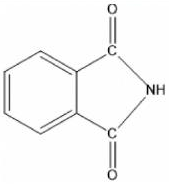
(C) Gattermann reaction(III) Preparation of primary amines by the action of primary alkyl halides on phthalimide in aq KOH.
(D) Sandmeyer reaction(IV) Synthesis of primary amines from an acid amide.
Answer options

Q21:

2026: 30 May Shift 1

Amines

Easy

What would be the product of alkylation of aniline in the presence anhydrous AlCl3AlCl_3 as catalyst?

Answer options

Q22:

2026: 30 May Shift 1

Amines

Easy

What would be the major product of ammonolysis of an alkyl halide if large excess of ammonia was taken?

Answer options

Q23:

2026: 30 May Shift 1

Amines

Easy

How do you differentiate between primary, secondary and tertiary amines?

A. Reaction with Br2Br_2 water.

B. Reaction with sulfonamide.

C. Reaction with Hinsberg's reagent followed by alkali.

D. Reaction with acetic anhydride.

Answer options

Q24:

2026: 30 May Shift 1

Amines

Easy

Compound (A) on reaction with NaNO2NaNO_2 and HCl at low temperature forms compound (B,) which on reaction with phenol in mild alkaline medium followed by acidification forms an orange dye (C). Identify compounds A, B, and C.

Answer options

Q25:

2026: 30 May Shift 1

Amines

Easy

Match the LIST-I with LIST-II.

LIST-I ReactionLIST-II Name of the Reaction/Test
A. Figure + KOH and R-XI. Gatterman reaction
B. RNH2+CHCl3+KOHRNH_2 + CHCl_3 + KOHII. Hinsberg's test
C. Figure +C2H5NH2+ C_2H_5NH_2III. Gabriel phthalimide synthesis
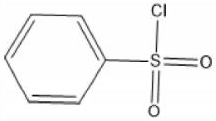
D. Figure + Cu/HClIV. Isocyanide test
Answer options

Q26:

2026: 29 May Shift 2

Amines

Easy

The hybridization of nitrogen in primary amines is........., and the geometry of amines is ...............

Answer options

Q27:

2026: 29 May Shift 2

Amines

Medium

The most suitable synthetic procedure involving various reactions to convert benzene to p-bromoaniline will be

Answer options

Q28:

2026: 29 May Shift 2

Amines

Easy

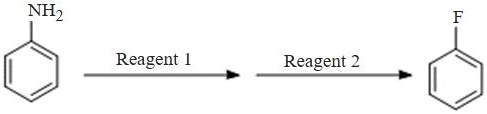
The correct reagents (Reagent 1 and Reagent 2) required for the following chemical transformation are .......................... and ..............................., respectively.

Figure

Answer options

Q29:

2026: 29 May Shift 2

Amines

Medium

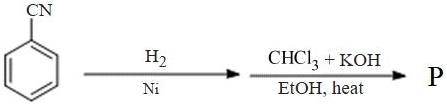
The major product (P) for the following chemical transformation is.

Figure

Answer options

Q30:

2026: 29 May Shift 2

Amines

Medium

Which of the following amines has highest pKb\mathrm{p}K_b in aqueous phase ?

Answer options