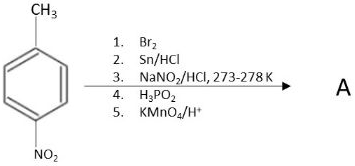
What is the major product (X) in the following series of reactions?
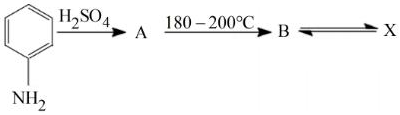
What is the major product (X) in the following series of reactions?
Solution
Aniline reacts with conc. to form anilinium hydrogen sulphate (A). On heating at 180-200 C, the group enters the para position, giving sulphanilic acid, p-aminobenzenesulphonic acid (B).
Sulphanilic acid exists in equilibrium with its dipolar (zwitterion) form (X), in which the acidic transfers its proton to the basic . The result is and on opposite (para) positions of the ring, which is Option 3.
Option 1: the ortho isomer. The bulky group prefers the less hindered para position at high temperature.
Option 2: the meta isomer. In acid, the (anilinium) group is meta-directing, but the thermal rearrangement of the hydrogen sulphate salt gives the para product.
Option 4: a disulphonated product, not formed under these conditions.
Sulphanilic acid is a zwitterion, so it has a high melting point and is soluble in water but insoluble in organic solvents.
Related questions:
2026: 29 May Shift 1
2026: 6 June Shift 1
2026: 19 May Shift 1
2025: 3 June Shift 2
2025: 24 May Shift 2