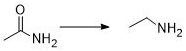
Q1:

Solutions

Easy

Which of the following statements are true for ideal solutions?

(A) The solutions obey Raoult's law over the entire range of concentration.

(B) The change in entropy of mixing of the pure components to form the solution is zero.

(C) The change in volume of mixing of the pure components to form the solution is zero.

(D) The solutions obey Raoult's law only in low concentrations.

Answer options
Option 2
Correct Answer
Explanation for 2026: 26 May Shift 1 CHE question 1

Q3:

Biomolecules

Medium

Amino acids are represented by the general structure Figure. Match the side chain 'R' given in List-I with the name of amino acid in List-II

List-IList-II
RAmino acid
(A) Figure(I) Tryptophan
(B) H2N−C∥O−CH2−CH2−\mathrm{H_2N{-}\overset{O}{\overset{\Vert}{C}}{-}CH_2{-}CH_2{-}}(II) Arginine
(C) HN=C(NH2)−NH−(CH2)3−\mathrm{HN{=}C(NH_2){-}NH{-}(CH_2)_3{-}}(III) Asparagine
(D) H2N−C∥O−CH2−\mathrm{H_2N{-}\overset{O}{\overset{\Vert}{C}}{-}CH_2{-}}(IV) Glutamine
Answer options
Option 2
Correct Answer
Explanation for 2026: 26 May Shift 1 CHE question 3

Q4:

Solutions

Medium

Calculate the vapour pressure (mm Hg) of the solution formed by mixing 25.5 g of A and 40.0 g of B at 298 K. The vapour pressure of A and B at 298 K are 200 mm Hg and 415 mm Hg, respectively. (Given: Molar mass of A =119.5 g/mol and B are 85.0 g/mol)

Answer options
Option 3
Correct Answer
Explanation for 2026: 26 May Shift 1 CHE question 4

Q5:

Solutions

Medium

The value of Henry's Law constant KHK_H(in kbar) for He, H2_2, N2_2 and O2_2 in water at a pressure of 10 atm and temperature 293 K are 144.97, 69.16, 76.48 and 34.86, respectively. Arrange the gases in decreasing order of their solubility.

(A) He

(B) H2_2

(C) N2_2

(D) O2_2

Answer options
Option 4
Correct Answer
Explanation for 2026: 26 May Shift 1 CHE question 5

Q6:

Coordination Compounds

Easy

Identify which of the following homoleptic metal complex is colorless?

Answer options
Option 2
Correct Answer
Explanation for 2026: 26 May Shift 1 CHE question 6

Q7:

d & f Block Elements

Medium

Which of the following are the characteristic properties of the manganate ion (MnO42−_4^{2-})?

(A) Tetrahedral geometry

(B) Purple color

(C) Diamagnetic

(D) Presence of two Mn = O bond

Answer options
Option 3
Correct Answer
Explanation for 2026: 26 May Shift 1 CHE question 7

Q8:

Solutions

Medium

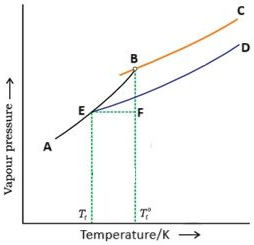
Match the various curves from List-I with the type of solutions/change in List-II with reference to the given figure..

Figure

CurveSolution/Change
(A) A-B(I) Liquid solvent
(B) B-C(II) Solution
(C) E-D(III) Depression in freezing point of solvent in solution
(D) E-F(IV) Frozen solvent
Answer options
Option 2
Correct Answer
Explanation for 2026: 26 May Shift 1 CHE question 8

Q9:

Coordination Compounds

Medium

Which of the following isomerism is not exhibited by complex [Co(NH3_3)4_4(NO2_2)2_2]Cl?

Answer options
Option 1
Correct Answer
Explanation for 2026: 26 May Shift 1 CHE question 9

Q11:

Coordination Compounds

Easy

The secondary valency of the compound NiCl2_2.6H2_2O if it precipitates 2 moles of AgCl with excess of AgNO3_3 is..........

Answer options

Q12:

Alcohols, Phenols & Ethers

Easy

Which of the following methods are used for the synthesis of an alcohol?

(A) Hydroboration–oxidation of alkenes

(B) By reduction of aldehydes and ketones

(C) By acid catalysed hydration of alkenes

(D) Hydration of alkyne in the presence of Hg2+^{2+}/H+^+

Answer options

Q13:

Haloalkanes & Haloarenes

Easy

The IUPAC name of the compound Figure is:

Answer options

Q15:

Chemical Kinetics

Easy

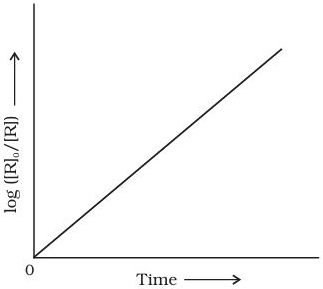
The figure given below represents the graph between log⁡[R]0[R]\log\frac{[R]_0}{[R]} vs time, for a first order reaction. The slope of the graph is:

Figure

Answer options

Q16:

Chemical Kinetics

Medium

For the reaction, 2A(g)+B(g)→C(g)\mathrm{2A(g) + B(g) \rightarrow C(g)}, the initial rate of the reaction at different concentrations of A and B is given in the table below. Which of the following statements are correct about the given data?

ExperimentInitial [A]/ mol L−1^{-1}Initial [B]/ mol L−1^{-1}Initial rate of formation of [C] /mol L−1^{-1}s−1^{-1}
10.300.300.096
20.600.300.384
30.300.600.192

(A) The order with respect to A is one.

(B) The order with respect to B is one.

(C) The overall order of the reaction is three.

(D) The molecularity of the reaction is two.

Answer options

Q17:

Alcohols, Phenols & Ethers

Medium

Arrange the following in decreasing order of their acidic strength?

(A) Phenol

(B) o-Nitrophenol

(C) m-Nitrophenol

(D) p-Nitrophenol

Answer options

Q18:

Amines

Medium

Which of the following statements are correct for Hinsberg test for amines?

(A) The reaction of benzenesulphonyl chloride with primary amine yields alkali soluble N-ethylbenzenesulphonamide.

(B) The reaction of benzenesulphonyl chloride with secondary amine yields alkali soluble N,N-diethylbenzenesulphonamide.

(C) The reaction of benzenesulphonyl chloride with tertiary amine yields alkali soluble triethylbenzenesulphonamide.

(D) Tertiary amines do not react with benzenesulphonyl chloride.

Answer options

Q20:

Solutions

Medium

Arrange 0.1 M aqueous solution of the following in decreasing order of their osmotic pressure

(A) Ammonium phosphate

(B) Glucose

(C) Sodium chloride

(D) Potassium sulphate

Answer options

Q21:

Chemical Kinetics

Easy

For the reaction, 2HI(g)→H2(g)+I2(g)\mathrm{2HI(g) \rightarrow H_2(g) + I_2(g)}, the rate of reaction can be represented as:

Answer options

Q22:

d & f Block Elements

Medium

Which of the following metal complexes will show spin only magnetic moment of 4.90 BM?

Answer options

Q23:

Haloalkanes & Haloarenes

Easy

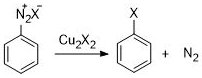
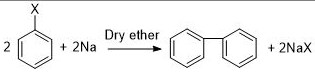
Match List-I with List-II

ReactionName of Reaction
(A) Figure(I) Finkelstein Reaction
(B) CH3−Br+AgF→CH3−F+AgBr\mathrm{CH_3{-}Br + AgF \rightarrow CH_3{-}F + AgBr}(II) Swarts Reaction
(C) CH3−Cl+NaI→CH3−I+NaCl\mathrm{CH_3{-}Cl + NaI \rightarrow CH_3{-}I + NaCl}(III) Fittig Reaction
(D) Figure + 2NaX(IV) Sandmeyer's Reaction
Answer options

Q24:

Coordination Compounds

Hard

Match the complex given in List-I with their hybridization and magnetic behavior in List-II

List-IList-II
Metal ComplexHybridization/Magnetic behavior
(A) [Zn(H2_2O)6_6]2+^{2+}(I) sp3d2sp^3d^2, paramagnetic
(B) [Co(NH3_3)6_6]3+^{3+}(II) d2sp3d^2sp^3, paramagnetic
(C) [Mn(CN)6_6]3−^{3-}(III) sp3d2sp^3d^2, diamagnetic
(D) [CoF6_6]3−^{3-}(IV) d2sp3d^2sp^3, diamagnetic
Answer options

Q25:

Coordination Compounds

Medium

Arrange the following ligands in increasing order of their field strength:

(A) NH3_3

(B) CO

(C) NCS−^-

(D) CN−^-

Answer options

Q26:

Alcohols, Phenols & Ethers

Medium

Which of the following products is not possible by the reaction of corresponding sodium alkoxide with methyl chloride in Williamson's synthesis?

Answer options

Q28:

d & f Block Elements

Medium

Which of the following will have a highest EoE^o value?

Answer options

Q29:

d & f Block Elements

Medium

In the formation of a Ce3+^{3+} ion from cerium (Ce), the electrons are removed from which orbitals?

Answer options

Q30:

Haloalkanes & Haloarenes

Easy

Which of the following will give a single monochloride on photochemical chlorination ?

Answer options

Q32:

Haloalkanes & Haloarenes

Easy

Arrange the following in order of their increasing bond enthalpies?

(A) Methyl Fluoride

(B) Methyl Iodide

(C) Methyl Chloride

(D) Methyl Bromide

Answer options

Q34:

Chemical Kinetics

Medium

For the first order reaction, the time required for the completion of 90% and 50% reaction are t90t_{90} and t1/2t_{1/2}, respectively. Which of the following relationships between the two is correct?

Answer options

Q38:

Biomolecules

Easy

In amylopectin, α-D-glucose units are joined by ________ glycosidic linkage.

Answer options

Q39:

Chemical Kinetics

Medium

Match List-I with List-II

List-IList-II
Concepts in chemical kineticsDetail
(A) Order applies(I) Zero order reaction
(B) Molecularity applies(II) First order reaction
(C) 2NH3(g)→N2(g)+3H2(g)\mathrm{2NH_3(g) \rightarrow N_2(g) + 3H_2(g)} (1130 K, Pt Catalyst)(III) To elementary as well as complex reactions
(D) 88226Ra→24He+86222Rn^{226}_{88}Ra \rightarrow ^{4}_{2}He + ^{222}_{86}Rn(IV) Only for elementary reactions.
Answer options

Q40:

Haloalkanes & Haloarenes

Easy

Which of the following undergoes fastest nucleophilic substitution reaction?

Answer options

Q41:

Electrochemistry

Easy

Daniell Cell

Electrochemistry is the study of the production of electricity from energy released during spontaneous chemical reactions and the use of electrical energy to bring about non-spontaneous chemical transformations. The cell below represents Daniell cell which converts the chemical energy liberated during the redox reaction to electrical energy.

Zn(s) + Cu2+^{2+}(aq) → Zn2+^{2+}(aq) + Cu(s)

The reaction is a combination of two half-cell reactions, one called the oxidation half-cell and the other called the reduction half-cell. Each half-cell consists of a metallic electrode dipped into an electrolyte. The two half-cells are connected through a metallic wire and switch externally. The electrolyte of the two half cells is connected internally through a salt bridge. At each electrode-electrolyte interface there is a tendency for metal ions from the solution to deposit on the metal electrode, trying to make it positively charged. At the same time, metal atoms of the electrode have a tendency to go into the solution as ions and leave behind the electrons at the electrode, trying to make it negatively charged. A potential difference develops between the electrode and the electrolyte, which is called electrode potential. When the concentrations of all the species involved in a half-cell is unity, then the electrode potential is known as the standard electrode potential.

For a general half-cell; Mn+^{n+}(aq) + ne−^{-} →M(s), the Nernst equation is written as

E(Mn+/M)=E(Mn+/M)o−RTnFln⁡1[Mn+]E_{(M^{n+}/M)} = E^{o}_{(M^{n+}/M)} - \frac{RT}{nF}\ln\frac{1}{[M^{n+}]}

where E(Mn+/M)oE^{o}_{(M^{n+}/M)} is the standard reduction potential of the half-cell, R is gas constant (8.314 J K−1^{-1} mol−1^{-1}), F is Faraday constant (96487 C mol−1^{-1}), T is temperature in kelvin and [Mn+^{n+}] is the concentration of the species, Mn+^{n+}.

Identify the electrode and the element which undergoes oxidation in the Daniell cell?

Answer options

Q42:

Electrochemistry

Easy

Daniell Cell

Electrochemistry is the study of the production of electricity from energy released during spontaneous chemical reactions and the use of electrical energy to bring about non-spontaneous chemical transformations. The cell below represents Daniell cell which converts the chemical energy liberated during the redox reaction to electrical energy.

Zn(s) + Cu2+^{2+}(aq) → Zn2+^{2+}(aq) + Cu(s)

The reaction is a combination of two half-cell reactions, one called the oxidation half-cell and the other called the reduction half-cell. Each half-cell consists of a metallic electrode dipped into an electrolyte. The two half-cells are connected through a metallic wire and switch externally. The electrolyte of the two half cells is connected internally through a salt bridge. At each electrode-electrolyte interface there is a tendency for metal ions from the solution to deposit on the metal electrode, trying to make it positively charged. At the same time, metal atoms of the electrode have a tendency to go into the solution as ions and leave behind the electrons at the electrode, trying to make it negatively charged. A potential difference develops between the electrode and the electrolyte, which is called electrode potential. When the concentrations of all the species involved in a half-cell is unity, then the electrode potential is known as the standard electrode potential.

For a general half-cell; Mn+^{n+}(aq) + ne−^{-} →M(s), the Nernst equation is written as

E(Mn+/M)=E(Mn+/M)o−RTnFln⁡1[Mn+]E_{(M^{n+}/M)} = E^{o}_{(M^{n+}/M)} - \frac{RT}{nF}\ln\frac{1}{[M^{n+}]}

where E(Mn+/M)oE^{o}_{(M^{n+}/M)} is the standard reduction potential of the half-cell, R is gas constant (8.314 J K−1^{-1} mol−1^{-1}), F is Faraday constant (96487 C mol−1^{-1}), T is temperature in kelvin and [Mn+^{n+}] is the concentration of the species, Mn+^{n+}.

Which of the following statements is not true for Daniell cell?

Answer options

Q43:

Electrochemistry

Easy

Daniell Cell

Electrochemistry is the study of the production of electricity from energy released during spontaneous chemical reactions and the use of electrical energy to bring about non-spontaneous chemical transformations. The cell below represents Daniell cell which converts the chemical energy liberated during the redox reaction to electrical energy.

Zn(s) + Cu2+^{2+}(aq) → Zn2+^{2+}(aq) + Cu(s)

The reaction is a combination of two half-cell reactions, one called the oxidation half-cell and the other called the reduction half-cell. Each half-cell consists of a metallic electrode dipped into an electrolyte. The two half-cells are connected through a metallic wire and switch externally. The electrolyte of the two half cells is connected internally through a salt bridge. At each electrode-electrolyte interface there is a tendency for metal ions from the solution to deposit on the metal electrode, trying to make it positively charged. At the same time, metal atoms of the electrode have a tendency to go into the solution as ions and leave behind the electrons at the electrode, trying to make it negatively charged. A potential difference develops between the electrode and the electrolyte, which is called electrode potential. When the concentrations of all the species involved in a half-cell is unity, then the electrode potential is known as the standard electrode potential.

For a general half-cell; Mn+^{n+}(aq) + ne−^{-} →M(s), the Nernst equation is written as

E(Mn+/M)=E(Mn+/M)o−RTnFln⁡1[Mn+]E_{(M^{n+}/M)} = E^{o}_{(M^{n+}/M)} - \frac{RT}{nF}\ln\frac{1}{[M^{n+}]}

where E(Mn+/M)oE^{o}_{(M^{n+}/M)} is the standard reduction potential of the half-cell, R is gas constant (8.314 J K−1^{-1} mol−1^{-1}), F is Faraday constant (96487 C mol−1^{-1}), T is temperature in kelvin and [Mn+^{n+}] is the concentration of the species, Mn+^{n+}.

Why is a salt bridge used in Daniell cell?

Answer options

Q44:

Electrochemistry

Medium

Daniell Cell

Electrochemistry is the study of the production of electricity from energy released during spontaneous chemical reactions and the use of electrical energy to bring about non-spontaneous chemical transformations. The cell below represents Daniell cell which converts the chemical energy liberated during the redox reaction to electrical energy.

Zn(s) + Cu2+^{2+}(aq) → Zn2+^{2+}(aq) + Cu(s)

The reaction is a combination of two half-cell reactions, one called the oxidation half-cell and the other called the reduction half-cell. Each half-cell consists of a metallic electrode dipped into an electrolyte. The two half-cells are connected through a metallic wire and switch externally. The electrolyte of the two half cells is connected internally through a salt bridge. At each electrode-electrolyte interface there is a tendency for metal ions from the solution to deposit on the metal electrode, trying to make it positively charged. At the same time, metal atoms of the electrode have a tendency to go into the solution as ions and leave behind the electrons at the electrode, trying to make it negatively charged. A potential difference develops between the electrode and the electrolyte, which is called electrode potential. When the concentrations of all the species involved in a half-cell is unity, then the electrode potential is known as the standard electrode potential.

For a general half-cell; Mn+^{n+}(aq) + ne−^{-} →M(s), the Nernst equation is written as

E(Mn+/M)=E(Mn+/M)o−RTnFln⁡1[Mn+]E_{(M^{n+}/M)} = E^{o}_{(M^{n+}/M)} - \frac{RT}{nF}\ln\frac{1}{[M^{n+}]}

where E(Mn+/M)oE^{o}_{(M^{n+}/M)} is the standard reduction potential of the half-cell, R is gas constant (8.314 J K−1^{-1} mol−1^{-1}), F is Faraday constant (96487 C mol−1^{-1}), T is temperature in kelvin and [Mn+^{n+}] is the concentration of the species, Mn+^{n+}.

Which of the following is the correct Nernst equation for Daniell cell?

Answer options

Q45:

Electrochemistry

Easy

Daniell Cell

Electrochemistry is the study of the production of electricity from energy released during spontaneous chemical reactions and the use of electrical energy to bring about non-spontaneous chemical transformations. The cell below represents Daniell cell which converts the chemical energy liberated during the redox reaction to electrical energy.

Zn(s) + Cu2+^{2+}(aq) → Zn2+^{2+}(aq) + Cu(s)

The reaction is a combination of two half-cell reactions, one called the oxidation half-cell and the other called the reduction half-cell. Each half-cell consists of a metallic electrode dipped into an electrolyte. The two half-cells are connected through a metallic wire and switch externally. The electrolyte of the two half cells is connected internally through a salt bridge. At each electrode-electrolyte interface there is a tendency for metal ions from the solution to deposit on the metal electrode, trying to make it positively charged. At the same time, metal atoms of the electrode have a tendency to go into the solution as ions and leave behind the electrons at the electrode, trying to make it negatively charged. A potential difference develops between the electrode and the electrolyte, which is called electrode potential. When the concentrations of all the species involved in a half-cell is unity, then the electrode potential is known as the standard electrode potential.

For a general half-cell; Mn+^{n+}(aq) + ne−^{-} →M(s), the Nernst equation is written as

E(Mn+/M)=E(Mn+/M)o−RTnFln⁡1[Mn+]E_{(M^{n+}/M)} = E^{o}_{(M^{n+}/M)} - \frac{RT}{nF}\ln\frac{1}{[M^{n+}]}

where E(Mn+/M)oE^{o}_{(M^{n+}/M)} is the standard reduction potential of the half-cell, R is gas constant (8.314 J K−1^{-1} mol−1^{-1}), F is Faraday constant (96487 C mol−1^{-1}), T is temperature in kelvin and [Mn+^{n+}] is the concentration of the species, Mn+^{n+}.

Calculate the emf of the Daniell cell when the concentration of [Cu2+^{2+}] and [Zn2+^{2+}] is unity.

(Given: The Standard electrode potential for the Daniell cell is 1.1V]

Answer options

Q46:

Aldehydes, Ketones & Carboxylic Acids

Easy

Carbonyl Compounds

2,4-dinitrophenylhydrazine (2,4-DNP) which is also known as Brady's reagent is used to identify the presence of carbonyl group in aliphatic as well as aromatic compounds. A solution of 2,4-DNP in sulphuric acid is added to the alcoholic solution of an organic compound (A) with molecular formula C4_4H8_8O. An orange-red precipitate is obtained. On warming Compound A with freshly prepared ammonical silver nitrate solution, a bright silver mirror is produced due to the formation of silver metal. Compound A is easily oxidised to carboxylic acid B with molecular formula C4_4H8_8O2_2 on treatment with common oxidising agents like nitric acid, potassium permanganate, potassium dichromate, etc.. A on catalytic hydrogenation give a straight chain alcohol.Two moles of compound A in the presence of dilute alkali form a β-hydroxy aldehyde C which readily loses water to give α,β-unsaturated carbonyl compound D.

The compound A discussed in above passage is:

Answer options

Q47:

Aldehydes, Ketones & Carboxylic Acids

Easy

Carbonyl Compounds

2,4-dinitrophenylhydrazine (2,4-DNP) which is also known as Brady's reagent is used to identify the presence of carbonyl group in aliphatic as well as aromatic compounds. A solution of 2,4-DNP in sulphuric acid is added to the alcoholic solution of an organic compound (A) with molecular formula C4_4H8_8O. An orange-red precipitate is obtained. On warming Compound A with freshly prepared ammonical silver nitrate solution, a bright silver mirror is produced due to the formation of silver metal. Compound A is easily oxidised to carboxylic acid B with molecular formula C4_4H8_8O2_2 on treatment with common oxidising agents like nitric acid, potassium permanganate, potassium dichromate, etc.. A on catalytic hydrogenation give a straight chain alcohol.Two moles of compound A in the presence of dilute alkali form a β-hydroxy aldehyde C which readily loses water to give α,β-unsaturated carbonyl compound D.

Which of the compound is formed by the oxidation of compound A?

Answer options

Q48:

Aldehydes, Ketones & Carboxylic Acids

Medium

Carbonyl Compounds

2,4-dinitrophenylhydrazine (2,4-DNP) which is also known as Brady's reagent is used to identify the presence of carbonyl group in aliphatic as well as aromatic compounds. A solution of 2,4-DNP in sulphuric acid is added to the alcoholic solution of an organic compound (A) with molecular formula C4_4H8_8O. An orange-red precipitate is obtained. On warming Compound A with freshly prepared ammonical silver nitrate solution, a bright silver mirror is produced due to the formation of silver metal. Compound A is easily oxidised to carboxylic acid B with molecular formula C4_4H8_8O2_2 on treatment with common oxidising agents like nitric acid, potassium permanganate, potassium dichromate, etc.. A on catalytic hydrogenation give a straight chain alcohol.Two moles of compound A in the presence of dilute alkali form a β-hydroxy aldehyde C which readily loses water to give α,β-unsaturated carbonyl compound D.

The IUPAC name of the compound C is:

Answer options

Q49:

Aldehydes, Ketones & Carboxylic Acids

Medium

Carbonyl Compounds

2,4-dinitrophenylhydrazine (2,4-DNP) which is also known as Brady's reagent is used to identify the presence of carbonyl group in aliphatic as well as aromatic compounds. A solution of 2,4-DNP in sulphuric acid is added to the alcoholic solution of an organic compound (A) with molecular formula C4_4H8_8O. An orange-red precipitate is obtained. On warming Compound A with freshly prepared ammonical silver nitrate solution, a bright silver mirror is produced due to the formation of silver metal. Compound A is easily oxidised to carboxylic acid B with molecular formula C4_4H8_8O2_2 on treatment with common oxidising agents like nitric acid, potassium permanganate, potassium dichromate, etc.. A on catalytic hydrogenation give a straight chain alcohol.Two moles of compound A in the presence of dilute alkali form a β-hydroxy aldehyde C which readily loses water to give α,β-unsaturated carbonyl compound D.

The α,β-unsaturated carbonyl compound formed by the dehydration of compound C is:

Answer options

Q50:

Aldehydes, Ketones & Carboxylic Acids

Easy

Carbonyl Compounds

2,4-dinitrophenylhydrazine (2,4-DNP) which is also known as Brady's reagent is used to identify the presence of carbonyl group in aliphatic as well as aromatic compounds. A solution of 2,4-DNP in sulphuric acid is added to the alcoholic solution of an organic compound (A) with molecular formula C4_4H8_8O. An orange-red precipitate is obtained. On warming Compound A with freshly prepared ammonical silver nitrate solution, a bright silver mirror is produced due to the formation of silver metal. Compound A is easily oxidised to carboxylic acid B with molecular formula C4_4H8_8O2_2 on treatment with common oxidising agents like nitric acid, potassium permanganate, potassium dichromate, etc.. A on catalytic hydrogenation give a straight chain alcohol.Two moles of compound A in the presence of dilute alkali form a β-hydroxy aldehyde C which readily loses water to give α,β-unsaturated carbonyl compound D.

The reactions involved in the formation of compound B, C and D, respectively are:

Answer options

CUET Chemistry 2026 26 May Shift 1 Past Year Question Paper

Every question from the CUET Chemistry 2026 26 May Shift 1 paper is here in full, with the correct answer and a step by step solution for each one. It is completely free, there is no login and no paywall, and you can read the whole paper online or download it to revise offline.

You can also attempt it instead of only reading it. Take the paper as a full length mock under exam conditions, or filter it by topic and attempt just that topic as a topic test. Both are free, and you get a breakdown of your accuracy, your timing and your weak areas once you submit.

CUET Chemistry past year questions (PYQs) are the closest thing to the real exam, so working through them is the quickest way to learn the paper pattern, the marking scheme and the level of difficulty to expect on the day.