Q1:
Chemistry
Alcohols, Phenols & Ethers
Easy
The correct structure of resorcinol is
Correct Answer
Option 2
Correct Answer

Chemistry
Alcohols, Phenols & Ethers
Easy
The correct structure of resorcinol is
Chemistry
Solutions
Medium
Match List-I with List-II
| List-I | List-II |
|---|---|
| Solution type | Examples |
| (A) Minimum boiling azeotrope | (I) Chloroform/Acetone |
| (B) Maximum boiling azeotrope | (II) Ethanol/Acetone |
| (C) Negative deviation from Raoult's law | (III) 95% Ethanol/water |
| (D) Positive deviation from Raoult's law | (IV) 68% |
Chemistry
Coordination Compounds
Hard
Arrange following complexes in decreasing order of number of unpaired electrons:
(A)
(B)
(C)
(D)
Chemistry
Biomolecules
Medium
The correct structure of D-Fructose is
Chemistry
d & f Block Elements
Medium
The silver UK coins and UK copper coins are respectively:
Chemistry
d & f Block Elements
Easy
Which of the following represents actionoid series?
Chemistry
Aldehydes, Ketones & Carboxylic Acids
Easy
Cyclohexanecarbaldehyde reacts with zinc-amalgam in the presence of concentrated hydrochloric acid to give the compound X. The compound X is
Chemistry
Haloalkanes & Haloarenes
Medium
Match List-I with List-II
| List-I | List-II |
|---|---|
| Chemicals | Applications |
| (A) Methylene chloride | (I) Antiseptic |
| (B) Triiodomethane | (II) Paint remover |
| (C) Trichloromethane | (III) Fire extinguisher |
| (D) Tetrachloromethane | (IV) Freon refrigerant |
Chemistry
Aldehydes, Ketones & Carboxylic Acids
Medium
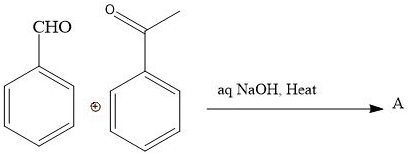
In the following reaction, the major product A is
Chemistry
Aldehydes, Ketones & Carboxylic Acids
Easy
Identify the final product of the following reaction
Chemistry
Biomolecules
Easy
The anomer of β-D-glucose is
Chemistry
Biomolecules
Easy
The sugar present in RNA molecule is
Chemistry
Solutions
Easy
Why is a cellulose acetate membrane used in reverse osmosis?
Chemistry
Electrochemistry
Easy
Match List-I with List-II
| List-I | List II |
|---|---|
| Units | Terms |
| (A) mol/L | (I) mole fraction |
| (B) no unit | (II) Conductivity |
| (C) S | (III) Molar conductivity |
| (D) S | (IV) Molarity |
Chemistry
Electrochemistry
Easy
Calculate the standard Gibbs energy.
The standard electrode potential for given cell is 1.7 V. (F= 96487 C )
Chemistry
Haloalkanes & Haloarenes
Easy
Which of the following alkyl halide requires the largest enthalpy to dissociate C-X bond ?
Chemistry
Aldehydes, Ketones & Carboxylic Acids
Medium
Match List-I with List-II
| List I | List II |
|---|---|
| Chemical name | Chemical formula |
| (A) Adipic acid | (I) 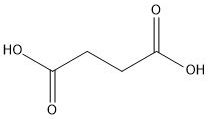 |
| (B) Succinic acid | (II) 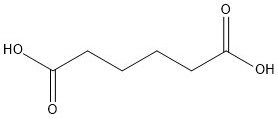 |
| (C) Glutaric acid | (III) 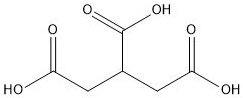 |
| (D) Carballylic acid | (IV) 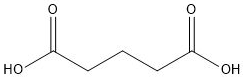 |
Chemistry
Electrochemistry
Medium
Arrange the given metals in the increasing order of their reducing powers
(A) = 0.80V
(B) = 0.79 V
(C) = -2.37V
(D) = -0.74V
Chemistry
Solutions
Easy
Arrange the following solutions in increasing order of their boiling point:
(A) 1% glucose
(B) 2% glucose
(C) 3% glucose
(D) 4% glucose
Chemistry
Solutions
Easy
Calculate the molarity (mol ) of a solution containing 25 g of in 675 mL solution.
Chemistry
Coordination Compounds
Hard
Which of the following metal complexes possess the same spin only magnetic moment:
(A)
(B)
(C)
(D)
Chemistry
Alcohols, Phenols & Ethers
Medium
Which of the following compound will react with NaOI to formed a yellow precipitate with a characteristic smell?
Chemistry
Coordination Compounds
Easy
Which of the following is not a heteroleptic complex?
Chemistry
Haloalkanes & Haloarenes
Medium
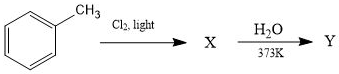
Identify the major product Y in the following reaction.
Chemistry
Electrochemistry
Easy
Calculate the in V for the following reaction
The standard reduction potential for & are -0.13V and 0.80 V respectively
Chemistry
Electrochemistry
Easy
Which of the following are semiconductors?
(A) CuO
(B) Si
(C) Glass
(D) Ge
Chemistry
Solutions
Easy
Which of following are solid solutions?
(A) Solution of hydrogen in palladium
(B) Camphor in nitrogen gas
(C) Copper dissolved in gold
(D) Amalgum of mercury with sodium
Chemistry
Coordination Compounds
Medium
What is the formula of tris(ethane-1,2-diamine)cobalt(III)sulphate?
Chemistry
d & f Block Elements
Easy
(Eu = 63) is stable because
Chemistry
Biomolecules
Hard
Arrange the following amino acids in increasing order of of N-atoms in their side chain.
(A) Histidine.
(B) Alanine.
(C) Lysine.
(D) Arginine.
Chemistry
Alcohols, Phenols & Ethers
Easy
Which of the following alcohol will react fastest with Lucas reagent?
Chemistry
Alcohols, Phenols & Ethers
Hard
The decreasing order of the reactivity of following alkyl halides towards Williamson ether synthesis is
(A) 
(B)
(C)
(D)
Chemistry
Coordination Compounds
Easy
What is the oxidation state of the metal ion in complex ?
Chemistry
Biomolecules
Easy
The products of complete hydrolysis of DNA are
(A) phosphoric acid.
(B) N-containing heterocyclic compound.
(C) nitrogen gas
(D) pentose sugar.
Chemistry
Haloalkanes & Haloarenes
Easy
Chlorobenzene can be prepared by which of the following set of reactions ?
(A) Phenol, + HCl, CuCl
(B) Aniline, HCl/
(C) Benzene + in presence of Fe
(D) Aniline, + HCl (273-278 K), /HCl
Chemistry
Alcohols, Phenols & Ethers
Easy
Phenetole on cleavage with HBr gives
Chemistry
Aldehydes, Ketones & Carboxylic Acids
Easy
Which of the following ketones does not give haloform reaction?
Chemistry
Coordination Compounds
Easy
Match List-I with List-II
| List-I (Complex/ion) | List-II (Use/Application) |
|---|---|
| (A) | (I) Anti-tumours |
| (B) | (II) Estimation of hardness of water |
| (C) Cis- | (III) Photography |
| (D) | (IV) Hydrogenation of alkenes |
Chemistry
d & f Block Elements
Medium
Which of the following is NOT an interstitial compound?
Chemistry
Haloalkanes & Haloarenes
Medium
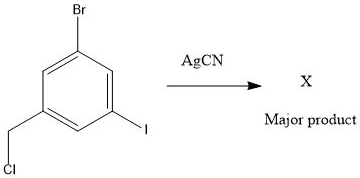
Identify the major product X in the following chemical reaction.
Chemistry
Chemical Kinetics
Easy
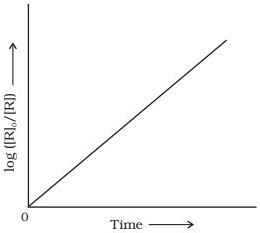
In the following graph for first order reaction the slope is
Chemistry
Chemical Kinetics
Easy
Chemistry
Chemical Kinetics
Easy
Chemistry
Chemical Kinetics
Easy
Chemistry
Chemical Kinetics
Medium
Chemistry
Amines
Easy
Chemistry
Amines
Medium
Chemistry
Amines
Medium
Chemistry
Amines
Medium
Chemistry
Amines
Medium
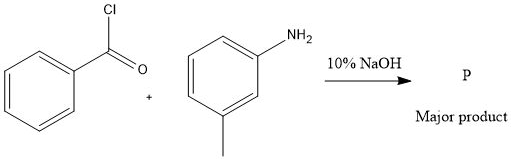
Identify the major product (P) in the following chemical reaction.
Every question from the CUET Chemistry 2026 19 May Shift 1 paper is here in full, with the correct answer and a step by step solution for each one. It is completely free, there is no login and no paywall, and you can read the whole paper online or download it to revise offline.
You can also attempt it instead of only reading it. Take the paper as a full length mock under exam conditions, or filter it by topic and attempt just that topic as a topic test. Both are free, and you get a breakdown of your accuracy, your timing and your weak areas once you submit.
CUET Chemistry past year questions (PYQs) are the closest thing to the real exam, so working through them is the quickest way to learn the paper pattern, the marking scheme and the level of difficulty to expect on the day.