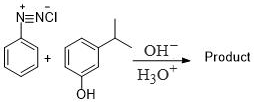
Q1:

Solutions

Easy

Two solutions having the same osmotic pressure at a given temperature are called:

Answer options
Option 2
Correct Answer
Explanation for 2026: 18 May Shift 2 CHE question 1

Q4:

Coordination Compounds

Hard

Arrange the following octahedral complexes in decreasing order of number of unpaired electrons in 3dd orbital:

A. [Mn(CN)6]3−[Mn(CN)_6]^{3-}

B. [CoF6]3−[CoF_6]^{3-}

C. [Fe(CN)6]3−[Fe(CN)_6]^{3-}

D. [Co(NH3)6]3+[Co(NH_3)_6]^{3+}

Answer options
Option 1
Correct Answer
Explanation for 2026: 18 May Shift 2 CHE question 4

Q7:

Haloalkanes & Haloarenes

Medium

Identify which of the given haloalkanes does not undergo elimination reaction?

Answer options
Option 4
Correct Answer
Explanation for 2026: 18 May Shift 2 CHE question 7

Q8:

Amines

Easy

Match the LIST-I with LIST-II.

LIST-I (Reaction)LIST-I (Name )
A.Benzonitrile →Na(Hg)/C2H5OH\xrightarrow{Na(Hg)/C_2H_5OH} PhenylmethanamineI.Reduction
B.Aniline + Chloroform + Sodium hydroxide →Δ\xrightarrow{\Delta} IsocyanobenzeneII.Benzoylation reaction
C.Aniline + Benzoyl chloride →NaOH\xrightarrow{NaOH} N-PhenylbenzamideIII.Hinsberg' test
D.Benzenesulphonyl chloride + N,N diethylamine ⟶\longrightarrow N,N-DiethylbenzenesulphonamideIV.Carbylamine reaction
Answer options
Option 1
Correct Answer
Explanation for 2026: 18 May Shift 2 CHE question 8

Q10:

Electrochemistry

Easy

The standard reduction potential of the given half cell, H+(aq)+e−→12H2H^+(aq) + e^- \rightarrow \frac{1}{2}H_2, is:

Answer options

Q11:

Coordination Compounds

Medium

Match the LIST-I with LIST-II.

LIST-I ComplexLIST-II Properties
A.[Mn(Br)4]2−[Mn(Br)_4]^{2-}I.Square planar, dsp2dsp^2 and 0 unpaired electrons
B.[Ni(CO)4][Ni(CO)_4]II.Tetrahedral, sp3sp^3 and 2 unpaired electrons
C.[Pt(Cl)4]2−[Pt(Cl)_4]^{2-}III.Tetrahedral, sp3sp^3 and 5 unpaired electrons
D.[Ni(Cl)4]2−[Ni(Cl)_4]^{2-}IV.Tetrahedral, sp3sp^3 and 0 unpaired electrons
Answer options

Q13:

d & f Block Elements

Medium

Which of the following Ln2+Ln^{2+} metal ion is diamagnetic?

(Given Atomic number, Yb= 70, Ho= 67, Pm = 61, Dy= 66)

Answer options

Q14:

Haloalkanes & Haloarenes

Medium

Arrange the following alkyl bromides in order of their increasing reactivity towards SN1S_N1 reaction.

A. 1-Bromobutane

B. Benzyl bromide

C. 3-Bromobut-1-ene

D. 2-Bromobutane

Answer options

Q15:

Solutions

Easy

Match the LIST-I with LIST-II

LIST-I Type of solutionLIST-II Example
A.Solid solute in solid solventI.Glucose dissolved in water
B.Gaseous solute in solid solventII.Copper dissolved in gold
C.Liquid solute in solid solventIII.Amalgam of mercury with sodium
D.Solid solute in liquid solventIV.Solution of hydrogen in palladium
Answer options

Q17:

Solutions

Medium

Match the LIST-I with LIST-II.

LIST-I Binary solutionLIST-II Type of solution
A.n-Hexane and n-HeptaneI.Isotonic with fluid inside blood cell
B.Nitric acid and WaterII.Minimum boiling azeotrope
C.0.9 % sodium chloride solutionIII.Ideal solution
D.Ethanol and WaterIV.Maximum boiling azeotrope
Answer options

Q18:

Electrochemistry

Medium

Arrange the following ions in order of their increasing limiting molar conductivities in water at 298 K?

A. K+K^+

B. Na+Na^+

C. Mg2+Mg^{2+}

D. H+H^+

Answer options

Q19:

Coordination Compounds

Medium

Which of the following metal carbonyls has a M – M bond bridged by two CO groups?

Answer options

Q20:

Biomolecules

Medium

Which of the following statements are CORRECT in relation to the cyclic structure of glucose?

A. It gives positive Schiff's test.

B. It exists in two different crystalline forms which are named as α\alpha and β\beta forms.

C. The α\alpha-form and β\beta-form are called anomers.

D. The six membered cyclic structure of glucose is called furanose structure.

Answer options

Q21:

Aldehydes, Ketones & Carboxylic Acids

Medium

Arrange the following groups in increasing order of their electron withdrawing tendency?

A. –CN

B. –CF3CF_3

C. –NO2NO_2

D. -Ph

Answer options

Q22:

Amines

Easy

In Hoffmann bromamide degradation reaction:

Answer options

Q23:

d & f Block Elements

Easy

The following reaction is catalysed by

2I−+S2O82−→I2+2SO42−2I^- + S_2O_8^{2-} \rightarrow I_2 + 2SO_4^{2-}

Answer options

Q25:

Electrochemistry

Easy

Which of the following statements are correct for Daniell cell?

A. Zinc electrode is negative terminal.

B. The direction of flow of current is from zinc to copper.

C. Reduction takes place at the copper electrode.

D. Oxidation and reduction half-cells are connected through a salt bridge.

Answer options

Q26:

Amines

Medium

Which of the following is FALSE in relation to the basicity of amines in aqueous solution?

Answer options

Q28:

Electrochemistry

Medium

The molar conductivity and limiting molar conductivity of acetic acid at concentration c, is Λm\Lambda_m and Λmo\Lambda_m^o, respectively. If α\alpha is the degree of dissociation, the dissociation constant of acetic acid is represented as:

Answer options

Q30:

d & f Block Elements

Medium

Which of the following metal ions will display maximum value of spin-only magnetic moment?

Answer options

Q31:

Electrochemistry

Medium

Match the LIST-I with LIST-II.

LIST-I Cell/Electrode reactionLIST-II Reaction involved in
A.Zn(Hg)+HgO(s)⟶ZnO(s)+Hg(l)Zn(Hg) + HgO(s) \longrightarrow ZnO(s) + Hg(l)I.Fuel cell
B.2H2(g)+O2(g)⟶2H2O(l)2H_2(g) + O_2(g) \longrightarrow 2H_2O(l)II.Reference electrode
C.Pb(s)+PbO2(s)+2H2SO4(aq)→2PbSO4(s)+2H2O(l)Pb(s) + PbO_2(s) + 2H_2SO_4(aq) \rightarrow 2PbSO_4(s) + 2H_2O(l)III.Primary battery
D.H+(aq)+e−→12H2(g)H^+(aq) + e^- \rightarrow \frac{1}{2}H_2(g)IV.Secondary battery
Answer options

Q32:

Amines

Easy

Amongst the given compounds, which will give Carbylamine reaction?

A. Aniline

B. pp-toluidine

C. Ethylamine

D. Diphenylamine

Answer options

Q33:

Aldehydes, Ketones & Carboxylic Acids

Medium

The addition of hydrogen cyanide to carbonyl carbon is an example of a nucleophilic addition reaction. Identify the CORRECT statements from the following.

A. The hybridization of carbonyl carbon changes from sp2sp^2 to sp3sp^3 after the attack of CN−CN^- to the carbonyl center.

B. It results in the formation of tetrahedral intermediate.

C. The reaction is acid catalysed.

D. Cyanohydrins are formed, which are useful synthetic intermediates.

Answer options

Q36:

Coordination Compounds

Easy

Which of the following statement is CORRECT for bonding in metal carbonyls?

Answer options

Q37:

Solutions

Medium

Arrange the following aqueous solutions of urea in increasing order of their freezing point?

A. 2% (w/v)

B. 10% (w/v)

C. 8% (w/v)

D. 5 % (w/v)

Answer options

Q38:

Biomolecules

Easy

What are the products formed when sucrose in alcoholic solution is boiled with dilute H2SO4H_2SO_4?

Answer options

Q39:

Solutions

Easy

Which of the following gases will have the lowest solubility in water at pressure pp and temperature 293 K?

(Given: Henry's constant (kbar) at 293 K for He, H2H_2, N2N_2 and O2O_2 are 144.97, 69.16, 76.48 and 34.86, respectively)

Answer options

Q40:

d & f Block Elements

Medium

Which of the following is characteristic property of interstitial compounds?

A. Interstitial compounds are formed when small atoms like H, C or N are trapped inside the crystal lattices of metals.

B. Interstitial compounds are very reactive.

C. They typically show covalent character and are generally soft.

D. They retain metallic conductivity.

Answer options

Q41:

Chemical Kinetics

Easy

Rate of reaction

Consider a general reaction: aA + bB →\rightarrow cC + dD

where a, b, c and d are the stoichiometric coefficients of reactants and products. The rate expression for this reaction is Rate α\alpha [A]x[B]y[A]^x[B]^y

where exponents x and y may or may not be equal to the stoichiometric coefficients (a and b) of the reactants. Above equation can also be written as Rate = k [A]x[B]y[A]^x[B]^y

Sum of these exponents, i.e., x + y gives the overall order of a reaction whereas x and y represent the order with respect to the reactants A and B, respectively.

−d[R]dt=k[A]x[B]y-\frac{d[R]}{dt} = k[A]^x[B]^y

The above equation is known as differential rate equation, where k is a proportionality constant called rate constant. The equation, which relates the rate of a reaction to concentration of reactants is called rate law or rate expression.

In the rate law expression reaction rate is given in terms of molar concentration of reactants with each term raised to some power, which may or may not be same as the stoichiometric coefficient of the reacting species in a balanced chemical equation. For example:

2NO2(g)+O2(g)→2NO3(g)2NO_2(g) + O_2(g) \rightarrow 2NO_3(g)

The rate of this reaction is measured as a function of initial concentrations either by keeping the concentration of one of the reactants constant and changing the concentration of the other reactant or by changing the concentration of both the reactants.

The results obtained are tabulated in table below:

ExperimentInitial [NO2][NO_2]/mol L−1L^{-1}Initial [O2][O_2]/mol L−1L^{-1}Initial rate of formation of [NO3][NO_3] /mol L−1s−1L^{-1}s^{-1}
10.250.250.090
20.500.250.360
30.250.500.180
40.500.500.720

What is the order of the reaction with respect to NO2NO_2?

Answer options

Q42:

Chemical Kinetics

Easy

Rate of reaction

Consider a general reaction: aA + bB →\rightarrow cC + dD

where a, b, c and d are the stoichiometric coefficients of reactants and products. The rate expression for this reaction is Rate α\alpha [A]x[B]y[A]^x[B]^y

where exponents x and y may or may not be equal to the stoichiometric coefficients (a and b) of the reactants. Above equation can also be written as Rate = k [A]x[B]y[A]^x[B]^y

Sum of these exponents, i.e., x + y gives the overall order of a reaction whereas x and y represent the order with respect to the reactants A and B, respectively.

−d[R]dt=k[A]x[B]y-\frac{d[R]}{dt} = k[A]^x[B]^y

The above equation is known as differential rate equation, where k is a proportionality constant called rate constant. The equation, which relates the rate of a reaction to concentration of reactants is called rate law or rate expression.

In the rate law expression reaction rate is given in terms of molar concentration of reactants with each term raised to some power, which may or may not be same as the stoichiometric coefficient of the reacting species in a balanced chemical equation. For example:

2NO2(g)+O2(g)→2NO3(g)2NO_2(g) + O_2(g) \rightarrow 2NO_3(g)

The rate of this reaction is measured as a function of initial concentrations either by keeping the concentration of one of the reactants constant and changing the concentration of the other reactant or by changing the concentration of both the reactants.

The results obtained are tabulated in table below:

ExperimentInitial [NO2][NO_2]/mol L−1L^{-1}Initial [O2][O_2]/mol L−1L^{-1}Initial rate of formation of [NO3][NO_3] /mol L−1s−1L^{-1}s^{-1}
10.250.250.090
20.500.250.360
30.250.500.180
40.500.500.720

The order with respect to O2O_2 is:

Answer options

Q43:

Chemical Kinetics

Easy

Rate of reaction

Consider a general reaction: aA + bB →\rightarrow cC + dD

where a, b, c and d are the stoichiometric coefficients of reactants and products. The rate expression for this reaction is Rate α\alpha [A]x[B]y[A]^x[B]^y

where exponents x and y may or may not be equal to the stoichiometric coefficients (a and b) of the reactants. Above equation can also be written as Rate = k [A]x[B]y[A]^x[B]^y

Sum of these exponents, i.e., x + y gives the overall order of a reaction whereas x and y represent the order with respect to the reactants A and B, respectively.

−d[R]dt=k[A]x[B]y-\frac{d[R]}{dt} = k[A]^x[B]^y

The above equation is known as differential rate equation, where k is a proportionality constant called rate constant. The equation, which relates the rate of a reaction to concentration of reactants is called rate law or rate expression.

In the rate law expression reaction rate is given in terms of molar concentration of reactants with each term raised to some power, which may or may not be same as the stoichiometric coefficient of the reacting species in a balanced chemical equation. For example:

2NO2(g)+O2(g)→2NO3(g)2NO_2(g) + O_2(g) \rightarrow 2NO_3(g)

The rate of this reaction is measured as a function of initial concentrations either by keeping the concentration of one of the reactants constant and changing the concentration of the other reactant or by changing the concentration of both the reactants.

The results obtained are tabulated in table below:

ExperimentInitial [NO2][NO_2]/mol L−1L^{-1}Initial [O2][O_2]/mol L−1L^{-1}Initial rate of formation of [NO3][NO_3] /mol L−1s−1L^{-1}s^{-1}
10.250.250.090
20.500.250.360
30.250.500.180
40.500.500.720

The correct rate equation and overall order of the reactions respectively, is:

Answer options

Q44:

Chemical Kinetics

Medium

Rate of reaction

Consider a general reaction: aA + bB →\rightarrow cC + dD

where a, b, c and d are the stoichiometric coefficients of reactants and products. The rate expression for this reaction is Rate α\alpha [A]x[B]y[A]^x[B]^y

where exponents x and y may or may not be equal to the stoichiometric coefficients (a and b) of the reactants. Above equation can also be written as Rate = k [A]x[B]y[A]^x[B]^y

Sum of these exponents, i.e., x + y gives the overall order of a reaction whereas x and y represent the order with respect to the reactants A and B, respectively.

−d[R]dt=k[A]x[B]y-\frac{d[R]}{dt} = k[A]^x[B]^y

The above equation is known as differential rate equation, where k is a proportionality constant called rate constant. The equation, which relates the rate of a reaction to concentration of reactants is called rate law or rate expression.

In the rate law expression reaction rate is given in terms of molar concentration of reactants with each term raised to some power, which may or may not be same as the stoichiometric coefficient of the reacting species in a balanced chemical equation. For example:

2NO2(g)+O2(g)→2NO3(g)2NO_2(g) + O_2(g) \rightarrow 2NO_3(g)

The rate of this reaction is measured as a function of initial concentrations either by keeping the concentration of one of the reactants constant and changing the concentration of the other reactant or by changing the concentration of both the reactants.

The results obtained are tabulated in table below:

ExperimentInitial [NO2][NO_2]/mol L−1L^{-1}Initial [O2][O_2]/mol L−1L^{-1}Initial rate of formation of [NO3][NO_3] /mol L−1s−1L^{-1}s^{-1}
10.250.250.090
20.500.250.360
30.250.500.180
40.500.500.720

Among the following, choose the CORRECT statement?

Answer options

Q45:

Chemical Kinetics

Easy

Rate of reaction

Consider a general reaction: aA + bB →\rightarrow cC + dD

where a, b, c and d are the stoichiometric coefficients of reactants and products. The rate expression for this reaction is Rate α\alpha [A]x[B]y[A]^x[B]^y

where exponents x and y may or may not be equal to the stoichiometric coefficients (a and b) of the reactants. Above equation can also be written as Rate = k [A]x[B]y[A]^x[B]^y

Sum of these exponents, i.e., x + y gives the overall order of a reaction whereas x and y represent the order with respect to the reactants A and B, respectively.

−d[R]dt=k[A]x[B]y-\frac{d[R]}{dt} = k[A]^x[B]^y

The above equation is known as differential rate equation, where k is a proportionality constant called rate constant. The equation, which relates the rate of a reaction to concentration of reactants is called rate law or rate expression.

In the rate law expression reaction rate is given in terms of molar concentration of reactants with each term raised to some power, which may or may not be same as the stoichiometric coefficient of the reacting species in a balanced chemical equation. For example:

2NO2(g)+O2(g)→2NO3(g)2NO_2(g) + O_2(g) \rightarrow 2NO_3(g)

The rate of this reaction is measured as a function of initial concentrations either by keeping the concentration of one of the reactants constant and changing the concentration of the other reactant or by changing the concentration of both the reactants.

The results obtained are tabulated in table below:

ExperimentInitial [NO2][NO_2]/mol L−1L^{-1}Initial [O2][O_2]/mol L−1L^{-1}Initial rate of formation of [NO3][NO_3] /mol L−1s−1L^{-1}s^{-1}
10.250.250.090
20.500.250.360
30.250.500.180
40.500.500.720

Which of the following are the units of rate constant for second order reaction?

Answer options

Q46:

Alcohols, Phenols & Ethers

Easy

Alcohols

Alcohols are formed when a hydrogen atom in aliphatic hydrocarbon is replaced by -OH group. Alcohols are classified as primary, secondary and tertiary alcohols depending on the attachment of -OH group to primary, secondary and tertiary carbon atom, respectively. In alcohols, the oxygen of the -OH group is attached to carbon by a sigma (σ\sigma) bond formed by the overlap of a sp3sp^3 hybridised orbital of carbon with a sp3sp^3 hybridised orbital of oxygen. Alcohols consist of two parts, an alkyl group and a hydroxyl group. The properties of alcohols are chiefly due to the hydroxyl group. The nature of alkyl groups simply modify these properties. The boiling points of alcohols increase with increase in the number of carbon atoms (increase in van der Waals forces). In alcohols, the boiling points decrease with increase of branching in carbon chain (because of decrease in van der Waals forces with decrease in surface area). Alcohols undergo dehydration (removal of a molecule of water) to form alkenes on treating with a protic acid e.g., concentrated H2SO4H_2SO_4 or H3PO4H_3PO_4, or catalysts such as anhydrous zinc chloride or alumina. Alcohols are versatile compounds. They act both as nucleophiles and electrophiles. An alcohol with molecular formula C4H10OC_4H_{10}O (A) is prepared the reduction of corresponding ketone. 'A' is also prepared by the reaction of propanal with methylmagnesium bromide followed by hydrolysis. Compound A on dehydration gives alkene (B).

Which reagent is used for reduction of ketone to compound "A"?

Answer options

Q47:

Alcohols, Phenols & Ethers

Easy

Alcohols

Alcohols are formed when a hydrogen atom in aliphatic hydrocarbon is replaced by -OH group. Alcohols are classified as primary, secondary and tertiary alcohols depending on the attachment of -OH group to primary, secondary and tertiary carbon atom, respectively. In alcohols, the oxygen of the -OH group is attached to carbon by a sigma (σ\sigma) bond formed by the overlap of a sp3sp^3 hybridised orbital of carbon with a sp3sp^3 hybridised orbital of oxygen. Alcohols consist of two parts, an alkyl group and a hydroxyl group. The properties of alcohols are chiefly due to the hydroxyl group. The nature of alkyl groups simply modify these properties. The boiling points of alcohols increase with increase in the number of carbon atoms (increase in van der Waals forces). In alcohols, the boiling points decrease with increase of branching in carbon chain (because of decrease in van der Waals forces with decrease in surface area). Alcohols undergo dehydration (removal of a molecule of water) to form alkenes on treating with a protic acid e.g., concentrated H2SO4H_2SO_4 or H3PO4H_3PO_4, or catalysts such as anhydrous zinc chloride or alumina. Alcohols are versatile compounds. They act both as nucleophiles and electrophiles. An alcohol with molecular formula C4H10OC_4H_{10}O (A) is prepared the reduction of corresponding ketone. 'A' is also prepared by the reaction of propanal with methylmagnesium bromide followed by hydrolysis. Compound A on dehydration gives alkene (B).

What type of alcohol is compound "A"?

Answer options

Q48:

Alcohols, Phenols & Ethers

Easy

Alcohols

Alcohols are formed when a hydrogen atom in aliphatic hydrocarbon is replaced by -OH group. Alcohols are classified as primary, secondary and tertiary alcohols depending on the attachment of -OH group to primary, secondary and tertiary carbon atom, respectively. In alcohols, the oxygen of the -OH group is attached to carbon by a sigma (σ\sigma) bond formed by the overlap of a sp3sp^3 hybridised orbital of carbon with a sp3sp^3 hybridised orbital of oxygen. Alcohols consist of two parts, an alkyl group and a hydroxyl group. The properties of alcohols are chiefly due to the hydroxyl group. The nature of alkyl groups simply modify these properties. The boiling points of alcohols increase with increase in the number of carbon atoms (increase in van der Waals forces). In alcohols, the boiling points decrease with increase of branching in carbon chain (because of decrease in van der Waals forces with decrease in surface area). Alcohols undergo dehydration (removal of a molecule of water) to form alkenes on treating with a protic acid e.g., concentrated H2SO4H_2SO_4 or H3PO4H_3PO_4, or catalysts such as anhydrous zinc chloride or alumina. Alcohols are versatile compounds. They act both as nucleophiles and electrophiles. An alcohol with molecular formula C4H10OC_4H_{10}O (A) is prepared the reduction of corresponding ketone. 'A' is also prepared by the reaction of propanal with methylmagnesium bromide followed by hydrolysis. Compound A on dehydration gives alkene (B).

Which of the isomers of the compound "A" has maximum boiling point?

Answer options

Q49:

Alcohols, Phenols & Ethers

Easy

Alcohols

Alcohols are formed when a hydrogen atom in aliphatic hydrocarbon is replaced by -OH group. Alcohols are classified as primary, secondary and tertiary alcohols depending on the attachment of -OH group to primary, secondary and tertiary carbon atom, respectively. In alcohols, the oxygen of the -OH group is attached to carbon by a sigma (σ\sigma) bond formed by the overlap of a sp3sp^3 hybridised orbital of carbon with a sp3sp^3 hybridised orbital of oxygen. Alcohols consist of two parts, an alkyl group and a hydroxyl group. The properties of alcohols are chiefly due to the hydroxyl group. The nature of alkyl groups simply modify these properties. The boiling points of alcohols increase with increase in the number of carbon atoms (increase in van der Waals forces). In alcohols, the boiling points decrease with increase of branching in carbon chain (because of decrease in van der Waals forces with decrease in surface area). Alcohols undergo dehydration (removal of a molecule of water) to form alkenes on treating with a protic acid e.g., concentrated H2SO4H_2SO_4 or H3PO4H_3PO_4, or catalysts such as anhydrous zinc chloride or alumina. Alcohols are versatile compounds. They act both as nucleophiles and electrophiles. An alcohol with molecular formula C4H10OC_4H_{10}O (A) is prepared the reduction of corresponding ketone. 'A' is also prepared by the reaction of propanal with methylmagnesium bromide followed by hydrolysis. Compound A on dehydration gives alkene (B).

The IUPAC name and structure of compound "A" is:

Answer options

Q50:

Alcohols, Phenols & Ethers

Easy

Alcohols

Alcohols are formed when a hydrogen atom in aliphatic hydrocarbon is replaced by -OH group. Alcohols are classified as primary, secondary and tertiary alcohols depending on the attachment of -OH group to primary, secondary and tertiary carbon atom, respectively. In alcohols, the oxygen of the -OH group is attached to carbon by a sigma (σ\sigma) bond formed by the overlap of a sp3sp^3 hybridised orbital of carbon with a sp3sp^3 hybridised orbital of oxygen. Alcohols consist of two parts, an alkyl group and a hydroxyl group. The properties of alcohols are chiefly due to the hydroxyl group. The nature of alkyl groups simply modify these properties. The boiling points of alcohols increase with increase in the number of carbon atoms (increase in van der Waals forces). In alcohols, the boiling points decrease with increase of branching in carbon chain (because of decrease in van der Waals forces with decrease in surface area). Alcohols undergo dehydration (removal of a molecule of water) to form alkenes on treating with a protic acid e.g., concentrated H2SO4H_2SO_4 or H3PO4H_3PO_4, or catalysts such as anhydrous zinc chloride or alumina. Alcohols are versatile compounds. They act both as nucleophiles and electrophiles. An alcohol with molecular formula C4H10OC_4H_{10}O (A) is prepared the reduction of corresponding ketone. 'A' is also prepared by the reaction of propanal with methylmagnesium bromide followed by hydrolysis. Compound A on dehydration gives alkene (B).

The IUPAC name of the major alkene (Compound B) formed by the dehydration of compound "A" is:

Answer options

CUET Chemistry 2026 18 May Shift 2 Past Year Question Paper

Every question from the CUET Chemistry 2026 18 May Shift 2 paper is here in full, with the correct answer and a step by step solution for each one. It is completely free, there is no login and no paywall, and you can read the whole paper online or download it to revise offline.

You can also attempt it instead of only reading it. Take the paper as a full length mock under exam conditions, or filter it by topic and attempt just that topic as a topic test. Both are free, and you get a breakdown of your accuracy, your timing and your weak areas once you submit.

CUET Chemistry past year questions (PYQs) are the closest thing to the real exam, so working through them is the quickest way to learn the paper pattern, the marking scheme and the level of difficulty to expect on the day.