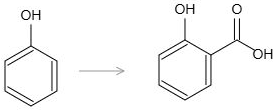
Identify the product of the following reaction
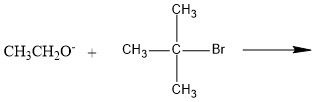
Identify the product of the following reaction
Solution
✅ Correct Option: 3
Ethoxide is a strong base, and tert-butyl bromide is a tertiary alkyl halide, so the carbon bearing Br is too crowded for backside attack (SN2). The ethoxide instead removes a -hydrogen from one of the three methyl groups, and Br leaves in a single E2 step.
The product is 2-methylpropene (isobutylene).
Option 1: this is the Williamson ether (SN2) product. Williamson synthesis fails with tertiary halides because elimination dominates.
Remember: a tertiary halide with a strong base such as an alkoxide gives an alkene, not an ether.
Related questions:
2025: 2 June Shift 1
2025: 30 May Shift 1
2025: 30 May Shift 2
2025: 26 May Shift 2