Q1:

Amines

Easy

The hybridization of nitrogen in primary amines is........., and the geometry of amines is ...............

Answer options
Option 4
Correct Answer
Explanation for 2026: 29 May Shift 2 CHE question 1

Q2:

Biomolecules

Easy

Which one of the following statements is incorrect regarding the chemical reactivity of Glucose?

Answer options
Option 2
Correct Answer
Explanation for 2026: 29 May Shift 2 CHE question 2

Q3:

Amines

Medium

The most suitable synthetic procedure involving various reactions to convert benzene to p-bromoaniline will be

Answer options
Option 4
Correct Answer
Explanation for 2026: 29 May Shift 2 CHE question 3

Q4:

Biomolecules

Medium

Match the LIST-I with LIST-II.

LIST-I CarbohydrateLIST-II Glycosidic linkage between
A.SucroseI.C1 of α-D-glucose and C2 of β-D-fructose
B.MaltoseII.C1 of β-D-galactose and C4 of β-D-glucose
C.LactoseIII.C1 of β-D-glucose and C4 of β-D-glucose
D.CelluloseIV.C1 of α-D-glucose and C4 of α-D-glucose
Answer options
Option 3
Correct Answer
Explanation for 2026: 29 May Shift 2 CHE question 4

Q5:

Amines

Easy

The correct reagents (Reagent 1 and Reagent 2) required for the following chemical transformation are .......................... and ..............................., respectively.
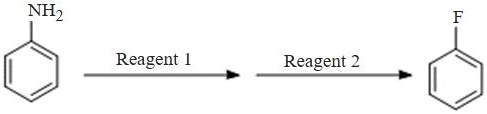
Figure

Answer options
Option 1
Correct Answer
Explanation for 2026: 29 May Shift 2 CHE question 5

Q6:

Chemical Kinetics

Medium

Match the LIST-I with LIST-II.

LIST-I Order of reactionLIST-II Example
A.Zero orderI.Decomposition of hydrogen peroxide using iodide ion as catalyst in alkaline medium
B.First orderII.Hydrolysis of ethyl acetate in the presence of acid
C.Pseudo First orderIII.Thermal decomposition of HI on gold surface
D.Second orderIV.Radioactive decay of unstable nuclei.
Answer options
Option 3
Correct Answer
Explanation for 2026: 29 May Shift 2 CHE question 6

Q7:

Haloalkanes & Haloarenes

Medium

Which one of the following statements is incorrect regarding polyhalogen compounds?

Answer options
Option 3
Correct Answer
Explanation for 2026: 29 May Shift 2 CHE question 7

Q8:

Solutions

Easy

Match the LIST-I with LIST-II.

LIST-I (Observations related to solutions)LIST-II (Equation: Symbols have their usual meanings)
A.Henry's LawI.Δp1=x2 p10\Delta p_1 = x_2\, p_1^0
B.Relative Lowering of Vapor PressureII.ΔTf=m Kf\Delta T_f = m\, K_f
C.Depression of Freezing PointIII.p=x KHp = x\, K_H
D.Elevation of Boiling PointIV.ΔTb=m Kb\Delta T_b = m\, K_b
Answer options
Option 1
Correct Answer
Explanation for 2026: 29 May Shift 2 CHE question 8

Q9:

Biomolecules

Easy

Vitamin C and vitamin D are

Answer options
Option 3
Correct Answer
Explanation for 2026: 29 May Shift 2 CHE question 9

Q10:

Coordination Compounds

Easy

The IUPAC name of the complex [Co(NH3)4(H2O)Cl]Br2\mathrm{[Co(NH_3)_4(H_2O)Cl]Br_2} is

Answer options

Q11:

Coordination Compounds

Medium

The dd-orbital electron distribution of Fe in the complex [Fe(H2O)6]3+\mathrm{[Fe(H_2O)_6]^{3+}} is ........

Answer options

Q12:

Aldehydes, Ketones & Carboxylic Acids

Easy

Bromination of benzoic acid with Br2\mathrm{Br_2} water in the presence of catalytic amounts of FeBr3\mathrm{FeBr_3} will give

Answer options

Q13:

d & f Block Elements

Easy

If the below equation is balanced, then the values of xx and yy are

Cr2O72−+x H++6 Fe2+→2 Cr3++6 Fe3++y H2O\mathrm{Cr_2O_7^{2-}} + x\,\mathrm{H^+} + 6\,\mathrm{Fe^{2+}} \rightarrow 2\,\mathrm{Cr^{3+}} + 6\,\mathrm{Fe^{3+}} + y\,\mathrm{H_2O}

Answer options

Q14:

Alcohols, Phenols & Ethers

Hard

The following chemical transformations can be achieved through a 4-step reaction involving the step-wise use of the reagents given below in a particular sequence:
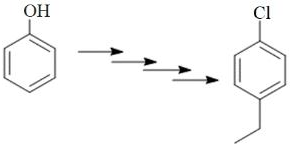
Figure

A. Cl2/FeCl3\mathrm{Cl_2/FeCl_3}

B. Zn dust

C. Zn(Hg)/HCl

D. CH3COCl/AlCl3\mathrm{CH_3COCl/AlCl_3}

Answer options

Q15:

d & f Block Elements

Medium

Which one of the following statements is incorrect regarding the inner-transition elements?

Answer options

Q16:

Chemical Kinetics

Easy

Which of the following statements are correct?

A. The overall rate of a reaction is controlled by the slowest step in a reaction.

B. Order of a reaction is an experimental quantity.

C. Molecularity is applicable to elementary as well as complex reactions.

D. The number of reacting species taking part in an elementary reaction is called molecularity of a reaction.

Answer options

Q17:

d & f Block Elements

Medium

Arrange the following transition metals in increasing order of their highest oxidation state exhibited by them:

A. Co

B. Mn

C. Cu

D. Cr

Answer options

Q18:

Chemical Kinetics

Easy

Which one of the following statements is incorrect regarding a catalyst?

Answer options

Q19:

Haloalkanes & Haloarenes

Medium

Which of the following statements is/are correct regarding nucleophilic substitution reactions of alkyl halides?

A. In case of optically active alkyl halides, the substitution product obtained as a result of SN2\mathrm{S_N2} mechanism has inverted configuration.

B. SN1\mathrm{S_N1} mechanism involves a transition state.

C. SN2\mathrm{S_N2} mechanism is a two-step process involving the formation of an intermediate.

D. In case of optically active alkyl halides, the substitution product obtained as a result of SN1\mathrm{S_N1} mechanism is a racemic mixture.

Answer options

Q20:

d & f Block Elements

Medium

Which one of the following metal ions will exhibits highest value of calculated magnetic moment (spin-only)?

Answer options

Q22:

Solutions

Medium

The osmotic pressure of a solution (in bar) obtained by dissolving 0.35 g of CaCl2\mathrm{CaCl_2} (van't Hoff factor, i=2.47i = 2.47) in 3.5 L of water at 345 K will be approximately

[Given : Molar mass of CaCl2=110.9 g mol−1\mathrm{CaCl_2} = 110.9\ \mathrm{g\ mol^{-1}} and R=0.083 L bar mol−1 K−1R = 0.083\ \mathrm{L\ bar\ mol^{-1}\ K^{-1}}]

Answer options

Q23:

Coordination Compounds

Medium

Which of the given complexes will be optically active?

cis-[PtCl2(en)2]2+\mathrm{[PtCl_2(en)_2]^{2+}} , trans-[PtCl2(en)2]2+\mathrm{[PtCl_2(en)_2]^{2+}} , cis-[CrCl2(ox)2]3−\mathrm{[CrCl_2(ox)_2]^{3-}} , trans-[CrCl2(ox)2]3−\mathrm{[CrCl_2(ox)_2]^{3-}}

Answer options

Q24:

Biomolecules

Easy

Which one of the following statements is incorrect regarding amino acids?

Answer options

Q25:

Alcohols, Phenols & Ethers

Medium

Which one of the following statements is incorrect regarding the nitration of phenol with nitric acid?

Answer options

Q26:

Solutions

Medium

Arrange the following equimolar solutions in the increasing order of their van’t Hoff factor values .

A. Aqueous Urea

B. Aqueous K2SO4\mathrm{K_2SO_4}

C. Aqueous NaCl

D. Ethanoic acid (in benzene)

Answer options

Q27:

Chemical Kinetics

Medium

While systematically calculating the order of the given reaction, 2A+B→C+D2A + B \rightarrow C + D using the data given below, the most appropriate correct sequence of steps (from the below given steps) that should be followed is

Experiment[A] (mol L−1\mathrm{mol\ L^{-1}})[B] (mol L−1\mathrm{mol\ L^{-1}})Initial rate of formation of D (mol L−1 min−1\mathrm{mol\ L^{-1}\ min^{-1}})
I0.10.16.00×10−36.00 \times 10^{-3}
II0.30.27.20×10−27.20 \times 10^{-2}
III0.30.12.88×10−12.88 \times 10^{-1}
IV0.40.42.40×10−22.40 \times 10^{-2}

A. Independently compare the proposed Rate Law equations of experiment II with III, AND of experiment I with IV.

B. Divide the proposed Rate Law equations for experiments I and IV to determine the value of m. Similarly, divide the proposed Rate Law equations for experiments II and III to determine the value of n.

C. Assume the Rate Law equation for the given reaction to be, Rate = k[A]m[B]nk[A]^m [B]^n

D. Add m and n to calculate the numerical value of order of the reaction.

Answer options

Q28:

Chemical Kinetics

Easy

The unit of rate constant for a zero order reaction is

Answer options

Q29:

Aldehydes, Ketones & Carboxylic Acids

Medium

Acid-catalyzed esterification of carboxylic acids with alcohols proceeds through number of steps in a sequential manner. Choose the correct sequence of steps from the following :

A. Nucleophilic addition of alcohol on the protonated carbonyl in carboxylic acid

B. Elimination of a water molecule

C. De-protonation

D. Proton transfer in the tetrahedral intermediate, converting OH to +OH2^{+}\mathrm{OH_2}.

Answer options

Q30:

Aldehydes, Ketones & Carboxylic Acids

Easy

Which one of the following reagents will selectively convert methyl propanoate to propanal?

Answer options

Q31:

Haloalkanes & Haloarenes

Easy

Match the LIST-I with LIST-II.

LIST-I Reaction of Alkyl HalidesLIST-II Major Product
A.CH3CH2Br+KOH (aq.)→\mathrm{CH_3CH_2Br + KOH\ (aq.) \rightarrow}I.CH2=CH2\mathrm{CH_2{=}CH_2}
B.CH3CH2Br+KOH (hot alc.)→\mathrm{CH_3CH_2Br + KOH\ (hot\ alc.) \rightarrow}II.CH3CH2CN\mathrm{CH_3CH_2CN}
C.CH3CH2Br+AgCN→\mathrm{CH_3CH_2Br + AgCN \rightarrow}III.CH3CH2OH\mathrm{CH_3CH_2OH}
D.CH3CH2Br+KCN→\mathrm{CH_3CH_2Br + KCN \rightarrow}IV.CH3CH2NC\mathrm{CH_3CH_2NC}
Answer options

Q32:

Solutions

Easy

Which of the following statements are correct regarding ideal and non-ideal solutions?

A. An ideal solution obeys Raoult's Law over the entire range of concentration.

B. A non-ideal solution does not obey Raoult's Law over the entire range of concentration.

C. A mixture of bromoethane and chloroethane is an example of non-ideal solution.

D. A mixture of chloroform and acetone is an example of ideal solution.

Answer options

Q33:

Coordination Compounds

Medium

Based on the Valence Bond Theory, which of the following complexes will exhibit either dsp2dsp^2 or d2sp3d^2sp^3 hybridisations?

A. [Ni(CN)4]2−\mathrm{[Ni(CN)_4]^{2-}}

B. [NiCl4]2−\mathrm{[NiCl_4]^{2-}}

C. [Co(NH3)6]3+\mathrm{[Co(NH_3)_6]^{3+}}

D. [CoF6]3−\mathrm{[CoF_6]^{3-}}

Answer options

Q34:

Alcohols, Phenols & Ethers

Medium

Which of the following statements is/are correct regarding ethers?

A. Ethers have higher boiling points than alcohols with comparable molecular masses.

B. Williamson synthesis is a laboratory method for preparing symmetrical and unsymmetrical ethers.

C. The methoxy group in anisole (C6H5OCH3\mathrm{C_6H_5OCH_3}) is meta-directing and activates the aromatic ring toward electrophilic substitution reaction.

D. Anisole on reaction with HI gives a mixture of phenol and methyl iodide.

Answer options

Q35:

Amines

Medium

The major product (P) for the following chemical transformation is.
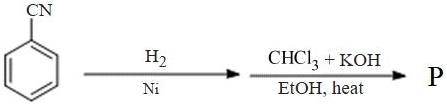
Figure

Answer options

Q37:

Solutions

Easy

Amalgam of mercury with sodium is an example of

Answer options

Q38:

d & f Block Elements

Medium

Among the given first-row transition metal oxides (VO2+\mathrm{VO_2^+}, Cr2O72−\mathrm{Cr_2O_7^{2-}}, MnO4−\mathrm{MnO_4^-}), the metal oxide(s) with the lowest oxidizing power will be

Answer options

Q39:

Biomolecules

Easy

Which one of the following is correct regarding nucleic acids?

Answer options

Q40:

Coordination Compounds

Easy

Match the LIST-I with LIST-II.

LIST-I Metal Carbonyl ComplexLIST-II Geometry/structure
A.[Fe(CO)5]\mathrm{[Fe(CO)_5]}I.Tetrahedral
B.[Mn2(CO)10]\mathrm{[Mn_2(CO)_{10}]}II.Octahedral
C.[Ni(CO)4]\mathrm{[Ni(CO)_4]}III.Trigonal bipyramidal
D.[Cr(CO)6]\mathrm{[Cr(CO)_6]}IV.Two Square pyramidal units joined by a Metal – Metal bond
Answer options

Q41:

Electrochemistry

Easy

A Daniell Cell is an electrochemical cell that converts chemical energy into electrical energy through a spontaneous redox reaction. It is also referred as a galvanic or voltaic cell. It consists of two half-cells that are connected by a salt bridge to maintain electrical neutrality through the flow of ions. The first half-cell consists of a Zn rod dipped in a ZnSO4\mathrm{ZnSO_4} solution, while the other half-cell consists of a Cu rod immersed in a CuSO4\mathrm{CuSO_4} solution. The two rods are connected by a wire to complete the circuit through which the electron flows, and a voltmeter may be connected in the circuit to measure the electrode potential. If the circuit in a Daniell cell represented by the cell notation, Zn∣Zn2+∥Cu2+∣Cu\mathrm{Zn} \mid \mathrm{Zn^{2+}} \Vert \mathrm{Cu^{2+}} \mid \mathrm{Cu}, is closed, then it is observed that as time passes the concentration of Zn2+\mathrm{Zn^{2+}} keeps on increasing, while the concentration of Cu2+\mathrm{Cu^{2+}} keeps on decreasing. At the same time, the voltage of the cell as read on the voltmeter keeps on decreasing. After some time, the voltmeter shows zero reading.

A zero reading in the voltmeter indicates

Answer options

Q42:

Electrochemistry

Easy

A Daniell Cell is an electrochemical cell that converts chemical energy into electrical energy through a spontaneous redox reaction. It is also referred as a galvanic or voltaic cell. It consists of two half-cells that are connected by a salt bridge to maintain electrical neutrality through the flow of ions. The first half-cell consists of a Zn rod dipped in a ZnSO4\mathrm{ZnSO_4} solution, while the other half-cell consists of a Cu rod immersed in a CuSO4\mathrm{CuSO_4} solution. The two rods are connected by a wire to complete the circuit through which the electron flows, and a voltmeter may be connected in the circuit to measure the electrode potential. If the circuit in a Daniell cell represented by the cell notation, Zn∣Zn2+∥Cu2+∣Cu\mathrm{Zn} \mid \mathrm{Zn^{2+}} \Vert \mathrm{Cu^{2+}} \mid \mathrm{Cu}, is closed, then it is observed that as time passes the concentration of Zn2+\mathrm{Zn^{2+}} keeps on increasing, while the concentration of Cu2+\mathrm{Cu^{2+}} keeps on decreasing. At the same time, the voltage of the cell as read on the voltmeter keeps on decreasing. After some time, the voltmeter shows zero reading.

The cell reaction for the above Daniell cell is

Answer options

Q43:

Electrochemistry

Easy

A Daniell Cell is an electrochemical cell that converts chemical energy into electrical energy through a spontaneous redox reaction. It is also referred as a galvanic or voltaic cell. It consists of two half-cells that are connected by a salt bridge to maintain electrical neutrality through the flow of ions. The first half-cell consists of a Zn rod dipped in a ZnSO4\mathrm{ZnSO_4} solution, while the other half-cell consists of a Cu rod immersed in a CuSO4\mathrm{CuSO_4} solution. The two rods are connected by a wire to complete the circuit through which the electron flows, and a voltmeter may be connected in the circuit to measure the electrode potential. If the circuit in a Daniell cell represented by the cell notation, Zn∣Zn2+∥Cu2+∣Cu\mathrm{Zn} \mid \mathrm{Zn^{2+}} \Vert \mathrm{Cu^{2+}} \mid \mathrm{Cu}, is closed, then it is observed that as time passes the concentration of Zn2+\mathrm{Zn^{2+}} keeps on increasing, while the concentration of Cu2+\mathrm{Cu^{2+}} keeps on decreasing. At the same time, the voltage of the cell as read on the voltmeter keeps on decreasing. After some time, the voltmeter shows zero reading.

If the standard electrode potential of Zn2+/Zn=−0.76\mathrm{Zn^{2+}/Zn} = -0.76 V and the standard electrode potential of Cu2+/Cu=0.34\mathrm{Cu^{2+}/Cu} = 0.34 V, then the standard electrode potential for the Daniell cell is

Answer options

Q44:

Electrochemistry

Medium

A Daniell Cell is an electrochemical cell that converts chemical energy into electrical energy through a spontaneous redox reaction. It is also referred as a galvanic or voltaic cell. It consists of two half-cells that are connected by a salt bridge to maintain electrical neutrality through the flow of ions. The first half-cell consists of a Zn rod dipped in a ZnSO4\mathrm{ZnSO_4} solution, while the other half-cell consists of a Cu rod immersed in a CuSO4\mathrm{CuSO_4} solution. The two rods are connected by a wire to complete the circuit through which the electron flows, and a voltmeter may be connected in the circuit to measure the electrode potential. If the circuit in a Daniell cell represented by the cell notation, Zn∣Zn2+∥Cu2+∣Cu\mathrm{Zn} \mid \mathrm{Zn^{2+}} \Vert \mathrm{Cu^{2+}} \mid \mathrm{Cu}, is closed, then it is observed that as time passes the concentration of Zn2+\mathrm{Zn^{2+}} keeps on increasing, while the concentration of Cu2+\mathrm{Cu^{2+}} keeps on decreasing. At the same time, the voltage of the cell as read on the voltmeter keeps on decreasing. After some time, the voltmeter shows zero reading.

The standard Gibbs energy for the reaction mentioned will be

[Given, F=96487 C mol−1F = 96487\ \mathrm{C\ mol^{-1}}]

Answer options

Q45:

Electrochemistry

Medium

A Daniell Cell is an electrochemical cell that converts chemical energy into electrical energy through a spontaneous redox reaction. It is also referred as a galvanic or voltaic cell. It consists of two half-cells that are connected by a salt bridge to maintain electrical neutrality through the flow of ions. The first half-cell consists of a Zn rod dipped in a ZnSO4\mathrm{ZnSO_4} solution, while the other half-cell consists of a Cu rod immersed in a CuSO4\mathrm{CuSO_4} solution. The two rods are connected by a wire to complete the circuit through which the electron flows, and a voltmeter may be connected in the circuit to measure the electrode potential. If the circuit in a Daniell cell represented by the cell notation, Zn∣Zn2+∥Cu2+∣Cu\mathrm{Zn} \mid \mathrm{Zn^{2+}} \Vert \mathrm{Cu^{2+}} \mid \mathrm{Cu}, is closed, then it is observed that as time passes the concentration of Zn2+\mathrm{Zn^{2+}} keeps on increasing, while the concentration of Cu2+\mathrm{Cu^{2+}} keeps on decreasing. At the same time, the voltage of the cell as read on the voltmeter keeps on decreasing. After some time, the voltmeter shows zero reading.

Assume that at any instance of time, the reaction in the above mentioned Daniell cell has not attained equilibrium, then which one of the following statements is incorrect?

Answer options

Q46:

Alcohols, Phenols & Ethers

Easy

Aspirin is a commonly used non-steroidal anti-inflammatory drug which reduces fever, relieves mild pain and decreases swelling. It is prepared by numerous synthetic methods; of which the acetylation of Compound A with acetyl chloride is one of the easiest methods. However, Compound A itself needs to be prepared from Compound B under basic conditions by using carbon dioxide as a reagent. Interestingly, Compound B along with Compound C can be obtained by the air oxidation of Compound D. Compound C is a commonly used industrial solvent and gives a positive iodoform test and a negative Tollen's test. Compound C easily forms 2,4-DNP derivative (Compound E). Compound C on reaction with Ba(OH)2\mathrm{Ba(OH)_2} under heating conditions produces Compound F whose molecular formula is C6H10O\mathrm{C_6H_{10}O}.

Aspirin is chemically known as

Answer options

Q47:

Alcohols, Phenols & Ethers

Medium

Aspirin is a commonly used non-steroidal anti-inflammatory drug which reduces fever, relieves mild pain and decreases swelling. It is prepared by numerous synthetic methods; of which the acetylation of Compound A with acetyl chloride is one of the easiest methods. However, Compound A itself needs to be prepared from Compound B under basic conditions by using carbon dioxide as a reagent. Interestingly, Compound B along with Compound C can be obtained by the air oxidation of Compound D. Compound C is a commonly used industrial solvent and gives a positive iodoform test and a negative Tollen's test. Compound C easily forms 2,4-DNP derivative (Compound E). Compound C on reaction with Ba(OH)2\mathrm{Ba(OH)_2} under heating conditions produces Compound F whose molecular formula is C6H10O\mathrm{C_6H_{10}O}.

The structures of Compound A and Compound B, respectively are

Answer options

Q48:

Alcohols, Phenols & Ethers

Easy

Aspirin is a commonly used non-steroidal anti-inflammatory drug which reduces fever, relieves mild pain and decreases swelling. It is prepared by numerous synthetic methods; of which the acetylation of Compound A with acetyl chloride is one of the easiest methods. However, Compound A itself needs to be prepared from Compound B under basic conditions by using carbon dioxide as a reagent. Interestingly, Compound B along with Compound C can be obtained by the air oxidation of Compound D. Compound C is a commonly used industrial solvent and gives a positive iodoform test and a negative Tollen's test. Compound C easily forms 2,4-DNP derivative (Compound E). Compound C on reaction with Ba(OH)2\mathrm{Ba(OH)_2} under heating conditions produces Compound F whose molecular formula is C6H10O\mathrm{C_6H_{10}O}.

The name and the structure of Compound D is

Answer options

Q49:

Aldehydes, Ketones & Carboxylic Acids

Medium

Aspirin is a commonly used non-steroidal anti-inflammatory drug which reduces fever, relieves mild pain and decreases swelling. It is prepared by numerous synthetic methods; of which the acetylation of Compound A with acetyl chloride is one of the easiest methods. However, Compound A itself needs to be prepared from Compound B under basic conditions by using carbon dioxide as a reagent. Interestingly, Compound B along with Compound C can be obtained by the air oxidation of Compound D. Compound C is a commonly used industrial solvent and gives a positive iodoform test and a negative Tollen's test. Compound C easily forms 2,4-DNP derivative (Compound E). Compound C on reaction with Ba(OH)2\mathrm{Ba(OH)_2} under heating conditions produces Compound F whose molecular formula is C6H10O\mathrm{C_6H_{10}O}.

The structures of Compound C and Compound E are

Answer options

Q50:

Aldehydes, Ketones & Carboxylic Acids

Hard

Aspirin is a commonly used non-steroidal anti-inflammatory drug which reduces fever, relieves mild pain and decreases swelling. It is prepared by numerous synthetic methods; of which the acetylation of Compound A with acetyl chloride is one of the easiest methods. However, Compound A itself needs to be prepared from Compound B under basic conditions by using carbon dioxide as a reagent. Interestingly, Compound B along with Compound C can be obtained by the air oxidation of Compound D. Compound C is a commonly used industrial solvent and gives a positive iodoform test and a negative Tollen's test. Compound C easily forms 2,4-DNP derivative (Compound E). Compound C on reaction with Ba(OH)2\mathrm{Ba(OH)_2} under heating conditions produces Compound F whose molecular formula is C6H10O\mathrm{C_6H_{10}O}.

The condensation reaction for converting Compound C to Compound F is called , and the structure of Compound F is

Answer options

CUET Chemistry 2026 29 May Shift 2 Past Year Question Paper

Every question from the CUET Chemistry 2026 29 May Shift 2 paper is here in full, with the correct answer and a step by step solution for each one. It is completely free, there is no login and no paywall, and you can read the whole paper online or download it to revise offline.

You can also attempt it instead of only reading it. Take the paper as a full length mock under exam conditions, or filter it by topic and attempt just that topic as a topic test. Both are free, and you get a breakdown of your accuracy, your timing and your weak areas once you submit.

CUET Chemistry past year questions (PYQs) are the closest thing to the real exam, so working through them is the quickest way to learn the paper pattern, the marking scheme and the level of difficulty to expect on the day.