Skip to main contentSkip to solution

Carboxylic Acids: Types of Reactions

Carboxylic acid exhibits a number of reactions depending on the involvement of a specific part of the -COOH group. It mainly includes nucleophilic acyl substitution reaction, in which a hydroxy group of -COOH is replaced by another nucleophile, and the acidic behavior of carboxylic acids, which is due to the cleavage of O-H bond in -COOH group. The former reaction leads to the conversion of carboxylic acid into a variety of different derivatives/categories of organic compounds, whereas the later converts it into salts which find applications in many industries, like soap and detergent synthesis and pharmaceutical industries. Other important types of chemical reactions involve reduction of -COOH group, decarboxylation, electrolysis and substitution reactions in the hydrocarbon part at α-carbon atom.

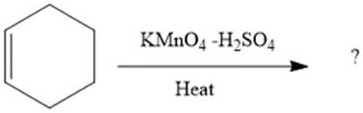
Identify the correct product of the following reaction:
Figure

Solution

✅ Correct Option: 4

Hot acidic KMnO4 is a strong oxidising agent that cleaves the C=C bond of cyclohexene and oxidises each carbon of the double bond to a -COOH group. The ring opens, and the six carbons stay in one chain: HOOC-(CH2)4-COOH, which is hexanedioic acid (adipic acid).

C6H10→HeatKMnO4/H2SO4HOOC-(CH2)4-COOH\text{C}_6\text{H}_{10} \xrightarrow[\text{Heat}]{\text{KMnO}_4/\text{H}_2\text{SO}_4} \text{HOOC-(CH}_2)_4\text{-COOH}


Glutaric acid: it has 5 carbons, but cleaving a 6-carbon ring gives a 6-carbon diacid.

Phthalic and terephthalic acids: these are aromatic acids, formed from the oxidation of xylenes, not from a cyclohexene ring.

Keyboard Shortcuts

  • Left arrow: Previous question
  • Right arrow: Next question
  • S key: Jump to solution
  • Q key: Jump to question