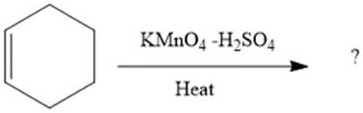
Solution
✅ Correct Option: 1
Strong oxidation of an unsymmetrical ketone breaks the C-C bond on either side of the C=O group. The carbonyl carbon becomes a -COOH group on one fragment, and the carbon on the other side of the broken bond also becomes -COOH.
The ketone is , so there are two possible cleavages:
| Bond broken | Acids formed |
|---|---|
| of the ethyl group | and |
| of the isobutyl group | and |
Together these give a mixture of four acids: ethanoic acid, 3-methylbutanoic acid, propanoic acid and 2-methylpropanoic acid.
Options 2, 3 and 4: each leaves out at least one of the four acids, so each assumes only one of the two cleavages (or part of one).
Popoff's rule says the C=O stays with the smaller alkyl group, which favours the second cleavage. The question asks for the full mixture, so both cleavages count.