CUET Chemistry: ChemistryChemical Kinetics. Free, no login required.

Q1:

2026: 7 June Shift 2

Chemical Kinetics

Easy

Match the units of k for different reaction orders.`.

List-IList-II
Order of reactionUnits
(A) Zero order reaction(I) mol−2^{-2} L2^2 s−1^{-1}
(B) First order reaction(II) mol−1^{-1} L s−1^{-1}
(C) Second order reaction(III) s−1^{-1}
(D) Third order reaction(IV) mol L−1^{-1} s−1^{-1}
Answer options
Option 3
Correct Answer
Explanation for 2026: 7 June Shift 2 CHE question 1

Q2:

2026: 7 June Shift 2

Chemical Kinetics

Medium

The decomposition of a substance R takes place according to Ist^{st} order kinetic reaction. The initial concentration is reduced to 1/8th^{th} of initial value in 24 seconds. The rate constant of the reaction is

Answer options
Option 3
Correct Answer
Explanation for 2026: 7 June Shift 2 CHE question 2

Q3:

2026: 7 June Shift 2

Chemical Kinetics

Medium

The correct statements about collision theory of reaction rates are

(A) The proper orientation of reactant molecules leads to bond formation

(B) In kinetic theory of gases, the reactant molecules are assumed to be soft spheres.

(C) The number of collisions per second per unit volume of the reaction mixture is known as Collision frequency (Z)

(D) In collision theory, activation energy and proper orientation of the molecules together determine the criteria for an effective collision.

Answer options
Option 3
Correct Answer
Explanation for 2026: 7 June Shift 2 CHE question 3

Q4:

2026: 7 June Shift 2

Chemical Kinetics

Easy

A catalyst is a substance which

Answer options
Option 4
Correct Answer
Explanation for 2026: 7 June Shift 2 CHE question 4

Q5:

2026: 7 June Shift 2

Chemical Kinetics

Medium

The half life period of first order decomposition of NH2NO2NH_2NO_2 is 2.1 hour at 15°C. The time required (in hour) for 5.2 g of NH2NO2NH_2NO_2 to decompose 99% will be ;

NH2NO2 (aq)⟶N2O(g)+H2O(l)NH_2NO_{2\,(aq)} \longrightarrow N_2O_{(g)} + H_2O_{(l)}

Answer options
Option 2
Correct Answer
Explanation for 2026: 7 June Shift 2 CHE question 5

Q6:

2026: 7 June Shift 2

Chemical Kinetics

Easy

Which of the following is an incorrect statement?

Answer options
Option 1
Correct Answer
Explanation for 2026: 7 June Shift 2 CHE question 6

Q7:

2026: 6 June Shift 1

Chemical Kinetics

Easy

For the following reaction choose the incorrect expression of rate of reaction.

5 Br−(aq.)+BrO3−(aq.)+6 H+(aq.)→3 Br2(aq.)+3 H2O(l)5\,Br^-(aq.) + BrO_3^-(aq.) + 6\,H^+(aq.) \rightarrow 3\,Br_2(aq.) + 3\,H_2O(l)

Answer options
Option 3
Correct Answer
Explanation for 2026: 6 June Shift 1 CHE question 7

Q8:

2026: 6 June Shift 1

Chemical Kinetics

Medium

Choose the correct statements

(A) For a gaseous reaction, if the concentration of gas is expressed in terms of their partial pressure 'atm' and time in 'minutes' then unit of rate are atm−1^{-1} min.

(B) The sum of power of the concentration of the reactants in the rate law expression is called order of that reaction.

(C) The thermal decomposition of HI on gold surface is an example of second order reaction.

(D) The overall rate of the reaction is controlled by the slowest step in a reaction called the rate determining step.

Answer options
Option 4
Correct Answer
Explanation for 2026: 6 June Shift 1 CHE question 8

Q9:

2026: 6 June Shift 1

Chemical Kinetics

Easy

The order of a reaction whose rate constant k = 0.693×10−60.693 \times 10^{-6} L mol−1^{-1} s−1^{-1} is

Answer options
Option 3
Correct Answer
Explanation for 2026: 6 June Shift 1 CHE question 9

Q10:

2026: 6 June Shift 1

Chemical Kinetics

Easy

Match List-I with List-II

List-IList-II
(A) Collision Theory(I) k=[R]0−[R]tk = \frac{[R]_0 - [R]}{t}
(B) Arrhenius Equation(II) k=A e−Ea/RTk = A\,e^{-Ea/RT}
(C) Rate constant for zero order(III) k=1tln⁡[R]0[R]k = \frac{1}{t}\ln\frac{[R]_0}{[R]}
(D) Rate constant for first order(IV) Rate =PZABe−Ea/RT= PZ_{AB}e^{-E_a/RT}
Answer options

Q11:

2026: 6 June Shift 1

Chemical Kinetics

Easy

75% of a first order reaction was completed in 32 minutes. How long will it take to undergo 50% completion?

Given: log 2 = 0.3010

Answer options

Q12:

2026: 31 May Shift 2

Chemical Kinetics

Easy

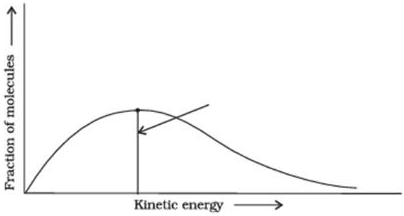
The peak in the following graph refers to-

Figure

Answer options

Q13:

2026: 31 May Shift 2

Chemical Kinetics

Easy

A reaction follows first order kinetics, its rate constant is found to be 4.794×10⁻³ min−14.794 \times 10^{-3}\ min^{-1} at 25° C. The half-life of the reaction is-

Answer options

Q14:

2026: 31 May Shift 2

Chemical Kinetics

Easy

Match the LIST-I with LIST-II.

LIST-I (Parameters)LIST-II (Definition)
A.Rate of reactionI.Rate of the reaction when the concentration of each of the reactant is unity
B.Rate constantII.Change in concentration of reactant or product per unit time
C.Order of a reactionIII.Sum of the powers to which the concentration terms are raised in the rate law.
D.MolecularityIV.Number of reacting species taking part in an elementary reaction
Answer options

Q15:

2026: 31 May Shift 2

Chemical Kinetics

Easy

In the equation, k=Ae−Ea/RTk = Ae^{-E_a/RT}, A is -

A. Arrhenius factor

B. Activated factor

C. Frequency factor

D. pre-exponential factor

E. Order factor

Answer options

Q16:

2026: 31 May Shift 2

Chemical Kinetics

Medium

For the hydrolysis of butyl chloride, the curve is plotted between the concentration of butyl chloride against time (s). Arrange the value of slope of the tangent drawn to the curve at the below given times in increasing order.

A. at t = 450 s.

B. at t = 350 s.

C. at t = 150 s.

D. at t = 250 s.

Answer options

Q17:

2026: 30 May Shift 2

Chemical Kinetics

Medium

Match List-I with List-II.

List-IList-II
Order of a chemical reactionUnit of rate constant
(A) -1/2(I) mol2 L−2 s−1\mathrm{mol^2\,L^{-2}\,s^{-1}}
(B) 3/2(II) s−1\mathrm{s^{-1}}
(C) 1(III) mol−1/2 L1/2 s−1\mathrm{mol^{-1/2}\,L^{1/2}\,s^{-1}}
(D) -1(IV) mol3/2 L−3/2 s−1\mathrm{mol^{3/2}\,L^{-3/2}\,s^{-1}}
Answer options

Q18:

2026: 30 May Shift 2

Chemical Kinetics

Medium

Consider the following statements in reference to the collision theory for chemical reaction. Identify the correct statements.

A+B→Products\mathrm{A + B \rightarrow Products}

(A) Expression for the rate of reaction = PZABe(−Ea/RT)PZ_{AB}e^{(-E_a/RT)}

(B) Collision theory considers the structural aspects of atoms and molecules.

(C) For an effective collision between the reactants, the reactant molecules must possess (i) sufficient kinetic energy called threshold energy and (ii) proper orientation.

(D) e(−Ea/RT)e^{(-E_a/RT)} represents the fraction of molecules with energies less than EaE_a.

Answer options

Q19:

2026: 30 May Shift 2

Chemical Kinetics

Medium

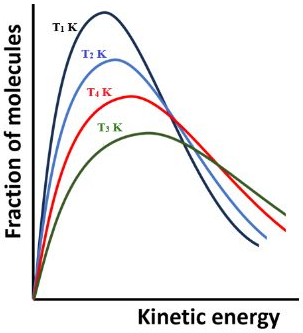
The Maxwell-Boltzmann distribution curve for a specific reaction carried out at various temperatures is shown below:

Figure

Arrange the following temperatures (in K) in the decreasing order of their values.

(A) T1T_1 K

(B) T2T_2 K

(C) T3T_3 K

(D) T4T_4 K

Answer options

Q20:

2026: 30 May Shift 2

Chemical Kinetics

Easy

According to Maxwell- Boltzmann distribution, the maximum in the curve between fraction of molecule (NE/NTN_E/N_T) with a given kinetic energy (E) vs kinetic energy, gives

Answer options

Q21:

2026: 30 May Shift 2

Chemical Kinetics

Medium

The half-life for a zero-order chemical reaction is X/T minutes. How much time will be required by the reaction for the concentration of the reactant to be decreased to 1/3rd of the initial concentration?

Answer options

Q22:

2026: 30 May Shift 1

Chemical Kinetics

Easy

For the reaction

2N2O5(g)⟶4NO2(g)+O2(g)2N_2O_5(g)\longrightarrow 4NO_2(g)+O_2(g)

The rate is expressed as:

Answer options

Q23:

2026: 30 May Shift 1

Chemical Kinetics

Medium

The rate constant of a nuclear decay is k=6.5×10⁻¹⁴ s−1k = 6.5\times10^{-14}\ s^{-1}. Which of the following statements is true for the half-life of the reaction and the time taken for the reaction to go to completion?

Answer options

Q24:

2026: 30 May Shift 1

Chemical Kinetics

Medium

Match the LIST-I with LIST-II.

LIST-I ReactionLIST-II Most appropriate reaction order
A. 2NH3(g)→Pt catalyst1130KN2(g)+3H2(g)2NH_3(g)\xrightarrow[\text{Pt catalyst}]{1130K}N_2(g)+3H_2(g)I. First-order Reaction
B. 88226Ra→24He+86222Rn{}^{226}_{88}Ra\rightarrow{}^{4}_{2}He+{}^{222}_{86}RnII. Second-order Reaction
C. KClO3+6FeSO4+3H2SO4→KCl+3Fe2(SO4)3+3H2OKClO_3+6FeSO_4+3H_2SO_4\rightarrow KCl+3Fe_2(SO_4)_3+3H_2OIII. Zero-order Reaction
D. C12H22O11+H2O→H+C6O12O6+C6O12O6C_{12}H_{22}O_{11}+H_2O\xrightarrow{H^+}C_6O_{12}O_6+C_6O_{12}O_6IV. Pseudo first-order Reaction
Answer options

Q25:

2026: 30 May Shift 1

Chemical Kinetics

Medium

Which of the following statements are correct?

A. The rate constant of a chemical reaction is nearly doubled with a 10°C rise in temperature.

B. A second-order reaction will obey first-order rate law if one of the reactant is taken in excess.

C. Inversion of cane sugar is a pseudo first order reaction.

D. In the concentration of reactant vs time graph of a zero-order reaction, the slope gives the value of the initial concentration of reactant.

Answer options

Q26:

2026: 30 May Shift 1

Chemical Kinetics

Easy

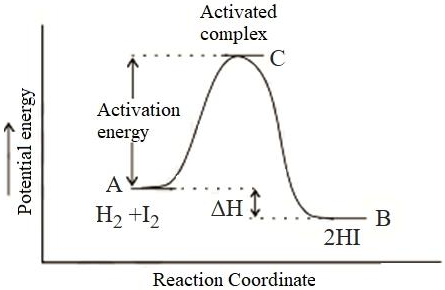
According to the following graph, the given reaction is a

Figure

Answer options

Q27:

2026: 29 May Shift 2

Chemical Kinetics

Medium

Match the LIST-I with LIST-II.

LIST-I Order of reactionLIST-II Example
A.Zero orderI.Decomposition of hydrogen peroxide using iodide ion as catalyst in alkaline medium
B.First orderII.Hydrolysis of ethyl acetate in the presence of acid
C.Pseudo First orderIII.Thermal decomposition of HI on gold surface
D.Second orderIV.Radioactive decay of unstable nuclei.
Answer options

Q28:

2026: 29 May Shift 2

Chemical Kinetics

Easy

Which of the following statements are correct?

A. The overall rate of a reaction is controlled by the slowest step in a reaction.

B. Order of a reaction is an experimental quantity.

C. Molecularity is applicable to elementary as well as complex reactions.

D. The number of reacting species taking part in an elementary reaction is called molecularity of a reaction.

Answer options

Q29:

2026: 29 May Shift 2

Chemical Kinetics

Easy

Which one of the following statements is incorrect regarding a catalyst?

Answer options

Q30:

2026: 29 May Shift 2

Chemical Kinetics

Medium

While systematically calculating the order of the given reaction, 2A+B→C+D2A + B \rightarrow C + D using the data given below, the most appropriate correct sequence of steps (from the below given steps) that should be followed is

Experiment[A] (mol L−1\mathrm{mol\ L^{-1}})[B] (mol L−1\mathrm{mol\ L^{-1}})Initial rate of formation of D (mol L−1 min−1\mathrm{mol\ L^{-1}\ min^{-1}})
I0.10.16.00×10−36.00 \times 10^{-3}
II0.30.27.20×10−27.20 \times 10^{-2}
III0.30.12.88×10−12.88 \times 10^{-1}
IV0.40.42.40×10−22.40 \times 10^{-2}

A. Independently compare the proposed Rate Law equations of experiment II with III, AND of experiment I with IV.

B. Divide the proposed Rate Law equations for experiments I and IV to determine the value of m. Similarly, divide the proposed Rate Law equations for experiments II and III to determine the value of n.

C. Assume the Rate Law equation for the given reaction to be, Rate = k[A]m[B]nk[A]^m [B]^n

D. Add m and n to calculate the numerical value of order of the reaction.

Answer options