Q2:

d & f Block Elements

Hard

Choose the correct statement from the following with reference to the dd- and ff - block elements:

A. Complex compounds having a transition metal in low oxidation states are formed when ligands exhibit π\pi-acceptor and σ\sigma-bonding characters.

B. The melting point of Tc is lower than the Mo but higher than the Ru.

C. Vanadium pentachloride (VCl5\mathrm{VCl_5}) on hydrolysis gives vanadium oxytrichloride (VOCl3\mathrm{VOCl_3}).

D. Alkalies have no action on actinoids.

Answer options
Option 4
Correct Answer
Explanation for 2026: 15 May Shift 1 CHE question 2

Q3:

Biomolecules

Medium

Match the LIST-I with LIST-II.

LIST-I BiomoleculeLIST-II Types of bonds/structural features
A.Nucleic acidsI.Glycosidic bonds between C-1 and C-4 of two β-D-glucose units.
B.CelluloseII.Hydrogen bonding,van der Waals and Disulphide bonds
C.Tertiary structure of proteinsIII.Glycosidic bonds between C-1and C-4 of two α-D-glucose units.
D.AmyloseIV.Phosphodiester bonds
Answer options
Option 4
Correct Answer
Explanation for 2026: 15 May Shift 1 CHE question 3

Q4:

Solutions

Medium

Match the LIST-I with LIST-II.

LIST-ILIST-II
A.AnoxiaI.Non-ideal solution with negative deviation.
B.Cellulose acetateII.Henry's Law
C.Ethanol and acetone solutionIII.Reverse Osmosis
D.Phenol and aniline solutionIV.Non-ideal solution with positive deviation.
Answer options
Option 3
Correct Answer
Explanation for 2026: 15 May Shift 1 CHE question 4

Q5:

Haloalkanes & Haloarenes

Easy

Predict the decreasing order of rate of reaction of the following compounds which is progressing via SN2\mathrm{S_N2} pathway ?

A. CH3CH2CH2I\mathrm{CH_3CH_2CH_2I}

B. CH3CH2CH2Cl\mathrm{CH_3CH_2CH_2Cl}

C. CH3CH2CH2Br\mathrm{CH_3CH_2CH_2Br}

D. CH3CH2CH2F\mathrm{CH_3CH_2CH_2F}

Answer options
Option 2
Correct Answer
Explanation for 2026: 15 May Shift 1 CHE question 5

Q6:

d & f Block Elements

Easy

Which of the following ions will be coloured in an aqueous solution?

Answer options
Option 4
Correct Answer
Explanation for 2026: 15 May Shift 1 CHE question 6

Q7:

Haloalkanes & Haloarenes

Easy

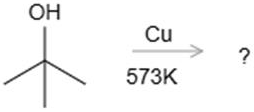
Identify the alkane which on photochemical chlorination yields a single mono chloro product .

Answer options
Option 2
Correct Answer
Explanation for 2026: 15 May Shift 1 CHE question 7

Q8:

Coordination Compounds

Easy

The value of spin only magnetic moment for the complex, [Pt(CN)4]2−[\mathrm{Pt(CN)_4}]^{2-} is..........

Answer options
Option 1
Correct Answer
Explanation for 2026: 15 May Shift 1 CHE question 8

Q9:

Amines

Easy

Which of the following reactions/tests can be used to distinguish between primary, secondary and tertiary amines?

Answer options
Option 3
Correct Answer
Explanation for 2026: 15 May Shift 1 CHE question 9

Q10:

Electrochemistry

Easy

Match the LIST-I with LIST-II.

LIST-I ElectrolyteLIST-II Cell/Battery
A.Moist paste of NH4Cl\mathrm{NH_4Cl} and ZnCl2\mathrm{ZnCl_2}.I.Fuel cell.
B.Paste of KOH and ZnO.II.Lead storage battery.
C.38% solution of H2SO4\mathrm{H_2SO_4}.III.Mercury cell.
D.Concentrated aqueous sodium hydroxide solution.IV.Lechlanche cell.
Answer options

Q14:

d & f Block Elements

Medium

Which of the following sets of oxometal ions of the 3dd series, shows the transition metals ion oxidation number equal to its group number?

Answer options

Q15:

Coordination Compounds

Easy

Which of the following is an example of a spin-free complex?

Answer options

Q16:

Amines

Medium

Read the following statements and identify the correct ones:

A. Gabriel phthalimide synthesis is preferred for secondary amines only.

B. Aniline doesn't undergo Friedel-Craft's reaction.

C. Methylamine in water doesn't precipitate ferric ions from ferric chloride.

D. Azo dyes are formed as a result of a coupling reaction of aryl dizaonium salts with phenols and arylamines.

Answer options

Q17:

Haloalkanes & Haloarenes

Easy

Which halogen compound is used as a spot remover, cleaning fluid and as fire extinguisher?

Answer options

Q18:

Amines

Medium

Arrange the following amines in the decreasing order of their basicity in aqueous phase.

A. C2H5NH2\mathrm{C_2H_5NH_2}

B. C6H5NHCH3\mathrm{C_6H_5NHCH_3}

C. (C2H5)2NH\mathrm{(C_2H_5)_2NH}

D. C6H5NH2\mathrm{C_6H_5NH_2}

Answer options

Q20:

Electrochemistry

Easy

Given are the standard electrode potentials:

A. I2/I−\mathrm{I_2/I^-} = +0.54 V

B. Fe3+/Fe2+\mathrm{Fe^{3+}/Fe^{2+}} = +0.77 V

C. Cu+/Cu\mathrm{Cu^+/Cu} = +0.52 V

D. Ag+/Ag\mathrm{Ag^+/Ag} = +0.80 V

Arrange these redox couples in the increasing order of oxidizing strength.

Answer options

Q21:

Solutions

Medium

Based on solute-solvent interactions, arrange the following in order of increasing solubility in n-octane.

A. Cyclohexane

B. Potassium chloride

C. Methanol

D. Acetonitrile

Answer options

Q22:

Aldehydes, Ketones & Carboxylic Acids

Easy

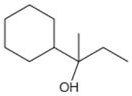
Give IUPAC name of the following compound:
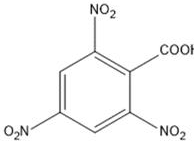
Figure

Answer options

Q23:

d & f Block Elements

Hard

In a faintly alkaline medium, the thiosulphate ion is oxidized to a sulphate ion as per the following reaction:

aMnO4−+bS2O32−+cH2O→aMnO2+xSO42−+yHO−\mathrm{aMnO_4^- + bS_2O_3^{2-} + cH_2O \rightarrow aMnO_2 + xSO_4^{2-} + yHO^-}

What is the value of the following equation?

2a+29b−32y2a+\frac{2}{9}b-\frac{3}{2}y

Answer options

Q24:

Solutions

Medium

Vapour pressure of water at 293 K is 17.535 mm Hg. The vapour pressure of solution after adding 8.28 g of urea in 450 g of water will be

Given: Molar mass of urea is 60 g mol−1\mathrm{mol^{-1}} and assume the solution to be dilute.

Answer options

Q25:

Biomolecules

Easy

Match the LIST-I with LIST-II.

LIST-I Function of HormoneLIST-II Hormone
A.Control carbohydrate metabolismI.Glucocorticoids
B.Maintains Glucose levelII.Norepinephrine
C.Implantation of fertilised eggIII.Insulin
D.Mediate response to external stimuliIV.Progesterone
Answer options

Q26:

Solutions

Medium

Which of the following statements are correct in regard to non-ideal binary solution (X) showing negative deviations from Raoult's law?

A. The vapour pressure of X is lower than that predicted by Raoult’s law.

B. A mixture of chloroform and acetone forms a solution with negative deviation from Raoult’s law.

C. The intermolecular attractive forces between A-A and B-B are weaker than those between A-B.

D. (ΔV)mixing=0(\Delta V)_{\text{mixing}} = 0

Answer options

Q27:

Electrochemistry

Easy

What will be the potential of a hydrogen electrode at 298 K in contact with a solution whose pH is 2 and the pressure of dihydrogen gas is maintained at 1 bar?

Answer options

Q28:

d & f Block Elements

Medium

Match the LIST-I with LIST-II.

LIST-I CompoundLIST-II Application
A.TiOI.Oxidation of ethyne
B.MnO2\mathrm{MnO_2}II.Pigment Industry
C.TiCl4\mathrm{TiCl_4} and Al(CH3)3\mathrm{Al(CH_3)_3}III.Dry battery cells
D.PdCl2\mathrm{PdCl_2}IV.Polyethene formation
Answer options

Q29:

Biomolecules

Easy

A patient visited a doctor with a complaint of bleeding gums. This medical condition arose due to deficiency of which vitamin?

Answer options

Q30:

Coordination Compounds

Easy

In black and white photography, the developed film is fixed by washing with hypo solution which helps in dissolving the remaining AgBr by forming a complex ion. What is the correct formula of the complex ion?

Answer options

Q31:

Electrochemistry

Medium

The correct representation of the Nernst equation for the following electrochemical cell at 298 K:

Pt(s)∣Cl2(g) (1 bar)∣Cl− (0.01M)∥H+(0.001M)∣H2(g) (0.5 bar)∣Pt(s)\mathrm{Pt(s) \mid Cl_2(g)\,(1\ bar) \mid Cl^-\,(0.01M) \Vert H^+(0.001M) \mid H_2(g)\,(0.5\ bar) \mid Pt(s)}

Answer options

Q32:

Coordination Compounds

Easy

The correct IUPAC name of the following complex compound

[Ag(NH3)2][Ag(CN)2][\mathrm{Ag(NH_3)_2}][\mathrm{Ag(CN)_2}] is:

Answer options

Q33:

Coordination Compounds

Medium

Arrange the following in decreasing order of the wavenumber of absorption in the visible region:

A. [Ni(CN)6]4−[\mathrm{Ni(CN)_6}]^{4-}

B. [Ni(H2O)6]2+[\mathrm{Ni(H_2O)_6}]^{2+}

C. [Ni(NH3)6]2+[\mathrm{Ni(NH_3)_6}]^{2+}

D. [Ni(en)3]2+[\mathrm{Ni(en)_3}]^{2+}

Answer options

Q35:

Biomolecules

Medium

With reference to the cyclic structure of glucose, which of the following are correct statements ?

A. Glucose does not give Schiff's test.

B. Glucose forms the hydrogen sulphite addition product with NaHSO3\mathrm{NaHSO_3}.

C. The melting point of the α-form of glucose is 419 K whereas the β-form is 423 K.

D. The existence of α-form and β-form of glucose explains the presence of the free ketonic group.

Answer options

Q37:

Electrochemistry

Medium

Which of the following statements are true with reference to the variation of conductivity and molar conductivity as concentration changes?

A. Conductivity decreases with decrease in concentration for weak electrolytes.

B. Conductivity decreases with decrease in concentration for strong electrolytes.

C. Molar conductivity increases slowly with dilution for weak electrolyte.

D. Molar conductivity increases steeply with dilution for strong electrolyte.

Answer options

Q38:

Alcohols, Phenols & Ethers

Easy

Secondary and tertiary alcohols are not favoured for the preparation of ether via dehydration at elevated temperature in the presence of sulfuric acid because

Answer options

Q41:

Chemical Kinetics

Medium

Rate of Chemical Reaction

Chemical reactions are the simplest way to convert one substance into the other substance. The feasibility of a chemical reaction is decided by the concepts of chemical thermodynamics under a defined set of conditions. The extent of a chemical reaction is determined by the principles of chemical equilibrium. But the information that remains undisclosed is the speed or rate of a chemical reaction, path or mechanism of a chemical reaction, time taken for a reaction to attain a state of equilibrium, factors controlling the rate of reaction etc. This information pertaining to the study of a chemical reaction is very pivotal, and it helps in understanding the nature (slow or fast nature) of a chemical reaction. The kinetics of a chemical reaction can be understood with the help of average rate of reaction or a differential rate law or an integrated rate law. There are various factors on which the rate of a chemical reaction depends viz. nature of reactants, temperature, catalyst, pressure and concentration of reactants and products (rate law expression).

Which of the following expressions correctly represents the rate of the following reaction?

5Br−(aq)+BrO3−(aq)+6H+(aq)⟶3Br2(l)+3H2O(l)5Br^-(aq) + BrO_3^-(aq) + 6H^+(aq) \longrightarrow 3Br_2(l) + 3H_2O(l)

Answer options

Q42:

Chemical Kinetics

Easy

Rate of Chemical Reaction

Chemical reactions are the simplest way to convert one substance into the other substance. The feasibility of a chemical reaction is decided by the concepts of chemical thermodynamics under a defined set of conditions. The extent of a chemical reaction is determined by the principles of chemical equilibrium. But the information that remains undisclosed is the speed or rate of a chemical reaction, path or mechanism of a chemical reaction, time taken for a reaction to attain a state of equilibrium, factors controlling the rate of reaction etc. This information pertaining to the study of a chemical reaction is very pivotal, and it helps in understanding the nature (slow or fast nature) of a chemical reaction. The kinetics of a chemical reaction can be understood with the help of average rate of reaction or a differential rate law or an integrated rate law. There are various factors on which the rate of a chemical reaction depends viz. nature of reactants, temperature, catalyst, pressure and concentration of reactants and products (rate law expression).

What is the maximum possible value of molecularity for an elementary reaction?

Answer options

Q43:

Chemical Kinetics

Easy

Rate of Chemical Reaction

Chemical reactions are the simplest way to convert one substance into the other substance. The feasibility of a chemical reaction is decided by the concepts of chemical thermodynamics under a defined set of conditions. The extent of a chemical reaction is determined by the principles of chemical equilibrium. But the information that remains undisclosed is the speed or rate of a chemical reaction, path or mechanism of a chemical reaction, time taken for a reaction to attain a state of equilibrium, factors controlling the rate of reaction etc. This information pertaining to the study of a chemical reaction is very pivotal, and it helps in understanding the nature (slow or fast nature) of a chemical reaction. The kinetics of a chemical reaction can be understood with the help of average rate of reaction or a differential rate law or an integrated rate law. There are various factors on which the rate of a chemical reaction depends viz. nature of reactants, temperature, catalyst, pressure and concentration of reactants and products (rate law expression).

The figure given below shows a plot of potential energy vs reaction coordinate. Which of the following option is true in regard to the reaction represented by the given diagram?
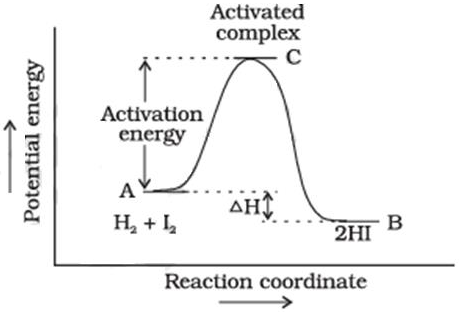
Figure

Answer options

Q44:

Chemical Kinetics

Medium

Rate of Chemical Reaction

Chemical reactions are the simplest way to convert one substance into the other substance. The feasibility of a chemical reaction is decided by the concepts of chemical thermodynamics under a defined set of conditions. The extent of a chemical reaction is determined by the principles of chemical equilibrium. But the information that remains undisclosed is the speed or rate of a chemical reaction, path or mechanism of a chemical reaction, time taken for a reaction to attain a state of equilibrium, factors controlling the rate of reaction etc. This information pertaining to the study of a chemical reaction is very pivotal, and it helps in understanding the nature (slow or fast nature) of a chemical reaction. The kinetics of a chemical reaction can be understood with the help of average rate of reaction or a differential rate law or an integrated rate law. There are various factors on which the rate of a chemical reaction depends viz. nature of reactants, temperature, catalyst, pressure and concentration of reactants and products (rate law expression).

The rate constants of a reaction at 700 K and 500 K are 0.07 s−1\mathrm{s^{-1}} and 0.02 s−1\mathrm{s^{-1}} respectively. What is the value of activation energy of the reaction?

(Given: log 7 = 0.8451, log 2 = 0.3010)

Answer options

Q45:

Chemical Kinetics

Easy

Rate of Chemical Reaction

Chemical reactions are the simplest way to convert one substance into the other substance. The feasibility of a chemical reaction is decided by the concepts of chemical thermodynamics under a defined set of conditions. The extent of a chemical reaction is determined by the principles of chemical equilibrium. But the information that remains undisclosed is the speed or rate of a chemical reaction, path or mechanism of a chemical reaction, time taken for a reaction to attain a state of equilibrium, factors controlling the rate of reaction etc. This information pertaining to the study of a chemical reaction is very pivotal, and it helps in understanding the nature (slow or fast nature) of a chemical reaction. The kinetics of a chemical reaction can be understood with the help of average rate of reaction or a differential rate law or an integrated rate law. There are various factors on which the rate of a chemical reaction depends viz. nature of reactants, temperature, catalyst, pressure and concentration of reactants and products (rate law expression).

Identify the incorrect statement from the following.

Answer options

Q46:

Aldehydes, Ketones & Carboxylic Acids

Easy

Carboxylic Acids: Types of Reactions

Carboxylic acid exhibits a number of reactions depending on the involvement of a specific part of the -COOH group. It mainly includes nucleophilic acyl substitution reaction, in which a hydroxy group of -COOH is replaced by another nucleophile, and the acidic behavior of carboxylic acids, which is due to the cleavage of O-H bond in -COOH group. The former reaction leads to the conversion of carboxylic acid into a variety of different derivatives/categories of organic compounds, whereas the later converts it into salts which find applications in many industries, like soap and detergent synthesis and pharmaceutical industries. Other important types of chemical reactions involve reduction of -COOH group, decarboxylation, electrolysis and substitution reactions in the hydrocarbon part at α-carbon atom.

Which of the following carboxylic acid has the highest pKa\mathrm{pK_a} value?

Answer options

Q47:

Aldehydes, Ketones & Carboxylic Acids

Easy

Carboxylic Acids: Types of Reactions

Carboxylic acid exhibits a number of reactions depending on the involvement of a specific part of the -COOH group. It mainly includes nucleophilic acyl substitution reaction, in which a hydroxy group of -COOH is replaced by another nucleophile, and the acidic behavior of carboxylic acids, which is due to the cleavage of O-H bond in -COOH group. The former reaction leads to the conversion of carboxylic acid into a variety of different derivatives/categories of organic compounds, whereas the later converts it into salts which find applications in many industries, like soap and detergent synthesis and pharmaceutical industries. Other important types of chemical reactions involve reduction of -COOH group, decarboxylation, electrolysis and substitution reactions in the hydrocarbon part at α-carbon atom.

Which of the following reagent is most preferred for converting RCOOH into RCOCl ?

Answer options

Q48:

Aldehydes, Ketones & Carboxylic Acids

Easy

Carboxylic Acids: Types of Reactions

Carboxylic acid exhibits a number of reactions depending on the involvement of a specific part of the -COOH group. It mainly includes nucleophilic acyl substitution reaction, in which a hydroxy group of -COOH is replaced by another nucleophile, and the acidic behavior of carboxylic acids, which is due to the cleavage of O-H bond in -COOH group. The former reaction leads to the conversion of carboxylic acid into a variety of different derivatives/categories of organic compounds, whereas the later converts it into salts which find applications in many industries, like soap and detergent synthesis and pharmaceutical industries. Other important types of chemical reactions involve reduction of -COOH group, decarboxylation, electrolysis and substitution reactions in the hydrocarbon part at α-carbon atom.

Identify the correct product of the following reaction:
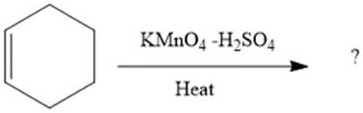
Figure

Answer options

Q49:

Aldehydes, Ketones & Carboxylic Acids

Hard

Carboxylic Acids: Types of Reactions

Carboxylic acid exhibits a number of reactions depending on the involvement of a specific part of the -COOH group. It mainly includes nucleophilic acyl substitution reaction, in which a hydroxy group of -COOH is replaced by another nucleophile, and the acidic behavior of carboxylic acids, which is due to the cleavage of O-H bond in -COOH group. The former reaction leads to the conversion of carboxylic acid into a variety of different derivatives/categories of organic compounds, whereas the later converts it into salts which find applications in many industries, like soap and detergent synthesis and pharmaceutical industries. Other important types of chemical reactions involve reduction of -COOH group, decarboxylation, electrolysis and substitution reactions in the hydrocarbon part at α-carbon atom.

Oxidation of 5-methylhexan-3-one using strong oxidising agent KMnO4\mathrm{KMnO_4} results in formation of which of the following mixture of acids ?

Answer options

Q50:

Aldehydes, Ketones & Carboxylic Acids

Easy

Carboxylic Acids: Types of Reactions

Carboxylic acid exhibits a number of reactions depending on the involvement of a specific part of the -COOH group. It mainly includes nucleophilic acyl substitution reaction, in which a hydroxy group of -COOH is replaced by another nucleophile, and the acidic behavior of carboxylic acids, which is due to the cleavage of O-H bond in -COOH group. The former reaction leads to the conversion of carboxylic acid into a variety of different derivatives/categories of organic compounds, whereas the later converts it into salts which find applications in many industries, like soap and detergent synthesis and pharmaceutical industries. Other important types of chemical reactions involve reduction of -COOH group, decarboxylation, electrolysis and substitution reactions in the hydrocarbon part at α-carbon atom.

Which of the following will give Cannizzaro reaction?

Answer options

CUET Chemistry 2026 15 May Shift 1 Past Year Question Paper

Every question from the CUET Chemistry 2026 15 May Shift 1 paper is here in full, with the correct answer and a step by step solution for each one. It is completely free, there is no login and no paywall, and you can read the whole paper online or download it to revise offline.

You can also attempt it instead of only reading it. Take the paper as a full length mock under exam conditions, or filter it by topic and attempt just that topic as a topic test. Both are free, and you get a breakdown of your accuracy, your timing and your weak areas once you submit.

CUET Chemistry past year questions (PYQs) are the closest thing to the real exam, so working through them is the quickest way to learn the paper pattern, the marking scheme and the level of difficulty to expect on the day.