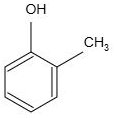
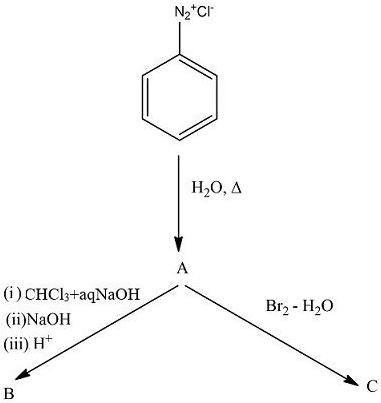
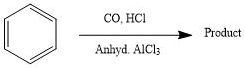
Q1:

Electrochemistry

Easy

Consider the following statements. Identify the correct statements.

(A) The cell constant is usually determined by measuring the resistance of the cell containing a solution whose conductivity is already known.

(B) The SI unit of molar conductivity is S m2 mol−1\mathrm{S\,m^2\,mol^{-1}}.

(C) The conductivity of solutions of different electrolytes in the same solvent and at a given temperature differs due to charge and size of the ions in which they dissociate, the concentration of ions or ease with which the ions move under a potential gradient.

(D) The conductance of electricity by ions present in the solutions is called metallic conductance.

Answer options
Option 2
Correct Answer
Explanation for 2026: 30 May Shift 2 CHE question 1

Q2:

Chemical Kinetics

Medium

Match List-I with List-II.

List-IList-II
Order of a chemical reactionUnit of rate constant
(A) -1/2(I) mol2 L−2 s−1\mathrm{mol^2\,L^{-2}\,s^{-1}}
(B) 3/2(II) s−1\mathrm{s^{-1}}
(C) 1(III) mol−1/2 L1/2 s−1\mathrm{mol^{-1/2}\,L^{1/2}\,s^{-1}}
(D) -1(IV) mol3/2 L−3/2 s−1\mathrm{mol^{3/2}\,L^{-3/2}\,s^{-1}}
Answer options
Option 2
Correct Answer
Explanation for 2026: 30 May Shift 2 CHE question 2

Q3:

Electrochemistry

Easy

Arrange the following redox couple in increasing order of their oxidising strength. The standard electrode potential of the redox couples are given in table.

Redox coupleStandard electrode potential (Xn+/X\mathrm{X^{n+}/X})
(A)0.79 V
(B)0.20 V
(C)-0.14 V
(D)-0.34 V
Answer options
Option 4
Correct Answer
Explanation for 2026: 30 May Shift 2 CHE question 3

Q4:

Amines

Medium

The primary amine is obtained by reduction of −NO2-\mathrm{NO_2} group using scrap iron and HCl (in small amounts) because:

Answer options
Option 1
Correct Answer
Explanation for 2026: 30 May Shift 2 CHE question 4

Q6:

Coordination Compounds

Easy

During the metallurgy of gold, from which solution gold is separated in metallic form?

Answer options
Option 1
Correct Answer
Explanation for 2026: 30 May Shift 2 CHE question 6

Q7:

Electrochemistry

Easy

Conductivity of an electrolytic solution increases with increase in concentration. It is due to...

Answer options
Option 1
Correct Answer
Explanation for 2026: 30 May Shift 2 CHE question 7

Q9:

Chemical Kinetics

Medium

Consider the following statements in reference to the collision theory for chemical reaction. Identify the correct statements.

A+B→Products\mathrm{A + B \rightarrow Products}

(A) Expression for the rate of reaction = PZABe(−Ea/RT)PZ_{AB}e^{(-E_a/RT)}

(B) Collision theory considers the structural aspects of atoms and molecules.

(C) For an effective collision between the reactants, the reactant molecules must possess (i) sufficient kinetic energy called threshold energy and (ii) proper orientation.

(D) e(−Ea/RT)e^{(-E_a/RT)} represents the fraction of molecules with energies less than EaE_a.

Answer options
Option 4
Correct Answer
Explanation for 2026: 30 May Shift 2 CHE question 9

Q10:

Coordination Compounds

Medium

Select the Incorrect staement from the following:

Answer options

Q14:

Alcohols, Phenols & Ethers

Easy

Arrange following alcohols in increasing order of ease of dehydration:

(A) (CH3)3C−OH\mathrm{(CH_3)_3C{-}OH}

(B) (CH3)2CH−OH\mathrm{(CH_3)_2CH{-}OH}

(C) CH3CH2CH2−OH\mathrm{CH_3CH_2CH_2{-}OH}

Answer options

Q15:

Alcohols, Phenols & Ethers

Medium

Consider the following statements with reference to alcohols. Choose the correct statements.

(A) Dehydration of tertiary alcohols using Cu-metal at 573 K forms an alkene.

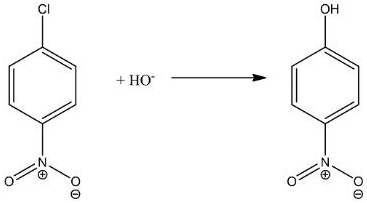
(B) p-Nitrophenol is steam volatile so it can distilled over o-nitrophenol.

(C) Friedel-Crafts acylation of anisole forms 4-methoxyacetophenone as the major product.

(D) During esterification of an alcohol with a carboxylic acid in presence of an acid, removal of water is essential.

Answer options

Q16:

Haloalkanes & Haloarenes

Easy

In the following chemical reaction, the major product obtained will be:

RMgBr+D2O→\mathrm{RMgBr + D_2O \rightarrow}

Answer options

Q17:

Chemical Kinetics

Medium

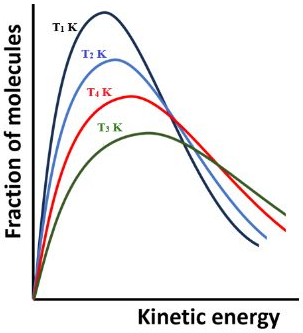
The Maxwell-Boltzmann distribution curve for a specific reaction carried out at various temperatures is shown below:

Figure

Arrange the following temperatures (in K) in the decreasing order of their values.

(A) T1T_1 K

(B) T2T_2 K

(C) T3T_3 K

(D) T4T_4 K

Answer options

Q18:

Haloalkanes & Haloarenes

Easy

The poisonous gas phosgene is obtained when sunlight and oxygen react with which of the following polyhalogen compound?

Answer options

Q19:

Alcohols, Phenols & Ethers

Medium

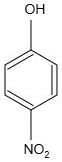
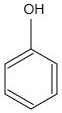
Arrange following alcohols in increasing order of their pKa\mathrm{pK_a} values.

(A)

Figure

(B)

Figure

(C)

Figure

(D) CH3CH2OH\mathrm{CH_3CH_2OH}

Answer options

Q20:

d & f Block Elements

Medium

Select the incorrect statement from the following:

Answer options

Q21:

Amines

Medium

Which of the following chemical tests can be used to distinguish between aniline and benzylamine?

Answer options

Q22:

Alcohols, Phenols & Ethers

Medium

Consider the following reaction chart and identify the correct products of the following reaction sequence:

Figure

Answer options

Q23:

Electrochemistry

Medium

Consider the following electrochemical cell reaction:

Mg (s)+2Ag+(aq, 0.1 M)→Mg2+ (aq, 0.01 M)+2Ag (s)\mathrm{Mg\,(s) + 2Ag^+(aq,\ 0.1\ M) \rightarrow Mg^{2+}\,(aq,\ 0.01\ M) + 2Ag\,(s)}

The emf of the cell in Volts is

(E(cell)∘=3.17E^\circ_{(\mathrm{cell})} = 3.17 V)

Answer options

Q24:

Coordination Compounds

Easy

In an experiment, the measured value of Δo\Delta_o for an octahedral complex [ML6]n+\mathrm{[ML_6]^{n+}} is found to be 18000 cm−1\mathrm{cm^{-1}}. Calculate the value of Δt\Delta_t for a tetrahedral complex [ML4]n+\mathrm{[ML_4]^{n+}}.

Answer options

Q25:

Biomolecules

Easy

The steroid hormones are produced by which of the following glands in the human body?

Answer options

Q26:

Coordination Compounds

Medium

Match List-I with List-II.

List-IList-II
COMPOUNDMAGNETIC MOMENT, HYBRIDIZATION
(A) [MnCl4]2−\mathrm{[MnCl_4]^{2-}}(I) 0.0 BM, d2sp3d^2sp^3
(B) [Cr(CO)6]\mathrm{[Cr(CO)_6]}(II) 5.92 BM, sp3sp^3
(C) [FeCl6]4−\mathrm{[FeCl_6]^{4-}}(III) 0.0 BM, dsp2dsp^2
(D) [Ni(CN)4]2−\mathrm{[Ni(CN)_4]^{2-}}(IV) 4.90 BM, sp3d2sp^3d^2
Answer options

Q27:

Biomolecules

Easy

Match List-I with List-II

List-IList-II
(A) Glucose(I) Aldotriose
(B) Glyceraldehyde(II) Aldohexose
(C) Fructose(III) Ketotriose
(D) Dihydroxyacetone(IV) Ketohexose
Answer options

Q28:

Chemical Kinetics

Easy

According to Maxwell- Boltzmann distribution, the maximum in the curve between fraction of molecule (NE/NTN_E/N_T) with a given kinetic energy (E) vs kinetic energy, gives

Answer options

Q29:

Amines

Easy

Why are arenediazonium salts stable for a short time in solution at low temperatures?

Answer options

Q30:

Chemical Kinetics

Medium

The half-life for a zero-order chemical reaction is X/T minutes. How much time will be required by the reaction for the concentration of the reactant to be decreased to 1/3rd of the initial concentration?

Answer options

Q32:

Haloalkanes & Haloarenes

Medium

Read the following statements carefully and identify the incorrect statement:

Answer options

Q33:

d & f Block Elements

Hard

Consider and select the correct statement from the following with reference to the ionization enthalpy (IE) values of the 3d series of transition elements:

(A) IE3\mathrm{IE_3} of Zn is greater than IE3\mathrm{IE_3} of Cu.

(B) IE3\mathrm{IE_3} of Mn is greater than IE3\mathrm{IE_3} of Fe.

(C) IE2\mathrm{IE_2} of Mn is greater than IE2\mathrm{IE_2} of Cr.

(D) IE2\mathrm{IE_2} of Cr is greater than IE2\mathrm{IE_2} of V.

Answer options

Q34:

Alcohols, Phenols & Ethers

Easy

Phenol, upon treatment with concentrated sulfuric acid, yields a compound (X), which upon reaction with concentrated nitric acid forms (Z). Identify compound (Z).

Answer options

Q35:

Amines

Easy

Match List-I with List-II.

List-IList-II
Name ReactionsSubstrates/ Reagents
(A) Hoffmann bromamide degradation reaction(I)Conversion of benzene diazonium salt into haloarene using Cu2X2\mathrm{Cu_2X_2}/(HX, X = Cl or Br).
(B) Gabriel phthalimide synthesis(II) Conversion of benzene diazonium salt into haloarene using Cu/(HX, X = Cl or Br).
(C) Gattermann reaction(III) Preparation of primary amines by the action of primary alkyl halides on phthalimide in aq KOH.
(D) Sandmeyer reaction(IV) Synthesis of primary amines from an acid amide.
Answer options

Q36:

Haloalkanes & Haloarenes

Medium

Which of the following haloalkanes will give a racemic modification on reaction with aqueous NaOH ?

(A) Benzyl Bromide

(B) Vinyl Bromide

(C) 2-Bromo-2-methylpropane

(D) 2-Bromo-2-methylbutane

Answer options

Q37:

Coordination Compounds

Medium

Which of the following complex will be repelled by the applied magnetic field?

Answer options

Q38:

Electrochemistry

Medium

Match List-I with List-II.

List-IList-II
ProcessMain products of electrolysis
(A) Electrolysis of molten NaCl(I) S2O82−\mathrm{S_2O_8^{2-}} (aq)
(B) Electrolysis of NaCl (aq)(II) Sodium metal and Cl2\mathrm{Cl_2} gas
(C) Electrolysis of dilute H2SO4\mathrm{H_2SO_4}(III) Sodium hydroxide, Cl2\mathrm{Cl_2} and H2\mathrm{H_2} gas
(D) Electrolysis of concentrated H2SO4\mathrm{H_2SO_4}(IV) O2\mathrm{O_2} gas
Answer options

Q39:

d & f Block Elements

Medium

Arrange the following d-block elements in increasing order of number of their valence shell d-electrons:

(A) Pt

(B) Mo

(C) Ni

(D) Pd

Answer options

Q40:

d & f Block Elements

Medium

Vanadium pentachloride undergoes hydrolysis so that

Answer options

Q41:

Solutions

Easy

Colligative Properties

Vapour pressure of a solution decreases when a non-volatile solute is added to a volatile solvent. There are many properties of solutions which are connected with this decrease of vapour pressure. These are: (1) relative lowering of vapour pressure of the solvent (2) depression of freezing point of the solvent (3) elevation of boiling point of the solvent and (4) osmotic pressure of the solution. All these properties depend on the number of solute particles irrespective of their nature relative to the total number of particles present in the solution. Such properties are called colligative properties.

18 g of glucose, C6H12O6\mathrm{C_6H_{12}O_6}, is dissolved in 1 kg of water. What is the boiling point elevation of the given solution? KbK_b for water is 0.52 K kg mol−1\mathrm{mol^{-1}}.

Answer options

Q42:

Solutions

Easy

Colligative Properties

Vapour pressure of a solution decreases when a non-volatile solute is added to a volatile solvent. There are many properties of solutions which are connected with this decrease of vapour pressure. These are: (1) relative lowering of vapour pressure of the solvent (2) depression of freezing point of the solvent (3) elevation of boiling point of the solvent and (4) osmotic pressure of the solution. All these properties depend on the number of solute particles irrespective of their nature relative to the total number of particles present in the solution. Such properties are called colligative properties.

Which one of the following aqueous solutions will boil at the highest temperature?

Answer options

Q43:

Solutions

Easy

Colligative Properties

Vapour pressure of a solution decreases when a non-volatile solute is added to a volatile solvent. There are many properties of solutions which are connected with this decrease of vapour pressure. These are: (1) relative lowering of vapour pressure of the solvent (2) depression of freezing point of the solvent (3) elevation of boiling point of the solvent and (4) osmotic pressure of the solution. All these properties depend on the number of solute particles irrespective of their nature relative to the total number of particles present in the solution. Such properties are called colligative properties.

An aqueous solution of sodium chloride has vapor pressure

Answer options

Q44:

Solutions

Easy

Colligative Properties

Vapour pressure of a solution decreases when a non-volatile solute is added to a volatile solvent. There are many properties of solutions which are connected with this decrease of vapour pressure. These are: (1) relative lowering of vapour pressure of the solvent (2) depression of freezing point of the solvent (3) elevation of boiling point of the solvent and (4) osmotic pressure of the solution. All these properties depend on the number of solute particles irrespective of their nature relative to the total number of particles present in the solution. Such properties are called colligative properties.

Which of the following is an example of a synthetic semi-permeable membrane?

Answer options

Q45:

Solutions

Easy

Colligative Properties

Vapour pressure of a solution decreases when a non-volatile solute is added to a volatile solvent. There are many properties of solutions which are connected with this decrease of vapour pressure. These are: (1) relative lowering of vapour pressure of the solvent (2) depression of freezing point of the solvent (3) elevation of boiling point of the solvent and (4) osmotic pressure of the solution. All these properties depend on the number of solute particles irrespective of their nature relative to the total number of particles present in the solution. Such properties are called colligative properties.

The osmotic pressure of a solution is directly proportional to

Answer options

Q46:

Aldehydes, Ketones & Carboxylic Acids

Medium

Nucleophilic Addition Reactions

Organic compounds containing carbon-oxygen double bond (>C=O ) are called carbonyl group, which is one of the most important functional group in organic chemistry. In aldehydes, the carbonyl group is bonded to a carbon and hydrogen while in ketones, it is bonded to two carbon atoms.The carbonyl compounds in which carbon of carbonyl group is bonded to carbon or hydrogen and oxygen of hydroxyl moiety (-OH) are known as carboxylic acids , while in compounds where carbon is attached to carbon or hydrogen and nitrogen of −NH2-\mathrm{NH_2} moiety or to halogens are called amides and acyl halides respectively. Aldehydes, ketones, and carboxylic acids are widespeard in plants and animal kingdom. They add fragrance and flavour to nature, for example, vanillin ( from vanilla bean), salicylaldehyde ( from meadow sweet ) and cinnamaldehye ( cinnamon) have pleasant fragrances.

The carbonyl carbon atom is sp2-hybridised and forms three sigma ( σ\sigma ) bonds. The fourth valence electron of carbon remains in its p-orbital and forms a π\pi-bond with oxygen by overlap with p-orbital of an oxygen. In addition , the oxygen atom also has two non bonding electron pairs. Thus, the carbonyl carbon and the three atoms attached to it lie in the same plane and the π\pi-electron cloud is above and below this plane. The bond angles are approximately 1200120^0 and trigonal coplanar structure.

The carbon-oygen double bond is polarised due to higher electronegativity of oxygen relative to carbon. Hence, the carbonyl carbon is an electrophilic (Lewis acid), and carbonyl oxygen , a nucleophilic (Lewis base) centre. Carbonyl compounds have substantial dipole moments and are polar than ethers. Aldehydye and ketone can be prepared by by oxidation of alcohols, dehydrogenation of alcohols, and ozonolysis of alkenes etc.

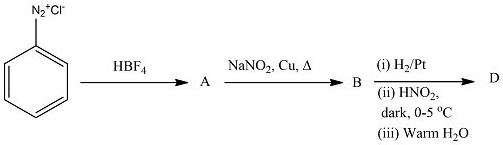
The structure of vanillin is

Answer options

Q47:

Aldehydes, Ketones & Carboxylic Acids

Easy

Nucleophilic Addition Reactions

Organic compounds containing carbon-oxygen double bond (>C=O ) are called carbonyl group, which is one of the most important functional group in organic chemistry. In aldehydes, the carbonyl group is bonded to a carbon and hydrogen while in ketones, it is bonded to two carbon atoms.The carbonyl compounds in which carbon of carbonyl group is bonded to carbon or hydrogen and oxygen of hydroxyl moiety (-OH) are known as carboxylic acids , while in compounds where carbon is attached to carbon or hydrogen and nitrogen of −NH2-\mathrm{NH_2} moiety or to halogens are called amides and acyl halides respectively. Aldehydes, ketones, and carboxylic acids are widespeard in plants and animal kingdom. They add fragrance and flavour to nature, for example, vanillin ( from vanilla bean), salicylaldehyde ( from meadow sweet ) and cinnamaldehye ( cinnamon) have pleasant fragrances.

The carbonyl carbon atom is sp2-hybridised and forms three sigma ( σ\sigma ) bonds. The fourth valence electron of carbon remains in its p-orbital and forms a π\pi-bond with oxygen by overlap with p-orbital of an oxygen. In addition , the oxygen atom also has two non bonding electron pairs. Thus, the carbonyl carbon and the three atoms attached to it lie in the same plane and the π\pi-electron cloud is above and below this plane. The bond angles are approximately 1200120^0 and trigonal coplanar structure.

The carbon-oygen double bond is polarised due to higher electronegativity of oxygen relative to carbon. Hence, the carbonyl carbon is an electrophilic (Lewis acid), and carbonyl oxygen , a nucleophilic (Lewis base) centre. Carbonyl compounds have substantial dipole moments and are polar than ethers. Aldehydye and ketone can be prepared by by oxidation of alcohols, dehydrogenation of alcohols, and ozonolysis of alkenes etc.
Identify the product in the following chemical reaction.

2 CH3−CHO→ii) Heati) dil. NaOHProduct2\ \mathrm{CH_3{-}CHO} \xrightarrow[\text{ii) Heat}]{\text{i) dil. NaOH}} \text{Product}

Answer options

Q48:

Aldehydes, Ketones & Carboxylic Acids

Medium

Nucleophilic Addition Reactions

Organic compounds containing carbon-oxygen double bond (>C=O ) are called carbonyl group, which is one of the most important functional group in organic chemistry. In aldehydes, the carbonyl group is bonded to a carbon and hydrogen while in ketones, it is bonded to two carbon atoms.The carbonyl compounds in which carbon of carbonyl group is bonded to carbon or hydrogen and oxygen of hydroxyl moiety (-OH) are known as carboxylic acids , while in compounds where carbon is attached to carbon or hydrogen and nitrogen of −NH2-\mathrm{NH_2} moiety or to halogens are called amides and acyl halides respectively. Aldehydes, ketones, and carboxylic acids are widespeard in plants and animal kingdom. They add fragrance and flavour to nature, for example, vanillin ( from vanilla bean), salicylaldehyde ( from meadow sweet ) and cinnamaldehye ( cinnamon) have pleasant fragrances.

The carbonyl carbon atom is sp2-hybridised and forms three sigma ( σ\sigma ) bonds. The fourth valence electron of carbon remains in its p-orbital and forms a π\pi-bond with oxygen by overlap with p-orbital of an oxygen. In addition , the oxygen atom also has two non bonding electron pairs. Thus, the carbonyl carbon and the three atoms attached to it lie in the same plane and the π\pi-electron cloud is above and below this plane. The bond angles are approximately 1200120^0 and trigonal coplanar structure.

The carbon-oygen double bond is polarised due to higher electronegativity of oxygen relative to carbon. Hence, the carbonyl carbon is an electrophilic (Lewis acid), and carbonyl oxygen , a nucleophilic (Lewis base) centre. Carbonyl compounds have substantial dipole moments and are polar than ethers. Aldehydye and ketone can be prepared by by oxidation of alcohols, dehydrogenation of alcohols, and ozonolysis of alkenes etc.
Which of the following compounds will exhibit slowest rate of reaction with HCN in the presence of NaOH?

Answer options

Q49:

Aldehydes, Ketones & Carboxylic Acids

Easy

Nucleophilic Addition Reactions

Organic compounds containing carbon-oxygen double bond (>C=O ) are called carbonyl group, which is one of the most important functional group in organic chemistry. In aldehydes, the carbonyl group is bonded to a carbon and hydrogen while in ketones, it is bonded to two carbon atoms.The carbonyl compounds in which carbon of carbonyl group is bonded to carbon or hydrogen and oxygen of hydroxyl moiety (-OH) are known as carboxylic acids , while in compounds where carbon is attached to carbon or hydrogen and nitrogen of −NH2-\mathrm{NH_2} moiety or to halogens are called amides and acyl halides respectively. Aldehydes, ketones, and carboxylic acids are widespeard in plants and animal kingdom. They add fragrance and flavour to nature, for example, vanillin ( from vanilla bean), salicylaldehyde ( from meadow sweet ) and cinnamaldehye ( cinnamon) have pleasant fragrances.

The carbonyl carbon atom is sp2-hybridised and forms three sigma ( σ\sigma ) bonds. The fourth valence electron of carbon remains in its p-orbital and forms a π\pi-bond with oxygen by overlap with p-orbital of an oxygen. In addition , the oxygen atom also has two non bonding electron pairs. Thus, the carbonyl carbon and the three atoms attached to it lie in the same plane and the π\pi-electron cloud is above and below this plane. The bond angles are approximately 1200120^0 and trigonal coplanar structure.

The carbon-oygen double bond is polarised due to higher electronegativity of oxygen relative to carbon. Hence, the carbonyl carbon is an electrophilic (Lewis acid), and carbonyl oxygen , a nucleophilic (Lewis base) centre. Carbonyl compounds have substantial dipole moments and are polar than ethers. Aldehydye and ketone can be prepared by by oxidation of alcohols, dehydrogenation of alcohols, and ozonolysis of alkenes etc.
Identify the name reaction and product in the following chemical reaction.

Figure

Answer options

Q50:

Aldehydes, Ketones & Carboxylic Acids

Medium

Nucleophilic Addition Reactions

Organic compounds containing carbon-oxygen double bond (>C=O ) are called carbonyl group, which is one of the most important functional group in organic chemistry. In aldehydes, the carbonyl group is bonded to a carbon and hydrogen while in ketones, it is bonded to two carbon atoms.The carbonyl compounds in which carbon of carbonyl group is bonded to carbon or hydrogen and oxygen of hydroxyl moiety (-OH) are known as carboxylic acids , while in compounds where carbon is attached to carbon or hydrogen and nitrogen of −NH2-\mathrm{NH_2} moiety or to halogens are called amides and acyl halides respectively. Aldehydes, ketones, and carboxylic acids are widespeard in plants and animal kingdom. They add fragrance and flavour to nature, for example, vanillin ( from vanilla bean), salicylaldehyde ( from meadow sweet ) and cinnamaldehye ( cinnamon) have pleasant fragrances.

The carbonyl carbon atom is sp2-hybridised and forms three sigma ( σ\sigma ) bonds. The fourth valence electron of carbon remains in its p-orbital and forms a π\pi-bond with oxygen by overlap with p-orbital of an oxygen. In addition , the oxygen atom also has two non bonding electron pairs. Thus, the carbonyl carbon and the three atoms attached to it lie in the same plane and the π\pi-electron cloud is above and below this plane. The bond angles are approximately 1200120^0 and trigonal coplanar structure.

The carbon-oygen double bond is polarised due to higher electronegativity of oxygen relative to carbon. Hence, the carbonyl carbon is an electrophilic (Lewis acid), and carbonyl oxygen , a nucleophilic (Lewis base) centre. Carbonyl compounds have substantial dipole moments and are polar than ethers. Aldehydye and ketone can be prepared by by oxidation of alcohols, dehydrogenation of alcohols, and ozonolysis of alkenes etc.
Which of the following represents Hell-Volhard-Zelinsky reaction?

Answer options

CUET Chemistry 2026 30 May Shift 2 Past Year Question Paper

Every question from the CUET Chemistry 2026 30 May Shift 2 paper is here in full, with the correct answer and a step by step solution for each one. It is completely free, there is no login and no paywall, and you can read the whole paper online or download it to revise offline.

You can also attempt it instead of only reading it. Take the paper as a full length mock under exam conditions, or filter it by topic and attempt just that topic as a topic test. Both are free, and you get a breakdown of your accuracy, your timing and your weak areas once you submit.

CUET Chemistry past year questions (PYQs) are the closest thing to the real exam, so working through them is the quickest way to learn the paper pattern, the marking scheme and the level of difficulty to expect on the day.