
Consider the following reaction
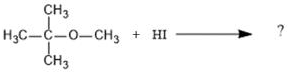
The final products are
Consider the following reaction
The final products are
Solution
The ether is tert-butyl methyl ether. HI first protonates the oxygen. The C-O bond then breaks by an path, because the tertiary carbocation is very stable. Iodide attacks this carbocation to give , and the leaving group is .
Methanol is the final product here, since the question asks for the products under these conditions (the ether reacts with one equivalent of HI).
Option 2: this is what an path would give, with I- attacking the less hindered methyl carbon. That path is followed only when both alkyl groups are primary or secondary. A tertiary alkyl group always goes by .
Options 3 and 4: these would need the ether to cleave at both C-O bonds, or the alcohol to remain on the tertiary side. Neither happens with one equivalent of HI.
Remember: in the HI cleavage of ethers, a tertiary alkyl group always leaves as the alkyl iodide, and the other group leaves as the alcohol.
Related questions:
2026: 21 May Shift 2
2025: 29 May Shift 1
2026: 31 May Shift 2
2026: 29 May Shift 1
2025: 22 May Shift 1