Skip to main contentSkip to solution

Amines

Amines are important class of organic compounds which are basic in nature. They are generally derived by replacing one or more hydrogen atoms of ammonia molecule by alkyl / aryl group(s). In nature, they are generally found in proteins, vitamins, alkaloids and hormones. Two biologically active compounds namely adrenaline and ephedrine contain secondary amino group and are used to increase blood pressure.

Like ammonia, nitrogen atom of amines is trivalent and carries an unshared pair of electrons. Nitrogen orbitals in amines are therefore, sp3sp^3 hybridized and the geometry of amine is pyramidal. Due to the presence of unshared pair of electrons, the angle C-N-E (where E is C or H) is less than 109.50109.5^0.

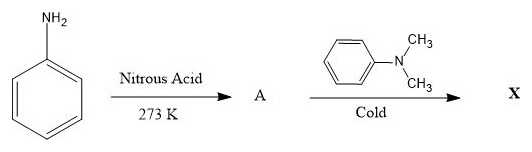
Inductive effects, solvation effects, steric effects etc. affect the basic strength of amines. Amines are classified as primary (1°), secondary (2°), and tertiary (3°) depending upon the number of hydrogen atoms replaced by alkyl or aryl groups in ammonia molecule. Amines can be prepared from various compounds like reduction of nitro, nitriles, amides etc. compounds. Amines are engaged in intermolecular hydrogen bonding. Aliphatic and aromatic primary amines show positive carbylamine reaction. A colourless crystalline solid benzene diazonium chloride can be obtained from aniline by reacting with sodium nitrite and hydrochloric acid at 273-278 K.

The final structure of amine produced by Hoffmann degradation of m-bromobenzamide is

Solution

✅ Correct Option: 2

Hoffmann bromamide degradation converts a primary amide into a primary amine with one carbon atom fewer. The C=O carbon is lost as carbonate, so the −CONH2-CONH_2 group becomes −NH2-NH_2 on the same ring position.

m-BrC6H4CONH2+Br2+4NaOH→m-BrC6H4NH2+Na2CO3+2NaBr+2H2Om\text{-}BrC_6H_4CONH_2 + Br_2 + 4NaOH \rightarrow m\text{-}BrC_6H_4NH_2 + Na_2CO_3 + 2NaBr + 2H_2O

The product is 3-bromoaniline (Option 2), with Br and −NH2-NH_2 still meta to each other.


Option 1: 3-bromobenzylamine has the same number of carbons as the amide, but Hoffmann degradation removes one carbon. A benzylamine would come from reducing the nitrile or amide.

Option 3: an N-methyl secondary amine is not formed, since the product of this reaction is always a primary amine.

Option 4: the Br is not replaced by −NH2-NH_2. Only the amide group changes.

Keyboard Shortcuts

  • Left arrow: Previous question
  • Right arrow: Next question
  • S key: Jump to solution
  • Q key: Jump to question