
Identify the major product X in the following chemical reaction.
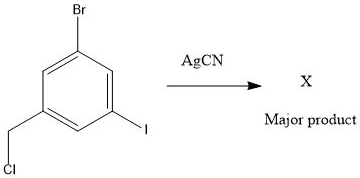
Identify the major product X in the following chemical reaction.
Solution
AgCN is largely covalent, so the carbon end is tied up with silver. The nitrogen lone pair attacks the benzylic carbon and displaces chloride, giving an isocyanide () rather than a nitrile.
The aryl C-Br and C-I bonds do not react. They are C-X bonds with partial double-bond character, so they resist nucleophilic substitution. Only the reactive benzylic C-Cl bond is substituted, so X is 1-bromo-3-iodo-5-(isocyanomethyl)benzene.
Option 1: this is the nitrile (), which forms with ionic cyanides such as KCN or NaCN. AgCN gives the isocyanide instead.
Options 2 and 3: these put the cyano group on the ring and leave untouched, but aryl halides do not undergo substitution under these conditions.
Memory trick: KCN gives R-CN (nitrile), AgCN gives R-NC (isocyanide).
Related questions:
2026: 18 May Shift 1
2026: 24 May Shift 1
2026: 30 May Shift 1