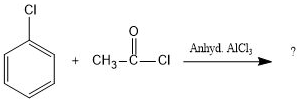
What would be the major product in the following reaction, and which rule would explain the formation of the major product?
What would be the major product in the following reaction, and which rule would explain the formation of the major product?
Solution
Propene reacts with HI by electrophilic addition. H+ adds first to the carbon with more hydrogens (), giving the more stable secondary carbocation . I- then attacks this carbocation to give 2-iodopropane, , which is (b).
This is Markovnikov's rule: in addition of HX to an unsymmetrical alkene, the negative part (X) goes to the carbon with fewer hydrogens.
Options 1 and 4: (a) is the anti-Markovnikov product, 1-iodopropane. It does not form here because it would need a less stable primary carbocation.
Option 3: (b) is formed by Markovnikov addition, not anti-Markovnikov.
Anti-Markovnikov addition happens only with HBr in the presence of peroxides (the peroxide effect). It does not occur with HI or HCl.
Related questions:
2026: 25 May Shift 2
2026: 14 May Shift 2
2026: 22 May Shift 2
2026: 20 May Shift 2
2026: 18 May Shift 1
2026: 18 May Shift 1