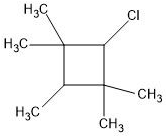
Identify the major product Y in the following reaction.
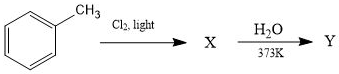
Identify the major product Y in the following reaction.
Solution
✅ Correct Option: 3
Chlorine in light substitutes the side-chain hydrogens of toluene by a free radical mechanism, giving benzal chloride, , as X.
Hydrolysis of benzal chloride with water at 373 K gives an unstable gem-diol, . It loses water at once to give benzaldehyde, , as Y.
Benzotrichloride (): hydrolysis gives benzoic acid, not the aldehyde.
Benzyl chloride (): hydrolysis gives benzyl alcohol.
Number of chlorines on the side chain decides the product: 1 gives alcohol, 2 gives aldehyde, 3 gives carboxylic acid.
Related questions:
2025: 23 May Shift 2
2025: 29 May Shift 2
2026: 26 May Shift 1
2026: 26 May Shift 1
2025: 3 June Shift 2