Skip to main contentSkip to solution

Chemical Kinetics

Some reactions such as ionic reactions occur very fast, for example, precipitation of silver chloride occurs instantaneously by mixing of aqueous solutions of silver nitrate and sodium chloride. On the other hand, some reactions are very slow, for example, rusting of iron in the presence of air and moisture. The sum of powers of the concentration of the reactants in the rate law expression is called the order of that chemical reaction. Another property of a reaction called molecularity helps in understanding its mechanism. The number of reacting species (atoms, ions or molecules) taking part in an elementary reaction, which must collide simultaneously in order to bring about a chemical reaction is called molecularity of a reaction. The half-life (t1/2t_{1/2}) of a reaction is the time in which the concentration of a reactant is reduced to one-half of its initial concentration.

The half-life of a first order reaction:

Solution

✅ Correct Option: 3

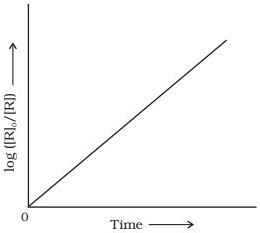
For a first order reaction, the integrated rate law is k=2.303tlog⁡[A]0[A]k = \dfrac{2.303}{t}\log\dfrac{[A]_0}{[A]}. At t=t1/2t = t_{1/2}, [A]=[A]02[A] = \dfrac{[A]_0}{2}, so

t1/2=2.303klog⁡2=0.693kt_{1/2} = \dfrac{2.303}{k}\log 2 = \boxed{\dfrac{0.693}{k}}

The initial concentration cancels out, so the half-life depends only on kk and not on the reactant concentration.


Option 1: this is true for a second order reaction, where t1/2=1k[A]0t_{1/2} = \dfrac{1}{k[A]_0}.

Option 2: this would hold for a third order reaction, where t1/2∝1[A]02t_{1/2} \propto \dfrac{1}{[A]_0^2}.

Option 4: this describes a zero order reaction, where t1/2=[A]02kt_{1/2} = \dfrac{[A]_0}{2k}.

In general, t1/2∝[A]0 1−nt_{1/2} \propto [A]_0^{\,1-n} for order nn, and for n=1n = 1 the power is zero.

Keyboard Shortcuts

  • Left arrow: Previous question
  • Right arrow: Next question
  • S key: Jump to solution
  • Q key: Jump to question