
In the following reaction, the major product A is
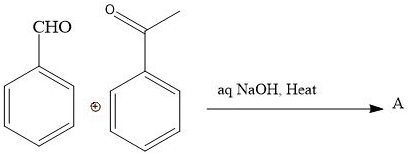
In the following reaction, the major product A is
Solution
This is a crossed aldol (Claisen-Schmidt) condensation. Acetophenone has alpha hydrogens, so NaOH forms its enolate. Benzaldehyde has no alpha hydrogens, so it can only act as the electrophile.
The enolate attacks the C=O of benzaldehyde to give the aldol, . On heating, this loses water (dehydration) to give a conjugated product, (chalcone). The new C=C is conjugated with both the benzene ring and the C=O group, which drives the dehydration. This matches Option 3.
Option 1: the saturated alcohol would need a reduction, and NaOH has no reducing agent.
Option 2: the saturated ketone would also need a reduction (hydrogenation of the C=C), which NaOH cannot do.
Option 4: this is the aldol (beta-hydroxy ketone) intermediate with the C=C and OH misplaced. Under heat the aldol loses water, so no OH remains in the product.
Heating with base turns an aldol addition into a condensation, because water is lost to form the conjugated enone.
Related questions:
2026: 25 May Shift 2
2026: 12 May Shift 2
2026: 31 May Shift 2
2026: 26 May Shift 1
2025: 30 May Shift 1