Skip to main contentSkip to solution

Preparation & Chemical reactions of amines

Preparation:

Nitro compounds are reduced to amines by passing hydrogen gas in the presence of finely divided nickel, palladium, or platinum as catalyst. Nitriles on reduction with lithium aluminum hydride or catalytic hydrogenation produce primary amines. The Gabriel synthesis is used for the preparation of primary amines. Phthalimide on treatment with ethanolic potassium hydroxide forms potassium salt of phthalimide.

Chemical reactions:

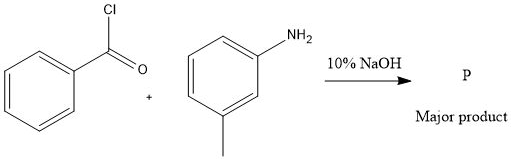
Aliphatic and aromatic primary and secondary amines react with acid chlorides, anhydrides, and esters by nucleophilic substitution reaction. This reaction is known as acylation. Both aliphatic and aromatic primary amines on heating with chloroform and ethanolic potassium hydroxide gives corresponding isocyanide. Benzenesulphonyl chloride also known as Hinsberg's reagent reacts with primary and secondary amines to form sulphonamide. Aniline reacts with bromine water at room temperature to give a white precipitate of 2,4,6-tribromoaniline. Aniline reacts with HNO3HNO_3 in the presence of H2SO4H_2SO_4 to give nitro derivatives. Aniline reacts with concentrated sulphuric acid to form anilinium hydrogensulphate which on heating with sulphuric acid at 453-473K produces p-aminobenzene sulphonic acid or sulphanilic acid.

Which of the following will not respond to carbylamine test ?

Solution

✅ Correct Option: 2

The passage states that primary amines, both aliphatic and aromatic, on heating with chloroform and ethanolic KOH give isocyanides. This is the carbylamine test, so only primary amines (−NH2-NH_2) respond.

N,N-Dimethylaniline is a tertiary amine with no N-H hydrogens, so it cannot form an isocyanide and gives no carbylamine test.


Options 1, 3 and 4: all are primary amines (aromatic, aromatic and aliphatic), so all give the foul-smelling isocyanide.

The ring substituent in p-bromoaniline does not matter, because only the −NH2-NH_2 group is involved.

Keyboard Shortcuts

  • Left arrow: Previous question
  • Right arrow: Next question
  • S key: Jump to solution
  • Q key: Jump to question