Skip to main contentSkip to solution

Amines

Amines are important class of organic compounds which are basic in nature. They are generally derived by replacing one or more hydrogen atoms of ammonia molecule by alkyl / aryl group(s). In nature, they are generally found in proteins, vitamins, alkaloids and hormones. Two biologically active compounds namely adrenaline and ephedrine contain secondary amino group and are used to increase blood pressure.

Like ammonia, nitrogen atom of amines is trivalent and carries an unshared pair of electrons. Nitrogen orbitals in amines are therefore, sp3sp^3 hybridized and the geometry of amine is pyramidal. Due to the presence of unshared pair of electrons, the angle C-N-E (where E is C or H) is less than 109.50109.5^0.

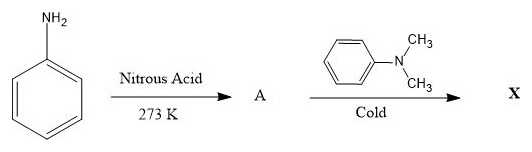
Inductive effects, solvation effects, steric effects etc. affect the basic strength of amines. Amines are classified as primary (1°), secondary (2°), and tertiary (3°) depending upon the number of hydrogen atoms replaced by alkyl or aryl groups in ammonia molecule. Amines can be prepared from various compounds like reduction of nitro, nitriles, amides etc. compounds. Amines are engaged in intermolecular hydrogen bonding. Aliphatic and aromatic primary amines show positive carbylamine reaction. A colourless crystalline solid benzene diazonium chloride can be obtained from aniline by reacting with sodium nitrite and hydrochloric acid at 273-278 K.

Select the correct order of boiling points of isomeric amines

Solution

✅ Correct Option: 1

The passage states that amines engage in intermolecular hydrogen bonding. The extent of this bonding decides the boiling point among isomers.

n-Butylamine is a primary amine with two N-H bonds, so it forms the most extensive hydrogen bonding. Diethylamine is secondary with one N-H bond, so its hydrogen bonding is weaker. Ethyldimethylamine is tertiary with no N-H bond, so it cannot form hydrogen bonds with its own molecules.

AmineTypeN-H bondsApprox. b.p.
n-C4H9NH2n\text{-}C_4H_9NH_21°2350 K
(C2H5)2NH(C_2H_5)_2NH2°1329 K
C2H5N(CH3)2C_2H_5N(CH_3)_23°0310 K

So the order is 1°>2°>3°1° > 2° > 3° for isomeric amines.


Options 3 and 4: these treat different amine classes as having equal boiling points, but the number of N-H bonds differs, so the hydrogen bonding and boiling points differ.
Keyboard Shortcuts

  • Left arrow: Previous question
  • Right arrow: Next question
  • S key: Jump to solution
  • Q key: Jump to question