
What would be the structure of final product X in the following chemical reaction?
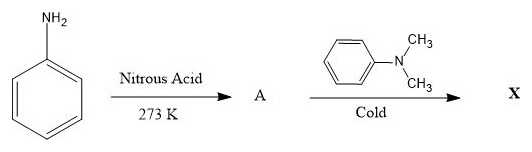
What would be the structure of final product X in the following chemical reaction?
Solution
Aniline reacts with nitrous acid () at 273 K to form benzene diazonium chloride (A). This diazonium salt is a weak electrophile. It attacks the electron-rich ring of N,N-dimethylaniline in a cold coupling reaction. The strongly activating group directs the attack to the para position.
The product is 4-(dimethylamino)azobenzene, (para), which is an azo dye.
Option 1: the coupling happens on the ring carbon, not through a linkage on the methyl group. The azo group is attached directly to the ring.
Option 2: this is a hydrazo compound (), which would form by reducing an azo compound. Coupling gives .
Option 4: this is a symmetrical azo compound with methyl groups on both rings, which does not come from these reagents.