
The major product Z in the following chemical reaction is
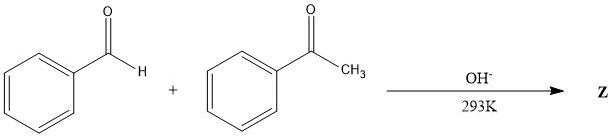
The major product Z in the following chemical reaction is
Solution
Benzaldehyde has no alpha-hydrogen, so it cannot form an enolate. Acetophenone has alpha-hydrogens on its CH3 group, so OH- converts it into an enolate. This enolate attacks the C=O carbon of benzaldehyde in a crossed aldol reaction, giving PhCH(OH)CH2COPh.
This aldol product is a beta-hydroxy ketone. Its alpha-hydrogen is acidic and the product is conjugated with the phenyl ring, so it loses water readily to give PhCH=CH-CO-Ph. This is the Claisen-Schmidt condensation, and the product is chalcone (1,3-diphenylprop-2-en-1-one), which is Option 1.
Option 2: benzil, a 1,2-diketone. It would need oxidation, and no oxidising agent is present.
Option 3: an allylic alcohol. It would need the C=O group to be reduced, and no reducing agent is present.
Option 4: a diol. It is the type of product formed in pinacol-type reductive coupling, not in a base-catalysed condensation.
Related questions:
2025: 28 May Shift 2
2025: 2 June Shift 2
2025: 24 May Shift 2
2025: 29 May Shift 1
2026: 31 May Shift 2
2025: 3 June Shift 2
