The final product D in the following reaction is
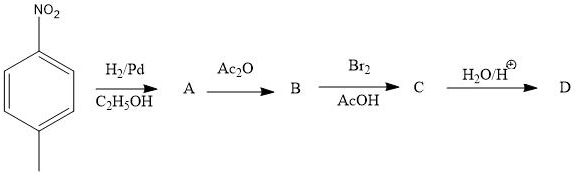
The final product D in the following reaction is
Solution
H2/Pd reduces the nitro group, so A is 4-methylaniline (p-toluidine). Ac2O acetylates the amine, so B is 4-methylacetanilide.
The NHCOCH3 group is a stronger ortho/para director than CH3, and its para position is already blocked by CH3. Br2/AcOH therefore adds one Br ortho to NHCOCH3, giving C as 2-bromo-4-methylacetanilide. Acid hydrolysis then removes the acetyl group, so D is 2-bromo-4-methylaniline.
Option 1: 4-bromo-2-methylaniline would form from o-toluidine, not p-toluidine.
Option 2: Br is meta to NH2 here, but NHCOCH3 directs only ortho/para.
Option 4: acetylation reduces the activating power of the amino group, so only monobromination occurs. Free aniline would give polybromination.
Related questions:
2025: 3 June Shift 2
2025: 30 May Shift 2
2026: 25 May Shift 2
2025: 15 May Shift 1
2026: 6 June Shift 1