
In the following reaction, the major products A and B respectively, are
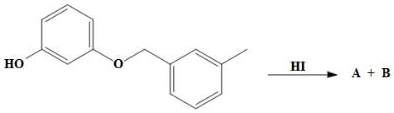
In the following reaction, the major products A and B respectively, are
Solution
The compound is an aryl benzyl ether: 3-hydroxyphenyl 3-methylbenzyl ether. With HI, the ether oxygen is protonated and I- attacks the alkyl carbon, here the benzylic CH2. It does not attack the aryl carbon, because an sp2 C-O bond is stronger (partial double bond character) and cannot undergo SN2 or SN1 at the ring.
The aryl-O bond stays intact, so the phenolic part is released as 3-hydroxyphenol (resorcinol), and the benzylic part becomes 3-methylbenzyl iodide (1-iodomethyl-3-methylbenzene).
Excess HI converts any alcohol formed into the alkyl iodide, so the benzylic product is the iodide, not the alcohol.
Options 1, 3 and 4: they give an alcohol (or a cresol or catechol) from the benzyl part, but HI converts the benzylic carbon to the iodide. Phenols are never cleaved at the aryl C-O bond, and catechol would need a shift of an OH group, which does not occur.
Rule to remember: in aryl alkyl ethers with HI, the products are always phenol + alkyl iodide.
Related questions:
2026: 25 May Shift 2
2026: 22 May Shift 1
2026: 18 May Shift 2
2026: 20 May Shift 2

2025: 27 May Shift 2