
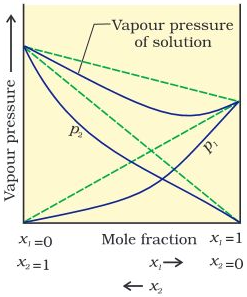
The graph given below indicates which of the following phenomena/ examples:
(A) Positive deviation from Raoult's law.
(B) Negative deviation from Raoult's law.
(C) Chloroform and acetone.
(D) Phenol and aniline.
The graph given below indicates which of the following phenomena/ examples:
(A) Positive deviation from Raoult's law.
(B) Negative deviation from Raoult's law.
(C) Chloroform and acetone.
(D) Phenol and aniline.
Solution
The vapour pressure curve of the solution and the partial pressure curves and all lie below the dashed straight lines of Raoult's law, and the total curve passes through a minimum. This is negative deviation, so (B) is correct.
Negative deviation occurs when A-B interactions are stronger than A-A and B-B interactions. Chloroform and acetone form a hydrogen bond between them, and phenol and aniline also attract each other strongly. Both pairs show negative deviation, so (C) and (D) are correct.
(A): Positive deviation would put the curves above the dashed lines and give a maximum in the total vapour pressure, for example ethanol and acetone.
Negative deviation gives a minimum-boiling-point-opposite result: the solution forms a maximum-boiling azeotrope, which is a quick way to remember it.
Related questions:
2025: 13 May Shift 2
2026: 25 May Shift 1