
Identify the final major product [Q] in the following reactions.
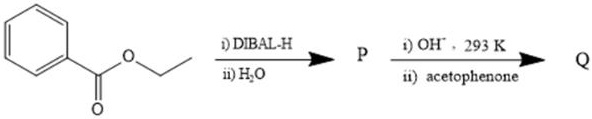
Identify the final major product [Q] in the following reactions.
Solution
DIBAL-H at low temperature reduces the ester (ethyl benzoate) only as far as the aldehyde, so P is benzaldehyde, .
Benzaldehyde has no -hydrogen, so with at 293 K it reacts with acetophenone (which has -hydrogens) in a crossed aldol (Claisen-Schmidt) condensation. The enolate of acetophenone attacks benzaldehyde, and the aldol product loses water to give the conjugated enone.
Q is chalcone (1,3-diphenylprop-2-en-1-one), which is the structure with the C=O group conjugated to the C=C, shown in Option 2.
Option 1: this is the allylic alcohol, which would need a further reduction step that is not present.
Option 3: this is 1,3-diphenylpropene, which would need complete removal of the carbonyl oxygen.
Option 4: this is the aldol-type product before dehydration. It is not the final product, because dehydration is easy as it gives a conjugated enone.
Related questions:
2026: 21 May Shift 1
2026: 19 May Shift 1
2026: 22 May Shift 2
2026: 20 May Shift 2
2026: 21 May Shift 2