
Match the reactions (List-I) with reagents (List-II) used to get the product.
LIST-I (Reactions) LIST-II (Reagents) A. 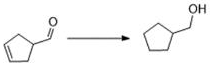
I. B. 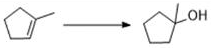
II. C. 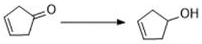
III. Lithium aluminum hydride/ D. 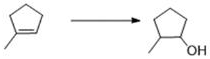
IV. Sodium borohydride
Match the reactions (List-I) with reagents (List-II) used to get the product.
| LIST-I (Reactions) | LIST-II (Reagents) | ||
|---|---|---|---|
| A. | | I. | |
| B. | | II. | |
| C. | | III. | Lithium aluminum hydride/ |
| D. | | IV. | Sodium borohydride |
Solution
✅ Correct Option: 4
| List I | List II |
|---|---|
| (A) Aldehyde to primary alcohol | (III) Lithium aluminum hydride/ |
| (B) 1-Methylcyclopentene to 1-methylcyclopentan-1-ol (OH on the more substituted carbon) | (I) |
| (C) Cyclopentenone to cyclopentenol (C=O reduced, C=C untouched) | (IV) Sodium borohydride |
| (D) 1-Methylcyclopentene to 2-methylcyclopentan-1-ol (OH on the less substituted carbon) | (II) |
B and D start from the same alkene but give different alcohols. Acid-catalysed hydration follows Markovnikov's rule, so OH goes to the more substituted carbon. Hydroboration-oxidation is anti-Markovnikov, so OH goes to the less substituted carbon.
is a mild reagent that reduces only the C=O group and leaves the C=C intact, which is why it fits C.
Related questions:
2026: 19 May Shift 1
2025: 21 May Shift 1
2025: 29 May Shift 2
2025: 15 May Shift 1
2026: 26 May Shift 1