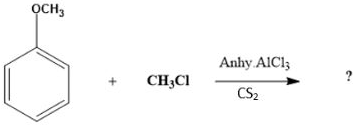
The major products for the following reaction will be

The major products for the following reaction will be
Solution
Benzyl phenyl ether, , is cleaved by HI. The oxygen is first protonated. Iodide then attacks the benzylic carbon through an / path, because the benzyl carbocation is stabilised by resonance. The bond is not broken, since the phenyl carbon is hybridised and has partial double bond character from resonance with oxygen.
The products are benzyl iodide and phenol.
Options 2 and 4: these would need I- to attack the phenyl carbon, which does not happen in aryl alkyl ethers, so iodobenzene never forms.
Option 3: benzyl alcohol could form only if the other fragment were iodobenzene, which is not possible. Excess HI would convert any benzyl alcohol to benzyl iodide anyway.
In aryl alkyl ethers, HI always gives phenol plus an alkyl iodide, never an aryl iodide.
Related questions:
2026: 25 May Shift 1
2026: 6 June Shift 1
2025: 13 May Shift 1
2025: 22 May Shift 1
2025: 3 June Shift 2
2025: 23 May Shift 2