
Read the statements related to the following reaction and choose the correct statements
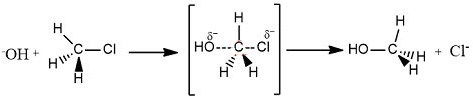
(A) It is reaction
(B) This process follows inversion of configuration.
(C) It follows second order kinetics.
(D) It is reaction.
Read the statements related to the following reaction and choose the correct statements
(A) It is reaction
(B) This process follows inversion of configuration.
(C) It follows second order kinetics.
(D) It is reaction.
Solution
The reaction is . It proceeds through a single concerted step with one transition state (shown in brackets). In it, is partially bonded to carbon while is partially leaving, and the nucleophile attacks from the side opposite to the leaving group. This makes it an S2 reaction, so (D) is correct.
Both the nucleophile and the substrate are involved in the rate-determining step, so . This is second order kinetics, so (C) is correct.
Backside attack turns the three hydrogens over like an umbrella in the wind, which inverts the configuration (Walden inversion). So (B) is correct.
(A): S1 involves a carbocation intermediate, two steps and first order kinetics. Methyl halides cannot form a stable carbocation, so they react by S2.
Related questions:
2025: 13 May Shift 2
2026: 18 May Shift 2
2025: 22 May Shift 1
2025: 29 May Shift 2
2025: 14 May Shift 1