
Identify the product [P] in the given sequence of reactions.
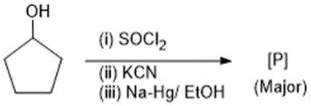
Identify the product [P] in the given sequence of reactions.
Solution
SOCl converts the -OH group into -Cl, giving cyclopentyl chloride. KCN then replaces Cl with CN by nucleophilic substitution, giving cyclopentyl cyanide, which has one more carbon.
Na-Hg/EtOH (nascent hydrogen) reduces the -CN group to -CHNH. The product is cyclopentylmethanamine, a primary amine with the ring carbon attached to a group.
Option 1: the acid would form by hydrolysis of the nitrile (), not by reduction.
Option 2: an amine directly on the ring has one carbon fewer. That is the Hofmann-type outcome, not a nitrile reduction.
Option 3: this is not formed in this sequence. SOCl gives chlorine directly on the ring, not on a group.
Related questions:
2026: 31 May Shift 2
2025: 27 May Shift 2
2025: 28 May Shift 2
2026: 18 May Shift 2
2025: 23 May Shift 2
2025: 21 May Shift 1