
Match the various curves from List-I with the type of solutions/change in List-II with reference to the given figure..
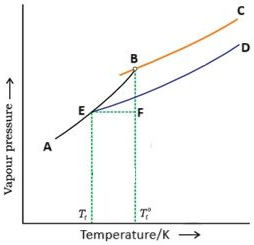
Curve Solution/Change (A) A-B (I) Liquid solvent (B) B-C (II) Solution (C) E-D (III) Depression in freezing point of solvent in solution (D) E-F (IV) Frozen solvent
Match the various curves from List-I with the type of solutions/change in List-II with reference to the given figure..
| Curve | Solution/Change |
|---|---|
| (A) A-B | (I) Liquid solvent |
| (B) B-C | (II) Solution |
| (C) E-D | (III) Depression in freezing point of solvent in solution |
| (D) E-F | (IV) Frozen solvent |
Solution
✅ Correct Option: 2
| List I | List II |
|---|---|
| (A) A-B | (IV) Frozen solvent |
| (B) B-C | (I) Liquid solvent |
| (C) E-D | (II) Solution |
| (D) E-F | (III) Depression in freezing point of solvent in solution |
A-B is the vapour pressure curve of the solid (frozen) solvent. B-C is that of the pure liquid solvent, and B is the freezing point of the pure solvent.
E-D lies below B-C because the non-volatile solute lowers the vapour pressure. The solution freezes where its curve meets the solid curve, at E (temperature ). The horizontal gap E-F, equal to , is the depression in freezing point, .
Related questions:
2026: 19 May Shift 2
2025: 22 May Shift 1