Skip to main contentSkip to solution

Alcohols, Phenols and Ethers

Alcohols and phenols are formed when a hydrogen atom in a hydrocarbon, aliphatic and aromatic respectively, is replaced by –OH group. These classes of compounds find wide applications in industry as well as in day-to-day life. For instance, have you ever noticed that ordinary spirit used for polishing wooden furniture is chiefly a compound containing hydroxyl group, ethanol. The sugar we eat, the cotton used for fabrics, the paper we use for writing, are all made up of compounds containing –OH groups. The common name of an alcohol is derived from the common name of the alkyl group and adding the word alcohol to it. For example, CH3OHCH_3OH is methyl alcohol. The simplest hydroxy derivative of benzene is phenol. It is its common name and also an accepted IUPAC name. As structure of phenol involves a benzene ring, in its substituted compounds the terms ortho (1,2-disubstituted), meta (1,3-disubstituted) and para (1,4-disubstituted) are often used in the common names.

In ethers, the four electron pairs, i.e., the two bond pairs and two lone pairs of electrons on oxygen are arranged approximately in a tetrahedral arrangement. The bond angle is slightly greater than the tetrahedral angle due to the repulsive interaction between the two bulky (–R) groups.

Consider the following chemical reaction and identify the final product(s)
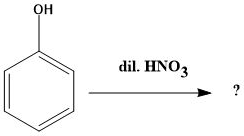
Figure

The final product(s) of the above reaction is

Solution

✅ Correct Option: 3

Phenol reacts with dilute HNO3HNO_3 at low temperature to give a mixture of o-nitrophenol and p-nitrophenol. The -OH group donates electron density into the ring by resonance, so it directs the incoming −NO2-NO_2 group to the ortho and para positions. This is the pair shown in Option 3.


Option 2: 2,4,6-trinitrophenol (picric acid) forms only with concentrated HNO3HNO_3, usually with H2SO4H_2SO_4.

Options 1 and 4: these contain m-nitrophenol, but -OH is an ortho/para director, so no meta product forms.

o-Nitrophenol is steam volatile because of intramolecular hydrogen bonding, while p-nitrophenol is not. This is how the two are separated.

Keyboard Shortcuts

  • Left arrow: Previous question
  • Right arrow: Next question
  • S key: Jump to solution
  • Q key: Jump to question