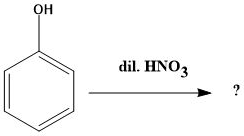
Consider the following chemical reaction and identify the intermediate involved in the reaction.
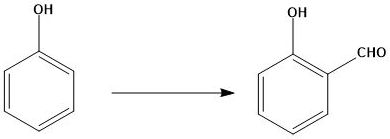
Consider the following chemical reaction and identify the intermediate involved in the reaction.
Solution
Phenol reacts with and aqueous NaOH (Reimer-Tiemann reaction). NaOH converts phenol to sodium phenoxide and also generates dichlorocarbene, , from chloroform.
The electron-rich ortho position of the phenoxide ion attacks the electrophilic dichlorocarbene. This gives the ortho-dichloromethyl sodium phenoxide, which has and groups. Hydrolysis by NaOH then converts to , and acidification gives salicylaldehyde.
Option 1: sodium salicylaldehyde phenoxide is formed after hydrolysis of , so it is the product salt and not the intermediate.
Option 3: in NaOH the phenol exists as the phenoxide ion, so a free with is not the intermediate.
Option 4: has only one chlorine, but dichlorocarbene adds a group.
More from this set:
Question 47