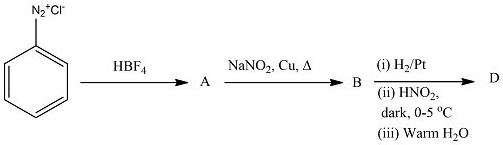
Identify the product formed in the reaction;
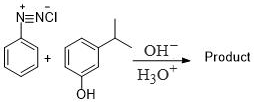
Identify the product formed in the reaction;
Solution
The diazonium salt couples with the phenol in alkaline medium (azo coupling). The phenoxide ion is strongly activated, and the electrophile attacks the position para to the group. In 3-isopropylphenol this is C-4, which is free.
Acidifying with regenerates the group. The product is 4-(phenylazo)-3-isopropylphenol: an unsubstituted phenyl ring joined through to the para position of the phenol ring, with the isopropyl group still at C-3.
Options 1 and 2: the isopropyl group is shown on the ring that came from the diazonium salt. That ring is plain benzene, so it cannot carry an isopropyl group.
Option 4: the azo group sits meta to , which is not an activated position.
Related questions:
2025: 26 May Shift 2
2025: 19 May Shift 2
2025: 15 May Shift 1
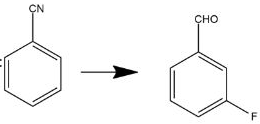
2026: 30 May Shift 2