Skip to main contentSkip to solution

Nucleophilic Addition Reactions

Organic compounds containing carbon-oxygen double bond (>C=O ) are called carbonyl group, which is one of the most important functional group in organic chemistry. In aldehydes, the carbonyl group is bonded to a carbon and hydrogen while in ketones, it is bonded to two carbon atoms.The carbonyl compounds in which carbon of carbonyl group is bonded to carbon or hydrogen and oxygen of hydroxyl moiety (-OH) are known as carboxylic acids , while in compounds where carbon is attached to carbon or hydrogen and nitrogen of −NH2-\mathrm{NH_2} moiety or to halogens are called amides and acyl halides respectively. Aldehydes, ketones, and carboxylic acids are widespeard in plants and animal kingdom. They add fragrance and flavour to nature, for example, vanillin ( from vanilla bean), salicylaldehyde ( from meadow sweet ) and cinnamaldehye ( cinnamon) have pleasant fragrances.

The carbonyl carbon atom is sp2-hybridised and forms three sigma ( σ\sigma ) bonds. The fourth valence electron of carbon remains in its p-orbital and forms a π\pi-bond with oxygen by overlap with p-orbital of an oxygen. In addition , the oxygen atom also has two non bonding electron pairs. Thus, the carbonyl carbon and the three atoms attached to it lie in the same plane and the π\pi-electron cloud is above and below this plane. The bond angles are approximately 1200120^0 and trigonal coplanar structure.

The carbon-oygen double bond is polarised due to higher electronegativity of oxygen relative to carbon. Hence, the carbonyl carbon is an electrophilic (Lewis acid), and carbonyl oxygen , a nucleophilic (Lewis base) centre. Carbonyl compounds have substantial dipole moments and are polar than ethers. Aldehydye and ketone can be prepared by by oxidation of alcohols, dehydrogenation of alcohols, and ozonolysis of alkenes etc.

Identify the name reaction and product in the following chemical reaction.
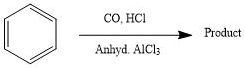
Figure

Solution

✅ Correct Option: 2

Benzene reacts with CO and HCl in the presence of anhydrous AlCl3_3 (with a little CuCl) to give benzaldehyde. This is the Gattermann-Koch reaction.

CO and HCl form the electrophile formyl chloride, HCOCl, in situ. It then attacks the benzene ring by electrophilic substitution, replacing one H with -CHO.

C6H6+CO+HCl→Anhyd. AlCl3/CuClC6H5CHO\text{C}_6\text{H}_6 + \text{CO} + \text{HCl} \xrightarrow{\text{Anhyd. AlCl}_3/\text{CuCl}} \text{C}_6\text{H}_5\text{CHO}


Option 1: The Etard reaction also gives benzaldehyde, but it starts from toluene with CrO2_2Cl2_2, not from benzene with CO/HCl.

Option 3: The Rosenmund reduction converts an acyl chloride to an aldehyde using H2_2 over Pd/BaSO4_4.

Option 4: Friedel-Crafts acylation needs an acyl chloride (RCOCl) or an anhydride, and gives a ketone. Here the electrophile is HCOCl, so the product is an aldehyde.

Gattermann-Koch works for benzene and alkylbenzenes, but not for phenols or aryl ketones.

Keyboard Shortcuts

  • Left arrow: Previous question
  • Right arrow: Next question
  • S key: Jump to solution
  • Q key: Jump to question