
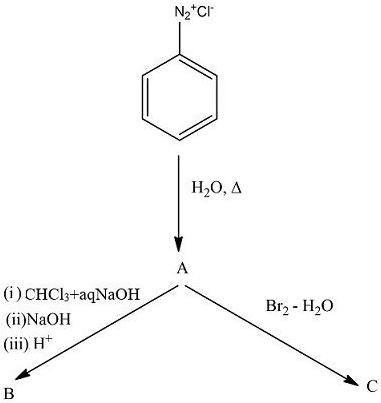
Reaction of phenol with chloroform in the presence of sodium hydroxide to form salicylaldehyde represents
Reaction of phenol with chloroform in the presence of sodium hydroxide to form salicylaldehyde represents
Solution
The reaction of phenol with chloroform () and aqueous NaOH, followed by acid work-up, introduces a group at the ortho position of phenol to give salicylaldehyde. This is the Reimer-Tiemann reaction.
NaOH and generate dichlorocarbene (), the electrophile that attacks the phenoxide ring. The resulting group is hydrolysed to .
Option 1: Kolbe's reaction also uses phenol and NaOH, but with instead of , and it gives salicylic acid (a group), not an aldehyde.
Options 3 and 4: Wurtz joins two alkyl halides using sodium metal, and Hell-Volhard-Zelinsky brominates the alpha carbon of carboxylic acids. Neither involves phenol.
Memory trick: Reimer-Tiemann gives using , while Kolbe gives using .
Related questions:
2026: 25 May Shift 1
2026: 30 May Shift 2
2026: 21 May Shift 1
 + HI
2026: 18 May Shift 1
2025: 21 May Shift 2