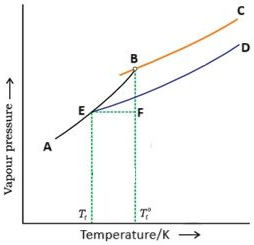
Which of the following statements are correct:
(A). In ideal solutions, the enthalpy of mixing of the pure components to form the solution is zero.
(B). The volume of the solution is equal to the sum of the volumes of the two components.
(C). In binary ideal solutions, attractive forces between A-A and B-B are nearly equal to those between A-B.
(D). In negative Raoult's law deviation, attractions between A-B are weaker than those of A-A and B-B attractions.
Solution
For an ideal solution, and . The solution's volume is therefore the sum of the component volumes, so (A) and (B) are correct.
This happens because the A-B attractions are nearly equal to the A-A and B-B attractions, so (C) is also correct.
(D) is wrong: in negative deviation from Raoult's law, A-B attractions are stronger than A-A and B-B attractions. This gives and . Options containing (D) are therefore incorrect.
Positive deviation is the case where A-B attractions are weaker than A-A and B-B, so .
Related questions:
2025: 2 June Shift 1
2025: 14 May Shift 2
2025: 26 May Shift 2