Q1:

Alcohols, Phenols & Ethers

Hard

Which of the following ethers cannot be prepared by bimolecular dehydration of alcohol?

(A) 2-Methoxy-2-methylpropane

(B) 2-Methoxy propane

(C) 1-Propoxypropane

(D) 2-Ethoxy butane

Answer options
Option 1
Correct Answer
Explanation for 2025: 28 May Shift 1 CHE question 1

Q2:

Amines

Medium

The correct increasing order of reactivity of alkyl halides with CH3NH2CH_3NH_2 is

(A) C2H5C_2H_5-Br

(B) C2H5C_2H_5-I

(C) C2H5C_2H_5-F

(D) C2H5C_2H_5-Cl

Answer options
Option 2
Correct Answer
Explanation for 2025: 28 May Shift 1 CHE question 2

Q3:

d & f Block Elements

Easy

Calculate the magnetic moment (spin-only) of a trivalent ion in aqueous solution if its atomic number is 22.

Answer options
Option 2
Correct Answer
Explanation for 2025: 28 May Shift 1 CHE question 3

Q4:

Biomolecules

Medium

Identify the incorrect statement with reference to biomolecules.

Answer options
Option 3
Correct Answer
Explanation for 2025: 28 May Shift 1 CHE question 4

Q5:

Biomolecules

Easy

Match List-I (biomolecule) with List-II (characteristics)

List-IList-II
BiomoleculeCharacteristics)
(A) Lactose(I) Menstrual cycle
(B) Glycine(II) Bleeding gums
(C) Ascorbic acid(III) Optically inactive
(D) Estradiol(IV) Reducing sugar
Answer options
Option 4
Correct Answer
Explanation for 2025: 28 May Shift 1 CHE question 5

Q8:

d & f Block Elements

Easy

Arrange the metal ions of the following compounds in increasing order of oxidation number:

(A) TiCl3TiCl_3

(B) CrF6CrF_6

(C) ZnO

(D) Mn2O7Mn_2O_7

Answer options
Option 4
Correct Answer
Explanation for 2025: 28 May Shift 1 CHE question 8

Q9:

d & f Block Elements

Easy

Actinoid contraction is greater from element to element than the Lanthanoid contraction because of

Answer options
Option 4
Correct Answer
Explanation for 2025: 28 May Shift 1 CHE question 9

Q10:

Electrochemistry

Easy

The conductivity of an electrolytic solution does not depend on

Answer options

Q11:

Amines

Medium

Arrange the following in the increasing order of their boiling points

(A) n-C4H9NH2C_4H_9NH_2

(B) (C2H5)2NH(C_2H_5)_2NH

(C) n-C4H9OHC_4H_9OH

(D) C2H5N(CH3)2C_2H_5N(CH_3)_2

Answer options

Q12:

Electrochemistry

Medium

A solution of CuSO4CuSO_4 is electrolyzed for 1 minute with a current of 1 ampere. Given the atomic mass of Cu as 63 g mol−1mol^{-1}, the mass of copper deposited at the cathode is

Answer options

Q13:

Amines

Medium

An aromatic compound 'X' on treatment with aqueous ammonia and heating forms the compound 'Y' which on heating with Br2Br_2 and KOH forms a compound 'Z' of the molecular formula C6H7NC_6H_7N. The structures of X, Y and Z can be

Answer options

Q14:

Solutions

Easy

The correct relation for determining the molar mass of solute (M2M_2) using osmotic pressure measurement, is

Answer options

Q15:

Solutions

Medium

For binary solution of two liquids, A and B

Match List-I with List-I

List-IList-II
Inter-molecular interactionBehavior
(A). A-A & B-B are nearly equal to A-B(I). Negative deviation from Raoult's Law
(B). A-A & B-B are stronger compared to A-B(II). Azeotropes
(C). A-A & B-B are weaker compared to A-B(III). Positive deviation from Raoult's Law
(D). Very strong A-B interaction(IV). No deviation from Raoult's Law
Answer options

Q16:

Biomolecules

Medium

With reference to D-glucose, which of the following cannot be explained by its open chain structure?

(A) D-Glucose does not give Schiff's test.

(B) The pentaacetate of D-glucose does not react with hydroxylamine.

(C) Glucose is found to exist in two different crystalline forms.

(D) D-glucose reacts with mild oxidizing agents like Br2Br_2-H2OH_2O and forms gluconic acid.

Answer options

Q18:

d & f Block Elements

Easy

When sodium chromate is acidified with sulfuric acid and then further treated with potassium chloride, we obtain....

Answer options

Q19:

Chemical Kinetics

Easy

A catalyst increases the rate of reaction by:

Answer options

Q20:

Alcohols, Phenols & Ethers

Easy

Phenols are acidic in nature. Which of the following statements is incorrect about them?

Answer options

Q21:

Haloalkanes & Haloarenes

Hard

Primary Alkyl halide C4H9BrC_4H_9Br (X) reacts with alcoholic KOH to give the compound (Y). Compound (Y) is reacted with HBr to give (Z) which is an isomer of (X). When (X) is reacted with Na/dry ether, it gives a compound (T), C8H18C_8H_{18}, which is different from the compound formed when n-butyl bromide is reacted with Na/dry ether. The correct IUPAC name of (T) is:

Answer options

Q22:

Haloalkanes & Haloarenes

Easy

The correct IUPAC name of Freon 12 is

Answer options

Q23:

Aldehydes, Ketones & Carboxylic Acids

Easy

Match List-I (compound) with List-II (reagent or chemical test)

List-IList-II
CompoundReagent or Chemical test
(A) Phenols(I) Tollen's test
(B) Amines(II) Neutral FeCl3FeCl_3 aq. solution
(C) Aldehydes(III) Iodoform Test
(D) Methyl Ketones(IV) Hinsberg's Test
Answer options

Q24:

Alcohols, Phenols & Ethers

Medium

Predict the products, A and B in the following reaction sequence:

C6H5−OH→Conc. H2SO4AC_6H_5 - OH \xrightarrow{Conc.\ H_2SO_4} A

A→Conc. HNO3BA \xrightarrow{Conc.\ HNO_3} B

Answer options

Q25:

Haloalkanes & Haloarenes

Medium

Which of the following methyl halide will have the highest value of dipole moment?

Answer options

Q26:

Haloalkanes & Haloarenes

Medium

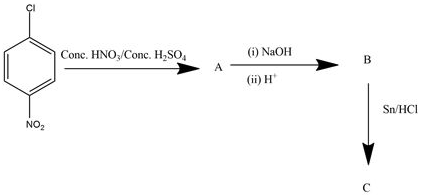
Identify A, B, and C in the following reaction:

Figure

Answer options

Q27:

Solutions

Easy

The flow of solvent from pure solvent side to solution side across a semipermeable membrane can be stopped if some extra pressure is applied on the solution. This pressure that just stops the flow of solvent is called

Answer options

Q29:

Alcohols, Phenols & Ethers

Medium

Which of the following reactions will give n-Propanol as a product?

(A) Hydroboration oxidation of Propene

(B) Reduction of propanal with Palladium as a catalyst

(C) Reaction of Formaldehdye with Ethylmagnesiumbromide followed by hydrolysis

(D) Acid catalyzed hydration of propene

Answer options

Q30:

Solutions

Easy

Azeotropes are binary mixtures having

Answer options

Q31:

Chemical Kinetics

Medium

Match List-I with List-II

List-IList-II
Reaction propertyFormula
(A) Half-life of decomposition of gaseous ammonia on hot platinum surface(I) ln⁡(a0at)t\frac{\ln\left(\frac{a_0}{a_t}\right)}{t}
(B) Instantaneous rate(II) [R]0/2k[R]_0/2k
(C) Rate constant of inversion of cane sugar(III) dxdt\frac{dx}{dt}
(D) Half-life of acid hydrolysis of methyl acetate(IV) (ln⁡2)/k(\ln 2)/k
Answer options

Q32:

Electrochemistry

Easy

Λm∘\Lambda^\circ_m for NaCl, HCl, and NaAc are 126.4, 425.9 and 91.0 S cm2cm^2 mol−1mol^{-1}, respectively. Λm\Lambda_m for HAc is

Answer options

Q33:

Amines

Medium

Arrange the following in the decreasing order of basic strength in gas phase:

(A) C2H5NH2C_2H_5NH_2

(B) (C2H5)2NH(C_2H_5)_2NH

(C) (C2H5)3N(C_2H_5)_3N

(D) NH3NH_3

Answer options

Q34:

Solutions

Easy

The van't Hoff Factor, ii for complete dissociation of (i) NaCl, (ii) MgSO4MgSO_4 and (iii) K2SO4K_2SO_4 are

Answer options

Q35:

Chemical Kinetics

Medium

Choose the correct statements from the following regarding the reaction kinetics

(A) A catalyst does not affect the Gibbs energy of a reaction.

(B) A catalyst alters the equilibrium constant.

(C) For a zero order reaction, half life is dependent on the initial concentration of the reactant.

(D) Orientation of reactant molecules affects the reaction rate.

Answer options

Q36:

Electrochemistry

Easy

Match List-I with List-II

List-IList-II
Type of cell/BatteriesReaction
(A) Daniell cell(I) 2H2(g)+O2(g)→2H2O (l)2H_2(g) + O_2(g) \rightarrow 2H_2O\ (l)
(B) Fuel Cell(II) Pb(s)+PbO2(s)+2H2SO4 (aq)→2PbSO4 (s)+2H2O (l)Pb(s) + PbO_2(s) + 2H_2SO_4\ (aq) \rightarrow 2PbSO_4\ (s) + 2H_2O\ (l)
(C) Primary Batteries(III) Zn(s)+Cu2+ (aq)→Zn2+ (aq)+Cu (s)Zn(s) + Cu^{2+}\ (aq) \rightarrow Zn^{2+}\ (aq) + Cu\ (s)
(D) Secondary Batteries(IV) Zn(Hg)+HgO(s)→ZnO(s)+Hg(l)Zn(Hg) + HgO(s) \rightarrow ZnO(s) + Hg(l)
Answer options

Q37:

Electrochemistry

Medium

The correct sequence of steps during the corrosion of iron is

(A) Ferrous ions are oxidized by atmospheric oxygen

(B) Hydrated ferric oxide (FeO3.xH2OFeO_3.xH_2O) formed with production of H+H^+ ions

(C) At a particular spot of iron object, oxidation takes place and that spot behaves as anode

(D) Electron released at anode moves through metal and reduces oxygen in the presence of H+H^+

Answer options

Q38:

Chemical Kinetics

Easy

From the following statement regarding the order of reaction, the statement that is not true is

Answer options

Q39:

d & f Block Elements

Medium

An increase in the density is seen when moving from Ti to Cu in transition mental series. This can be attributed to ....

Answer options

Q40:

Haloalkanes & Haloarenes

Medium

Which of the following is a characteristic of SN2S_N2 reaction?

(A). Concentration of both reactants determines the reaction rate.

(B). Proceeds with inversion of configuration.

(C). The transition state involves central carbon bonded to five species.

(D). Occurs in polar protic solvent

Answer options

Q41:

Coordination Compounds

Medium

In the formation of coordination complexes, if the inner d orbital (n-1d) is used in hybridisation, the complex, is called an inner orbital or low spin or spin paired complex. And if it uses outer d orbital (nd) in hybridisation (like sp3d2sp^3d^2), it is called outer orbital or high spin or spin free complex. The degeneracy of the d orbitals has been removed due to ligand electron-metal electron repulsions in the complex. This splitting of the degenerate levels due to the presence of ligands in a definite geometry is termed as crystal field splitting. For coordination complexes, the magnetic moment is determined by the number of unpaired electrons and is calculated by using the 'spin-only' formula, μ=n(n+2)\mu = \sqrt{n(n+2)} where n is the number of unpaired electrons and μ is the magnetic moment in units of Bohr magneton (BM). The coordination compounds are of great importance. These compounds are widely present in the mineral, plant and animal worlds and are known to play many important functions in the area of analytical chemistry, metallurgy, biological systems, industry and medicine.

[Co(NH3)6]3+[Co(NH_3)_6]^{3+} and [Ni(NH3)6]2+[Ni(NH_3)_6]^{2+} respectively are

Answer options

Q42:

Coordination Compounds

Medium

In the formation of coordination complexes, if the inner d orbital (n-1d) is used in hybridisation, the complex, is called an inner orbital or low spin or spin paired complex. And if it uses outer d orbital (nd) in hybridisation (like sp3d2sp^3d^2), it is called outer orbital or high spin or spin free complex. The degeneracy of the d orbitals has been removed due to ligand electron-metal electron repulsions in the complex. This splitting of the degenerate levels due to the presence of ligands in a definite geometry is termed as crystal field splitting. For coordination complexes, the magnetic moment is determined by the number of unpaired electrons and is calculated by using the 'spin-only' formula, μ=n(n+2)\mu = \sqrt{n(n+2)} where n is the number of unpaired electrons and μ is the magnetic moment in units of Bohr magneton (BM). The coordination compounds are of great importance. These compounds are widely present in the mineral, plant and animal worlds and are known to play many important functions in the area of analytical chemistry, metallurgy, biological systems, industry and medicine.

Which of the following complex has the highest magnetic moment?

Answer options

Q43:

Coordination Compounds

Medium

In the formation of coordination complexes, if the inner d orbital (n-1d) is used in hybridisation, the complex, is called an inner orbital or low spin or spin paired complex. And if it uses outer d orbital (nd) in hybridisation (like sp3d2sp^3d^2), it is called outer orbital or high spin or spin free complex. The degeneracy of the d orbitals has been removed due to ligand electron-metal electron repulsions in the complex. This splitting of the degenerate levels due to the presence of ligands in a definite geometry is termed as crystal field splitting. For coordination complexes, the magnetic moment is determined by the number of unpaired electrons and is calculated by using the 'spin-only' formula, μ=n(n+2)\mu = \sqrt{n(n+2)} where n is the number of unpaired electrons and μ is the magnetic moment in units of Bohr magneton (BM). The coordination compounds are of great importance. These compounds are widely present in the mineral, plant and animal worlds and are known to play many important functions in the area of analytical chemistry, metallurgy, biological systems, industry and medicine.

Fe(II) octahedral complexes can show different 'spin only' magnetic moments for arrangements in the presence of weak and strong ligands. The 'spin only' magnetic moments of these complexes with weak and strong ligands, respectively, are

Answer options

Q44:

Coordination Compounds

Medium

In the formation of coordination complexes, if the inner d orbital (n-1d) is used in hybridisation, the complex, is called an inner orbital or low spin or spin paired complex. And if it uses outer d orbital (nd) in hybridisation (like sp3d2sp^3d^2), it is called outer orbital or high spin or spin free complex. The degeneracy of the d orbitals has been removed due to ligand electron-metal electron repulsions in the complex. This splitting of the degenerate levels due to the presence of ligands in a definite geometry is termed as crystal field splitting. For coordination complexes, the magnetic moment is determined by the number of unpaired electrons and is calculated by using the 'spin-only' formula, μ=n(n+2)\mu = \sqrt{n(n+2)} where n is the number of unpaired electrons and μ is the magnetic moment in units of Bohr magneton (BM). The coordination compounds are of great importance. These compounds are widely present in the mineral, plant and animal worlds and are known to play many important functions in the area of analytical chemistry, metallurgy, biological systems, industry and medicine.

The CFSE for tetrahedral [CoCl4]2−[CoCl_4]^{2-} is 8000 cm−1cm^{-1}, the CFSE for octahedral [CoCl6]4−[CoCl_6]^{4-} will be.........

Answer options

Q45:

Coordination Compounds

Easy

In the formation of coordination complexes, if the inner d orbital (n-1d) is used in hybridisation, the complex, is called an inner orbital or low spin or spin paired complex. And if it uses outer d orbital (nd) in hybridisation (like sp3d2sp^3d^2), it is called outer orbital or high spin or spin free complex. The degeneracy of the d orbitals has been removed due to ligand electron-metal electron repulsions in the complex. This splitting of the degenerate levels due to the presence of ligands in a definite geometry is termed as crystal field splitting. For coordination complexes, the magnetic moment is determined by the number of unpaired electrons and is calculated by using the 'spin-only' formula, μ=n(n+2)\mu = \sqrt{n(n+2)} where n is the number of unpaired electrons and μ is the magnetic moment in units of Bohr magneton (BM). The coordination compounds are of great importance. These compounds are widely present in the mineral, plant and animal worlds and are known to play many important functions in the area of analytical chemistry, metallurgy, biological systems, industry and medicine.

Which of the following metals belongs to Wilkinson catalyst?

Answer options

Q46:

Aldehydes, Ketones & Carboxylic Acids

Easy

Aldehydes and ketones are important organic compounds prepared mainly by oxidation of alcohols. Primary alcohols give aldehyde and secondary alcohols yield ketones. Aldehydes can also be formed by partial reduction of acid chlorides, reduction of esters or by Gattermann-Koch reaction. Ketones are prepared via Friedel-Craft's acylation, hydration of alkyne and reaction of Grignard's reagent with nitriles. Chemically, aldehydes and ketones are reactive in nature due to the carbonyl group and undergo nucleophilic addition reactions. Aldehydes are more reactive than ketones and can be oxidized to carboxylic acids, while both can be reduced to alcohols or hydrocarbons and exhibit condensation reaction.

Hydration of propyne in the presence of H2SO4H_2SO_4 and HgSO4HgSO_4 gives

Answer options

Q47:

Aldehydes, Ketones & Carboxylic Acids

Medium

Aldehydes and ketones are important organic compounds prepared mainly by oxidation of alcohols. Primary alcohols give aldehyde and secondary alcohols yield ketones. Aldehydes can also be formed by partial reduction of acid chlorides, reduction of esters or by Gattermann-Koch reaction. Ketones are prepared via Friedel-Craft's acylation, hydration of alkyne and reaction of Grignard's reagent with nitriles. Chemically, aldehydes and ketones are reactive in nature due to the carbonyl group and undergo nucleophilic addition reactions. Aldehydes are more reactive than ketones and can be oxidized to carboxylic acids, while both can be reduced to alcohols or hydrocarbons and exhibit condensation reaction.

The correct IUPAC name of Vanillin is

Answer options

Q48:

Aldehydes, Ketones & Carboxylic Acids

Medium

Aldehydes and ketones are important organic compounds prepared mainly by oxidation of alcohols. Primary alcohols give aldehyde and secondary alcohols yield ketones. Aldehydes can also be formed by partial reduction of acid chlorides, reduction of esters or by Gattermann-Koch reaction. Ketones are prepared via Friedel-Craft's acylation, hydration of alkyne and reaction of Grignard's reagent with nitriles. Chemically, aldehydes and ketones are reactive in nature due to the carbonyl group and undergo nucleophilic addition reactions. Aldehydes are more reactive than ketones and can be oxidized to carboxylic acids, while both can be reduced to alcohols or hydrocarbons and exhibit condensation reaction.

The correct structure of the product in the following reaction is;

C2H5−C≡N+C6H5−MgBr→(ii)H3O+(i)EtherAC_2H_5 - C \equiv N + C_6H_5 - MgBr \xrightarrow[(ii) H_3O^+]{(i) Ether} A

Answer options

Q49:

Aldehydes, Ketones & Carboxylic Acids

Easy

Aldehydes and ketones are important organic compounds prepared mainly by oxidation of alcohols. Primary alcohols give aldehyde and secondary alcohols yield ketones. Aldehydes can also be formed by partial reduction of acid chlorides, reduction of esters or by Gattermann-Koch reaction. Ketones are prepared via Friedel-Craft's acylation, hydration of alkyne and reaction of Grignard's reagent with nitriles. Chemically, aldehydes and ketones are reactive in nature due to the carbonyl group and undergo nucleophilic addition reactions. Aldehydes are more reactive than ketones and can be oxidized to carboxylic acids, while both can be reduced to alcohols or hydrocarbons and exhibit condensation reaction.

When two moles of benzaldehyde are heated with concentrated NaOH solution, the product/s obtained is/are;

Answer options

Q50:

Aldehydes, Ketones & Carboxylic Acids

Hard

Aldehydes and ketones are important organic compounds prepared mainly by oxidation of alcohols. Primary alcohols give aldehyde and secondary alcohols yield ketones. Aldehydes can also be formed by partial reduction of acid chlorides, reduction of esters or by Gattermann-Koch reaction. Ketones are prepared via Friedel-Craft's acylation, hydration of alkyne and reaction of Grignard's reagent with nitriles. Chemically, aldehydes and ketones are reactive in nature due to the carbonyl group and undergo nucleophilic addition reactions. Aldehydes are more reactive than ketones and can be oxidized to carboxylic acids, while both can be reduced to alcohols or hydrocarbons and exhibit condensation reaction.

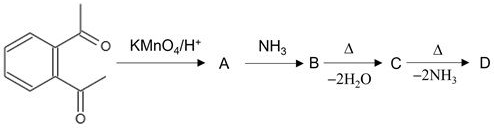
Predict the end product (D) of the following reaction sequence;

Figure

Answer options

CUET Chemistry 2025 28 May Shift 1 Past Year Question Paper

Every question from the CUET Chemistry 2025 28 May Shift 1 paper is here in full, with the correct answer and a step by step solution for each one. It is completely free, there is no login and no paywall, and you can read the whole paper online or download it to revise offline.

You can also attempt it instead of only reading it. Take the paper as a full length mock under exam conditions, or filter it by topic and attempt just that topic as a topic test. Both are free, and you get a breakdown of your accuracy, your timing and your weak areas once you submit.

CUET Chemistry past year questions (PYQs) are the closest thing to the real exam, so working through them is the quickest way to learn the paper pattern, the marking scheme and the level of difficulty to expect on the day.