Skip to main contentSkip to solution

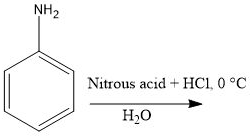
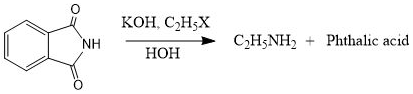
Amines are classified as primary (1°), secondary (2°) and tertiary (3°) depending upon the number of hydrogen atoms replaced by alkyl or aryl groups in ammonia molecules. Aliphatic amines are a stronger bases due to +I effect of an alkyl groups. Intermolecular hydrogen bonding in primary and secondary amines affects the boiling points of amines. The intermolecular association is more in primary amines than in secondary amines as there are more number of hydrogen atoms available for hydrogen bond formation. Nitro compounds are reduced to amines by passing hydrogen gas in the presence of finely divided nickel, palladium or platinum and also by reduction with metals in an acidic medium. Gabriel synthesis is used for the preparation of primary amines. Primary amines react with nitrous acid to give unstable diazonium-salts which can be used to synthesize a variety of compounds.

X in the following reaction is
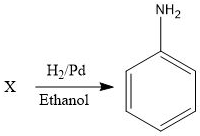
Figure

Solution

✅ Correct Option: 1

The passage states that nitro compounds are reduced to amines by hydrogen gas in the presence of finely divided Ni, Pd or Pt. So X is nitrobenzene, which H2/Pd in ethanol reduces to aniline:

\ceC6H5NO2+3H2→Pd/ethanol\ceC6H5NH2+2H2O\ce{C6H5NO2} + 3H_2 \xrightarrow{Pd/\text{ethanol}} \ce{C6H5NH2} + 2H_2O


Benzoic acid and benzamide: catalytic hydrogenation with H2/Pd does not convert these to aniline. Benzamide gives aniline by Hofmann bromamide degradation (Br2/NaOH), not by H2/Pd.

Benzylamine: it already has a \ce−CH2NH2\ce{-CH2NH2} group, so it is not an aniline precursor.

Keyboard Shortcuts

  • Left arrow: Previous question
  • Right arrow: Next question
  • S key: Jump to solution
  • Q key: Jump to question