Q1:

Chemical Kinetics

Medium

For first order decomposition of N2_2O5_5 at constant volume, pip_i is initial pressure and ptp_t is pressure at any time t, during the reaction. Which of the following statement/s is incorrect?

(A) Half life does not depend on initial pressure

(B) Total pressure decreases with time

(C) rate constant will be the same if initial pressure is doubled.

(D) k=2.303tlog⁡(ptpi)k = \frac{2.303}{t}\log\left(\frac{p_t}{p_i}\right)

Answer options
Option 4
Correct Answer
Explanation for 2025: 19 May Shift 2 CHE question 1

Q2:

Alcohols, Phenols & Ethers

Easy

The major product of Kolbe's reaction is used for the synthesis of a precursor substrate in the preparation of aspirin. The electrophile used in Kolbe's reaction is

Answer options
Option 1
Correct Answer
Explanation for 2025: 19 May Shift 2 CHE question 2

Q3:

Solutions

Medium

A solution contains 50 g of a non-electrolytic solute per 100g of water at 25°C. The vapor pressure of water is 23.5 mmHg at this temperature. The molar mass of the solute is 250 g mol−1^{-1}. The vapor pressure of the solution at 25°C will be

Answer options
Option 2
Correct Answer
Explanation for 2025: 19 May Shift 2 CHE question 3

Q4:

Aldehydes, Ketones & Carboxylic Acids

Medium

Out of the following given statements, the incorrect statements are;

(A) 2, 2, 6-Trimethylcyclohexanone forms a cyanohydrin in good yield, but the cyclohexanone doesn't.

(B) There are two amino groups in semicarbazide and both can be involved in the formation of semicarbazones.

(C) Mononitration of benzaldehyde will form m-nitrobenzaldehyde.

(D) Mononitration of acetophenone will form m-nitroacetophenone.

Answer options
Option 4
Correct Answer
Explanation for 2025: 19 May Shift 2 CHE question 4

Q5:

d & f Block Elements

Easy

The products for the reaction of KMnO4_4 with potassium iodide in acidic solutions are

Answer options
Option 1
Correct Answer
Explanation for 2025: 19 May Shift 2 CHE question 5

Q6:

Solutions

Easy

Match List-I with List-II

List-IList-II
Solutevan't Hoff factor, ii
(A) Benzoic acid in benzene(I) 3
(B) K2_2SO4_4 (aq)(II) 2
(C) Urea (aq)(III) 0.5
(D) KOH (aq)(IV) 1
Answer options
Option 4
Correct Answer
Explanation for 2025: 19 May Shift 2 CHE question 6

Q7:

d & f Block Elements

Medium

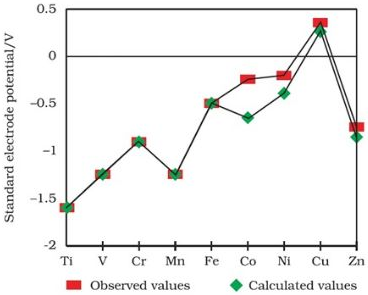
Figure

Observed and calculated values for the standard electrode potentials (M2+→^{2+}\rightarrow M) are shown in the figure above. Based on the data shown, which of the following statements are true?

(A) Cu is not able to liberate H2_2 from acid.

(B) Zn is not able to liberate H2_2 from acid.

(C) An increase in the sum of the first and second ionization enthalpies leads to less negative E° values.

(D) Only oxidising acids react with Cu

Answer options
Option 1
Correct Answer
Explanation for 2025: 19 May Shift 2 CHE question 7

Q8:

Solutions

Easy

Arrange the following steps in the correct sequence to carry out reverse osmosis

(A) Two solutions having different concentrations of the same solute are taken.

(B) Very high external pressure is applied on the high concentration side.

(C) A semipermeable membrane is inserted between the two solutions.

(D) Solvent flows from the high concentration side to the low concentration one.

Answer options
Option 2
Correct Answer
Explanation for 2025: 19 May Shift 2 CHE question 8

Q9:

Coordination Compounds

Easy

Arrange the following complexes in increasing order of number of moles of silver chloride precipitated when one mole of each is reacted with excess of silver nitrate.

(A) [Co(NH3_3)4_4Cl2_2]Cl

(B) [Co(NH3_3)5_5Cl]Cl2_2

(C) [Co(NH3_3)3_3Cl3_3]

(D) [Co(NH3_3)6_6]Cl3_3

Answer options
Option 1
Correct Answer
Explanation for 2025: 19 May Shift 2 CHE question 9

Q10:

Coordination Compounds

Easy

(a) Ni(CO)4_4, (b) [Ni(CN4_4)]2−^{2-} and (c) [Pt(NH3_3)2_2Cl2_2] are respectively ................... complexes.

Answer options

Q11:

Biomolecules

Easy

When a protein in its native form is subjected to physical or chemical change, then its

Answer options

Q12:

Aldehydes, Ketones & Carboxylic Acids

Easy

Which of the following compounds will show the least reactivity towards nucleophilic addition reaction?

Answer options

Q13:

Chemical Kinetics

Easy

The correct sequence for product formation according to the Collision theory of chemical reaction is

(A) Proper orientation

(B) Molecules collide with threshold energy

(C) Intermediate formation

(D) Formation of products

Answer options

Q14:

Solutions

Medium

To avoid the medical condition called 'bends' in scuba divers, the composition of gas filled in the tank is

Answer options

Q17:

Biomolecules

Easy

Match List-I (type of linkages) with List-II (Biomolecules)

List-IList-II
Type of linkageBiomolecule
(A) Glycosidic linkage(I) Tertiary structure of proteins
(B) Peptide Linkage(II) Disaccharide
(C) Phosphodiester linkage(III) Primary structure of proteins
(D) Disulfide linkage(IV) Nucleotide
Answer options

Q18:

Aldehydes, Ketones & Carboxylic Acids

Easy

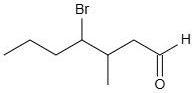
The correct IUPAC name of the following organic compound is

Figure

Answer options

Q19:

Haloalkanes & Haloarenes

Easy

Arrange the following compounds in the decreasing order of reactivity towards SN_N1 reaction

(A) (Ph)3_3C-I

(B) (Ph)3_3C-Br

(C) (Ph)3_3C-Cl

(D) (Ph)3_3C-F

Answer options

Q20:

Haloalkanes & Haloarenes

Easy

With reference to the elimination reaction of alkyl halides, the correct statements are;

(A) Zaitsev rule predicts the major product in dehydrohalogenation reaction.

(B) Grignard's reagent is prepared under perfectly anhydrous conditions.

(C) Alkyl halides on reaction with aqueous KOH forms an eliminated product but with alcoholic KOH forms a substituted product.

(D) Alkyl halides on reaction with aqueous KOH forms a substituted product but with alcoholic KOH forms an eliminated product.

Answer options

Q21:

Chemical Kinetics

Medium

The rate constants of the reaction at 100 K and 200 K are 0.01 s−1^{-1} and 0.02 s−1^{-1}, respectively. The value of activation energy (EaE_a) will be

(log 2=0.3010)

Answer options

Q23:

Biomolecules

Medium

Addison's disease is not characterised by

Answer options

Q26:

d & f Block Elements

Easy

Which compound of transition metal is used as a catalyst in the Contact Process?

Answer options

Q27:

Aldehydes, Ketones & Carboxylic Acids

Medium

Arrange the following compounds in the increasing order of their boiling points:

(A) Pentan-1-ol

(B) n-Butane

(C) Pentan-1-al

(D) Ethoxyethane

Answer options

Q28:

Coordination Compounds

Medium

Match the complexes given in List-I with the number of unpaired electrons given in List-II

List-IList-II
ComplexesNumber of unpaired electrons
(A) [Ti(H2_2O)6_6]3+^{3+}(I) 1
(B) [NiF6_6]4−^{4-}(II) 5
(C) [Fe(CN)6_6]4−^{4-}(III) 2
(D) [MnF6_6]4−^{4-}(IV) 0
Answer options

Q29:

Alcohols, Phenols & Ethers

Easy

Match List -I with List-II

List-IList-II
Name of CompoundApplication
(A) Neutral Ferric Chloride(I) Anaesthetic
(B) Methanol(II) Detection of Phenolic group
(C) Diethylether(III) Wood Spirit
(D) Acetylsalicylic acid(IV) Analgesic
Answer options

Q31:

Biomolecules

Easy

When a nucleotide from DNA containing adenine is hydrolyzed, the products obtained are

Answer options

Q32:

Chemical Kinetics

Medium

A radioactive substance decays with a rate constant of 9.2×10−39.2\times 10^{-3} min−1^{-1}. Time taken for 75% of the sample to decompose is

Answer options

Q33:

Coordination Compounds

Easy

Match the biological entity given in List-I with the metal involved in it given in List-II

List-IList-II
Biological entityMetal involved
(A) Chlorophyll(I) Iron
(B) Haemoglobin(II) Magnesium
(C) Vitamin B12(III) Nickel
(D) Urease(IV) Cobalt
Answer options

Q34:

Chemical Kinetics

Easy

For a bimolecular elementary reaction between A and B, the rate of reaction is expressed as

rate=P.ZABe(−EaRT)rate = P.Z_{AB}e^{(-\frac{E_a}{RT})}

Identify the terms P, ZABZ_{AB} and EaE_a involved in this expression, respectively

Answer options

Q36:

Solutions

Easy

1.00 g of a non-electrolyte solute when dissolved in 50 g of organic solvent, lowered the freezing point of organic solvent by 0.50 K. If the freezing point depression constant of organic solvent is 5 K kg mol−1^{-1}, the molar mass of the solute will be

Answer options

Q38:

Aldehydes, Ketones & Carboxylic Acids

Medium

Which of the following is the best reducing agent to convert RCOOH into RCH2_2OH ?

Answer options

Q39:

Alcohols, Phenols & Ethers

Medium

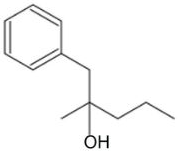
The substrates required for the preparation of the following alcohol are

Figure

Answer options

Q40:

Coordination Compounds

Medium

Select the high spin complexes from the following:

(A) [Ni(CN)4_4]2−^{2-}

(B) [Fe(CN)6_6]3−^{3-}

(C) [MnBr4_4]2−^{2-}

(D) [Fe(H2_2O)6_6]2+^{2+}

Answer options

Q41:

Electrochemistry

Easy

The molar conductivity of a solution at any given concentration is the conductance of the volume of solution containing one mole of electrolyte kept between two platinum electrodes with unit area of cross-section and at a distance of unit length. Both conductivity and molar conductivity change with the concentration of the electrolyte. Kohlrausch examined Λm∘\Lambda^\circ_m values for a number of strong electrolytes and observed certain regularities. He noted that the difference in Λm∘\Lambda^\circ_m of the electrolytes NaX and KX for any X is nearly constant. On the basis of the above observations, he enunciated the Kohlrausch law of independent migration of ions.

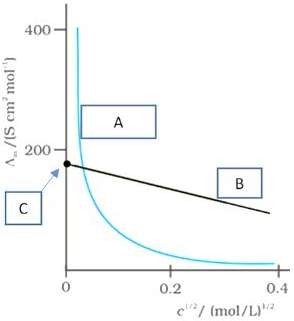
Figure

Identify electrolyte A and B in the given image.

Answer options

Q42:

Electrochemistry

Easy

The molar conductivity of a solution at any given concentration is the conductance of the volume of solution containing one mole of electrolyte kept between two platinum electrodes with unit area of cross-section and at a distance of unit length. Both conductivity and molar conductivity change with the concentration of the electrolyte. Kohlrausch examined Λm∘\Lambda^\circ_m values for a number of strong electrolytes and observed certain regularities. He noted that the difference in Λm∘\Lambda^\circ_m of the electrolytes NaX and KX for any X is nearly constant. On the basis of the above observations, he enunciated the Kohlrausch law of independent migration of ions.

Figure

Point C in the image is called

Answer options

Q43:

Electrochemistry

Medium

The molar conductivity of a solution at any given concentration is the conductance of the volume of solution containing one mole of electrolyte kept between two platinum electrodes with unit area of cross-section and at a distance of unit length. Both conductivity and molar conductivity change with the concentration of the electrolyte. Kohlrausch examined Λm∘\Lambda^\circ_m values for a number of strong electrolytes and observed certain regularities. He noted that the difference in Λm∘\Lambda^\circ_m of the electrolytes NaX and KX for any X is nearly constant. On the basis of the above observations, he enunciated the Kohlrausch law of independent migration of ions.

Figure

A 0.001 mol L−1^{-1} solution of acetic acid shows conductivity of 5.02×10−55.02 \times 10^{-5} S cm−1^{-1}. If Λm∘\Lambda^\circ_m for acetic acid is 390 cm2^2 mol−1^{-1}, then the degree of dissociation is

Answer options

Q44:

Electrochemistry

Medium

The molar conductivity of a solution at any given concentration is the conductance of the volume of solution containing one mole of electrolyte kept between two platinum electrodes with unit area of cross-section and at a distance of unit length. Both conductivity and molar conductivity change with the concentration of the electrolyte. Kohlrausch examined Λm∘\Lambda^\circ_m values for a number of strong electrolytes and observed certain regularities. He noted that the difference in Λm∘\Lambda^\circ_m of the electrolytes NaX and KX for any X is nearly constant. On the basis of the above observations, he enunciated the Kohlrausch law of independent migration of ions.

Figure

The decrease in molar conductivity of a weak electrolyte on increasing the concentration for a fixed volume is due to

Answer options

Q45:

Electrochemistry

Easy

The molar conductivity of a solution at any given concentration is the conductance of the volume of solution containing one mole of electrolyte kept between two platinum electrodes with unit area of cross-section and at a distance of unit length. Both conductivity and molar conductivity change with the concentration of the electrolyte. Kohlrausch examined Λm∘\Lambda^\circ_m values for a number of strong electrolytes and observed certain regularities. He noted that the difference in Λm∘\Lambda^\circ_m of the electrolytes NaX and KX for any X is nearly constant. On the basis of the above observations, he enunciated the Kohlrausch law of independent migration of ions.

Figure

Units of conductivity and molar conductivity are, respectively

Answer options

Q46:

Amines

Medium

Organic compounds derived from NH3_3 by replacing one or more H-atoms with alkyl or aryl groups will form primary, secondary and tertiary amines. The common methods which include their preparations are reduction of nitro group, amide group and nitrile group, Gabriel phthalimide synthesis and ammonolysis of alkyl halides. Amines are basic in nature due to the presence of a lone pair of electrons on the nitrogen atom. Important chemical properties of amines include acylation, alkylation and their interaction with nitrous acid. There are various tests which can distinguish different types of amines from each other, for e.g. carbylamine test, Hinsberg's test, coupling reaction etc. Another important class of compounds which can be derived from primary amines is azo compounds. These compounds are intensely colored and widely used as dyes in textile, leather and food industries.

The final product of the following reaction is;

C6H5-NH2→(iii) NaNO2/Cu, Δ(i) HNO2(ii) HBF4?C_6H_5\text{-}NH_2 \xrightarrow[\text{(iii) } NaNO_2/Cu,\ \Delta]{\text{(i) } HNO_2 \quad \text{(ii) } HBF_4} ?

Answer options

Q47:

Amines

Hard

Organic compounds derived from NH3_3 by replacing one or more H-atoms with alkyl or aryl groups will form primary, secondary and tertiary amines. The common methods which include their preparations are reduction of nitro group, amide group and nitrile group, Gabriel phthalimide synthesis and ammonolysis of alkyl halides. Amines are basic in nature due to the presence of a lone pair of electrons on the nitrogen atom. Important chemical properties of amines include acylation, alkylation and their interaction with nitrous acid. There are various tests which can distinguish different types of amines from each other, for e.g. carbylamine test, Hinsberg's test, coupling reaction etc. Another important class of compounds which can be derived from primary amines is azo compounds. These compounds are intensely colored and widely used as dyes in textile, leather and food industries.

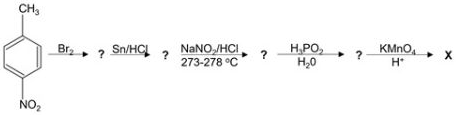
In the following sequence of the conversion, identify the final product (X)

Figure

Answer options

Q48:

Amines

Easy

Organic compounds derived from NH3_3 by replacing one or more H-atoms with alkyl or aryl groups will form primary, secondary and tertiary amines. The common methods which include their preparations are reduction of nitro group, amide group and nitrile group, Gabriel phthalimide synthesis and ammonolysis of alkyl halides. Amines are basic in nature due to the presence of a lone pair of electrons on the nitrogen atom. Important chemical properties of amines include acylation, alkylation and their interaction with nitrous acid. There are various tests which can distinguish different types of amines from each other, for e.g. carbylamine test, Hinsberg's test, coupling reaction etc. Another important class of compounds which can be derived from primary amines is azo compounds. These compounds are intensely colored and widely used as dyes in textile, leather and food industries.

Correctly predict the final product and the type of reaction for the following reaction:

C6H5−N2+Cl−+C6H5−OH→HO−?C_6H_5 - N_2^+Cl^- + C_6H_5 -OH \xrightarrow{HO^-} ?

Answer options

Q49:

Amines

Medium

Organic compounds derived from NH3_3 by replacing one or more H-atoms with alkyl or aryl groups will form primary, secondary and tertiary amines. The common methods which include their preparations are reduction of nitro group, amide group and nitrile group, Gabriel phthalimide synthesis and ammonolysis of alkyl halides. Amines are basic in nature due to the presence of a lone pair of electrons on the nitrogen atom. Important chemical properties of amines include acylation, alkylation and their interaction with nitrous acid. There are various tests which can distinguish different types of amines from each other, for e.g. carbylamine test, Hinsberg's test, coupling reaction etc. Another important class of compounds which can be derived from primary amines is azo compounds. These compounds are intensely colored and widely used as dyes in textile, leather and food industries.

How many different structural isomers that correspond to the molecular formula C3_3H9_9N are possible? Out of these, how many will give a positive carbylamine test?

Answer options

Q50:

Amines

Easy

Organic compounds derived from NH3_3 by replacing one or more H-atoms with alkyl or aryl groups will form primary, secondary and tertiary amines. The common methods which include their preparations are reduction of nitro group, amide group and nitrile group, Gabriel phthalimide synthesis and ammonolysis of alkyl halides. Amines are basic in nature due to the presence of a lone pair of electrons on the nitrogen atom. Important chemical properties of amines include acylation, alkylation and their interaction with nitrous acid. There are various tests which can distinguish different types of amines from each other, for e.g. carbylamine test, Hinsberg's test, coupling reaction etc. Another important class of compounds which can be derived from primary amines is azo compounds. These compounds are intensely colored and widely used as dyes in textile, leather and food industries.

Conversion of nitro group into primary amine is preferred using

Answer options

CUET Chemistry 2025 19 May Shift 2 Past Year Question Paper

Every question from the CUET Chemistry 2025 19 May Shift 2 paper is here in full, with the correct answer and a step by step solution for each one. It is completely free, there is no login and no paywall, and you can read the whole paper online or download it to revise offline.

You can also attempt it instead of only reading it. Take the paper as a full length mock under exam conditions, or filter it by topic and attempt just that topic as a topic test. Both are free, and you get a breakdown of your accuracy, your timing and your weak areas once you submit.

CUET Chemistry past year questions (PYQs) are the closest thing to the real exam, so working through them is the quickest way to learn the paper pattern, the marking scheme and the level of difficulty to expect on the day.