Q1:

Electrochemistry

Easy

Which one represents the correct reduction reaction for Cu2+\mathrm{Cu^{2+}}|Cu half-cell?

Answer options
Option 1
Correct Answer
Explanation for 2025: 21 May Shift 2 CHE question 1

Q2:

Amines

Medium

Match List-I with List-II

List-IList-II
(A) Coupling reaction(I) Primary amines
(B) Hofmann's degradation(II) Aromatic amines
(C) Isocyanide test(III) Phenols and aromatic amines
(D) Diazonium salts(IV) Amide to amine
Answer options
Option 3
Correct Answer
Explanation for 2025: 21 May Shift 2 CHE question 2

Q3:

Aldehydes, Ketones & Carboxylic Acids

Easy

The correct order of increasing acidic strength is

(A) Ethanol

(B) Phenol

(C) Chloroacetic acid

(D) Acetic acid

Answer options
Option 1
Correct Answer
Explanation for 2025: 21 May Shift 2 CHE question 3

Q4:

Electrochemistry

Medium

Match List-I with List-II

List-IList-II
MaterialsConductivity (S m−1\mathrm{S\ m^{-1}})
(A) Gold(I) 1.0×10−161.0 \times 10^{-16}
(B) Germanium(II) 1.2×101.2 \times 10
(C) Glass(III) 4.5×1034.5 \times 10^{3}
(D) Graphite(IV) 2.0
Answer options
Option 4
Correct Answer
Explanation for 2025: 21 May Shift 2 CHE question 4

Q5:

Haloalkanes & Haloarenes

Easy

The reagent used to convert propanol to 1-bromopropane is:

Answer options
Option 1
Correct Answer
Explanation for 2025: 21 May Shift 2 CHE question 5

Q6:

Solutions

Medium

Which of the following statements are correct?

(A) A solution which obeys Raoult's law strictly is called an ideal solution.

(B) A solution which shows deviations from Raoult's law is called the Real solution.

(C) If TbT_b is the boiling point of the solvent and T is the boiling point of the solution, the difference in the boiling points (ΔTb=Tb−T\Delta T_b = T_b - T) is called the elevation of the boiling point.

(D) The elevation of the boiling point is related to the lowering of vapor pressure.

Answer options
Option 1
Correct Answer
Explanation for 2025: 21 May Shift 2 CHE question 6

Q7:

Coordination Compounds

Medium

On the basis of following observations arrange the following compounds in increasing order of mol of AgCl precipitated per mol of the compound with excess of AgNO3\mathrm{AgNO_3}

FormulaSecondary valencesSolution conductivity
(A) PdCl2.4NH3\mathrm{PdCl_2.4NH_3}41:2 electrolyte
(B) NiCl4.2K\mathrm{NiCl_4.2K}42:1 electrolyte
(C) CoCl3.4NH3\mathrm{CoCl_3.4NH_3}61:1 electrolyte
(D) CrCl3.6H2O\mathrm{CrCl_3.6H_2O}61:3 electrolyte
Answer options
Option 2
Correct Answer
Explanation for 2025: 21 May Shift 2 CHE question 7

Q9:

Aldehydes, Ketones & Carboxylic Acids

Medium

Which of the following compounds will respond to iodoform test?

(A) Acetone

(B) Ethyl methyl ketone

(C) Acetophenone

(D) Pentan-2-one

Answer options
Option 3
Correct Answer
Explanation for 2025: 21 May Shift 2 CHE question 9

Q12:

Electrochemistry

Easy

How much current is needed to pass for 1 sec for depositing a metal with a mass equal to double of its electrochemical equivalent?

Answer options

Q13:

Solutions

Easy

Which of the following is not true with reference to evaporation of liquid?

Answer options

Q14:

Haloalkanes & Haloarenes

Easy

The Grignard reagent can be prepared by using magnesium in dry ether on

Answer options

Q15:

Chemical Kinetics

Medium

Choose the examples of first order reactions.

(A) Artificial radioactive decay of unstable nuclei

(B) Hydrogenation of ethylene

(C) Thermal decomposition of HI on gold surface

(D) Decomposition of N2O\mathrm{N_2O}

Answer options

Q19:

Haloalkanes & Haloarenes

Easy

Arrange the following compounds in increasing order of reactivity towards Nucleophilic Substitution Reaction

(A) Chlorobenzene

(B) 4- Nitrochlorobenzene

(C) 2,4 - Dinitrochlorobenzene

(D) 2,4,6-Trinitrochloronitrobenzene

Answer options

Q21:

Aldehydes, Ketones & Carboxylic Acids

Easy

The reduction of cyclohexanone with LiAlH4\mathrm{LiAlH_4} will give:

Answer options

Q22:

Chemical Kinetics

Easy

The following statements predict the temperature dependence on the rate of reaction:

(A) Increase in temperature increases the rate of reaction.

(B) Increase in temperature decreases the rate of reaction.

(C) Increase in temperature by 10 °C doubles the reaction rate.

(D) An increase in temperature by 10 °C triples the rate of reaction.

Answer options

Q23:

Alcohols, Phenols & Ethers

Easy

Reaction of phenol with chloroform in the presence of sodium hydroxide gives salicylaldehyde. The reaction is known as

Answer options

Q24:

Coordination Compounds

Medium

CuSO4\mathrm{CuSO_4} is colorless but CuSO4.5H2O\mathrm{CuSO_4.5H_2O} is blue in color. Which of the following statements is incorrect about the color of CuSO4.5H2O\mathrm{CuSO_4.5H_2O}?

Answer options

Q26:

Alcohols, Phenols & Ethers

Medium

Match List-I with List-II

List-IList-II
(A) Fermentation of glucose(I) Invertase
(B) Methanol(II) Zymase
(C) Ethanol(III) Poisonous even in small amounts
(D) Fermentation of sucrose(IV) Solvent in paint industry
Answer options

Q27:

Aldehydes, Ketones & Carboxylic Acids

Easy

Acetaldehyde on treatment with Fehling's solution gives a precipitate of

Answer options

Q28:

Chemical Kinetics

Easy

The rate of a first order reaction at a constant temperature

Answer options

Q29:

Chemical Kinetics

Easy

The units of rate of reaction and rate constant are identical for a

Answer options

Q30:

Haloalkanes & Haloarenes

Medium

The final product of 1-chlorobutane and 2-chlorobutane when treated in KOH (alcohol) gives:

Answer options

Q31:

Amines

Medium

Decreasing order of basicity for the following compounds:

(A) Ethylamine

(B) Diethylamine

(C) Ammonia

(D) Benzenamine

Answer options

Q32:

Coordination Compounds

Easy

What is the oxidation number of the metal of [Co(H2O)(CN)(ox)2]2−\mathrm{[Co(H_2O)(CN)(ox)_2]^{2-}}coordination entity?

Answer options

Q33:

Coordination Compounds

Medium

Match the wavelength of light absorbed given in List-I with the color of light absorbed in List-II

List-IList-II
Wavelength of light absorbed(nm)Colour of light absorbed
(A) 535(I) Yellow
(B) 475(II) Red
(C) 600(III) Blue
(D) 498(IV) Blue Green
Answer options

Q34:

Electrochemistry

Medium

If the Ecell0E^0_{cell} of the given hypothetical cell reaction is 0.046 V, the value of log KcK_c for this reaction at 298 K would be

A(s)+2B+(aq)→A2+(aq)+2B(s)\mathrm{A(s) + 2B^+(aq) \rightarrow A^{2+}(aq) + 2B(s)}

Answer options

Q35:

Chemical Kinetics

Medium

Which of the following statements, for the reaction of type A → B, are correct?

(A) The initial rates for a second order reaction depend on the square of the concentration of the reactant

(B) The half-life is the time for half of the reactant to be consumed

(C) The expression for rate of second order reaction is r=k[2A]2r = k[2A]^2

(D) The half-life of a second-order reaction depends on the initial concentration

Answer options

Q37:

Alcohols, Phenols & Ethers

Easy

The Lucas reagent will react fastest with

Answer options

Q38:

Solutions

Easy

Match solution in List-I with nature of solute and solvent List-II

List-IList-II
SolutionSolute and Solvent
(A) Amalgam of mercury in sodium(I) solid in liquid
(B) An alloy(II) liquid in gas
(C) A saturated solution of KCl(III) liquid in solid
(D) Chloroform in nitrogen gas(IV) Copper in gold
Answer options

Q39:

Electrochemistry

Hard

The aqueous solutions of the following salts were electrolyzed for 30 min with a current of 20 amp. Arrange the following in the increasing order of the amount of metal deposited at the cathode.

(A) WCl6\mathrm{WCl_6}

(B) ZnSO4\mathrm{ZnSO_4}

(C) HfCl4\mathrm{HfCl_4}

(D) AgNO3\mathrm{AgNO_3}

(Atomic mass of: W =184 u, Zn = 65 u, Hf = 178 u and Ag = 108u)

Answer options

Q41:

Biomolecules

Easy

Biomolecules are the organic compounds present as an essential constituents of living organisms in different cells. The molecules are generally termed as macromolecules.which are carbohydrates, enzymes, nucleic acids, amino acids and proteins etc. Carbohydrates are classified as sugars and non-sugars include sucrose, glucose, fructose, starch and cellulose. Enzymes are coordinated with various chemical reactions in nucleic acid. Nucleic acids are found in living organisms made up of proteins and natural polymers. Two types that are generally found in biological systems are DNA and RNA nucleic acid. Amino acids are bifunctional groups of carboxyl and amino groups. Proteins are a class of biologically important compounds. They are crucial to virtually all processes in living systems. Some of them are hormones, which serve as chemical messengers that coordinate certain biochemical activities.

The disaccharide present in milk is known as

Answer options

Q42:

Biomolecules

Easy

Biomolecules are the organic compounds present as an essential constituents of living organisms in different cells. The molecules are generally termed as macromolecules.which are carbohydrates, enzymes, nucleic acids, amino acids and proteins etc. Carbohydrates are classified as sugars and non-sugars include sucrose, glucose, fructose, starch and cellulose. Enzymes are coordinated with various chemical reactions in nucleic acid. Nucleic acids are found in living organisms made up of proteins and natural polymers. Two types that are generally found in biological systems are DNA and RNA nucleic acid. Amino acids are bifunctional groups of carboxyl and amino groups. Proteins are a class of biologically important compounds. They are crucial to virtually all processes in living systems. Some of them are hormones, which serve as chemical messengers that coordinate certain biochemical activities.

Starch is a polymer of saccharides known as

Answer options

Q43:

Biomolecules

Easy

Biomolecules are the organic compounds present as an essential constituents of living organisms in different cells. The molecules are generally termed as macromolecules.which are carbohydrates, enzymes, nucleic acids, amino acids and proteins etc. Carbohydrates are classified as sugars and non-sugars include sucrose, glucose, fructose, starch and cellulose. Enzymes are coordinated with various chemical reactions in nucleic acid. Nucleic acids are found in living organisms made up of proteins and natural polymers. Two types that are generally found in biological systems are DNA and RNA nucleic acid. Amino acids are bifunctional groups of carboxyl and amino groups. Proteins are a class of biologically important compounds. They are crucial to virtually all processes in living systems. Some of them are hormones, which serve as chemical messengers that coordinate certain biochemical activities.

Glucose when treated with Bromine water forms

Answer options

Q44:

Biomolecules

Easy

Biomolecules are the organic compounds present as an essential constituents of living organisms in different cells. The molecules are generally termed as macromolecules.which are carbohydrates, enzymes, nucleic acids, amino acids and proteins etc. Carbohydrates are classified as sugars and non-sugars include sucrose, glucose, fructose, starch and cellulose. Enzymes are coordinated with various chemical reactions in nucleic acid. Nucleic acids are found in living organisms made up of proteins and natural polymers. Two types that are generally found in biological systems are DNA and RNA nucleic acid. Amino acids are bifunctional groups of carboxyl and amino groups. Proteins are a class of biologically important compounds. They are crucial to virtually all processes in living systems. Some of them are hormones, which serve as chemical messengers that coordinate certain biochemical activities.

Cane sugar on boiling with HCl or H2SO4\mathrm{H_2SO_4} hydrolysis yields

Answer options

Q45:

Biomolecules

Easy

Biomolecules are the organic compounds present as an essential constituents of living organisms in different cells. The molecules are generally termed as macromolecules.which are carbohydrates, enzymes, nucleic acids, amino acids and proteins etc. Carbohydrates are classified as sugars and non-sugars include sucrose, glucose, fructose, starch and cellulose. Enzymes are coordinated with various chemical reactions in nucleic acid. Nucleic acids are found in living organisms made up of proteins and natural polymers. Two types that are generally found in biological systems are DNA and RNA nucleic acid. Amino acids are bifunctional groups of carboxyl and amino groups. Proteins are a class of biologically important compounds. They are crucial to virtually all processes in living systems. Some of them are hormones, which serve as chemical messengers that coordinate certain biochemical activities.

The zwitterionic form of amino acid is
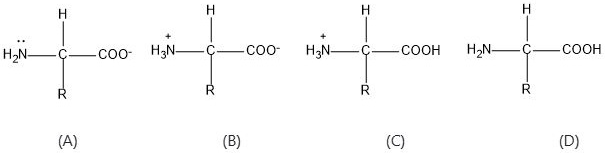
Figure

Answer options

Q46:

d & f Block Elements

Easy

The transition metals and their compounds are known for their catalytic activity. This activity is ascribed to their ability to adopt multiple oxidation states and to form complexes. Vanadium(V) oxide (in Contact Process), finely divided iron, and nickel (in Catalytic Hydrogenation) are some of the examples. Catalysts at a solid surface involve the formation of bonds between reactant molecules and atoms of the surface of the catalyst (first row transition metals utilise 3d and 4s electrons for bonding). This has the effect of increasing the concentration of the reactants at the catalyst surface and also weakening of the bonds in the reacting molecules (the activation energy is lowering). Also because the transition metal ions can change their oxidation states, they become more effective as catalysts.

Which of the following catalyses the oxidation of SO2\mathrm{SO_2} in the manufacture of sulphuric acid?

Answer options

Q47:

d & f Block Elements

Easy

The transition metals and their compounds are known for their catalytic activity. This activity is ascribed to their ability to adopt multiple oxidation states and to form complexes. Vanadium(V) oxide (in Contact Process), finely divided iron, and nickel (in Catalytic Hydrogenation) are some of the examples. Catalysts at a solid surface involve the formation of bonds between reactant molecules and atoms of the surface of the catalyst (first row transition metals utilise 3d and 4s electrons for bonding). This has the effect of increasing the concentration of the reactants at the catalyst surface and also weakening of the bonds in the reacting molecules (the activation energy is lowering). Also because the transition metal ions can change their oxidation states, they become more effective as catalysts.

In the Wacker process the oxidation of ethyne to ethanal is catalysed by_______

Answer options

Q48:

d & f Block Elements

Medium

The transition metals and their compounds are known for their catalytic activity. This activity is ascribed to their ability to adopt multiple oxidation states and to form complexes. Vanadium(V) oxide (in Contact Process), finely divided iron, and nickel (in Catalytic Hydrogenation) are some of the examples. Catalysts at a solid surface involve the formation of bonds between reactant molecules and atoms of the surface of the catalyst (first row transition metals utilise 3d and 4s electrons for bonding). This has the effect of increasing the concentration of the reactants at the catalyst surface and also weakening of the bonds in the reacting molecules (the activation energy is lowering). Also because the transition metal ions can change their oxidation states, they become more effective as catalysts.

Reaction between iodide and persulphate ions take place as follows:

2I−+S2O82−→I2+2SO42−\mathrm{2I^- + S_2O_8^{2-} \rightarrow I_2 + 2SO_4^{2-}}

Which of the following catalyses the above reaction?

Answer options

Q49:

d & f Block Elements

Medium

The transition metals and their compounds are known for their catalytic activity. This activity is ascribed to their ability to adopt multiple oxidation states and to form complexes. Vanadium(V) oxide (in Contact Process), finely divided iron, and nickel (in Catalytic Hydrogenation) are some of the examples. Catalysts at a solid surface involve the formation of bonds between reactant molecules and atoms of the surface of the catalyst (first row transition metals utilise 3d and 4s electrons for bonding). This has the effect of increasing the concentration of the reactants at the catalyst surface and also weakening of the bonds in the reacting molecules (the activation energy is lowering). Also because the transition metal ions can change their oxidation states, they become more effective as catalysts.

Which of the following is incorrect about the ability of catalytic action of transition metals?

Answer options

Q50:

d & f Block Elements

Easy

The transition metals and their compounds are known for their catalytic activity. This activity is ascribed to their ability to adopt multiple oxidation states and to form complexes. Vanadium(V) oxide (in Contact Process), finely divided iron, and nickel (in Catalytic Hydrogenation) are some of the examples. Catalysts at a solid surface involve the formation of bonds between reactant molecules and atoms of the surface of the catalyst (first row transition metals utilise 3d and 4s electrons for bonding). This has the effect of increasing the concentration of the reactants at the catalyst surface and also weakening of the bonds in the reacting molecules (the activation energy is lowering). Also because the transition metal ions can change their oxidation states, they become more effective as catalysts.

TiCl4+Al(CH3)3\mathrm{TiCl_4 + Al(CH_3)_3} is used as catalyst in______

Answer options

CUET Chemistry 2025 21 May Shift 2 Past Year Question Paper

Every question from the CUET Chemistry 2025 21 May Shift 2 paper is here in full, with the correct answer and a step by step solution for each one. It is completely free, there is no login and no paywall, and you can read the whole paper online or download it to revise offline.

You can also attempt it instead of only reading it. Take the paper as a full length mock under exam conditions, or filter it by topic and attempt just that topic as a topic test. Both are free, and you get a breakdown of your accuracy, your timing and your weak areas once you submit.

CUET Chemistry past year questions (PYQs) are the closest thing to the real exam, so working through them is the quickest way to learn the paper pattern, the marking scheme and the level of difficulty to expect on the day.