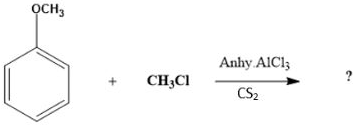
Q1:

Chemical Kinetics

Easy

75% of a first order reaction was completed in 16 minutes. When was it half completed?

(Given: log(0.75) = -0.125, log(0.25) = -0.602)

Answer options
Option 1
Correct Answer
Explanation for 2025: 23 May Shift 2 CHE question 1

Q2:

Coordination Compounds

Easy

Isomerism shown by the complex pair [Co(NH3)5(NO3)]SO4[\text{Co(NH}_3)_5(\text{NO}_3)]\text{SO}_4 and [Co(NH3)5(SO4)]NO3[\text{Co(NH}_3)_5(\text{SO}_4)]\text{NO}_3 is _____

Answer options
Option 2
Correct Answer
Explanation for 2025: 23 May Shift 2 CHE question 2

Q3:

Aldehydes, Ketones & Carboxylic Acids

Easy

Which of the following reactions are involved in preparation of aldehydes?

(A) Gatterman-Koch reaction

(B) Etard Reaction

(C) Stephen Reaction

(D) Rosenmund Reaction

Answer options
Option 3
Correct Answer
Explanation for 2025: 23 May Shift 2 CHE question 3

Q4:

Haloalkanes & Haloarenes

Easy

Reaction of Ethene with Bromine in CCl4\text{CCl}_4 will result in

Answer options
Option 2
Correct Answer
Explanation for 2025: 23 May Shift 2 CHE question 4

Q5:

Aldehydes, Ketones & Carboxylic Acids

Medium

The order of increasing boiling point for the following compounds is

(A) CH3CH2CH2CH3\text{CH}_3\text{CH}_2\text{CH}_2\text{CH}_3

(B) CH3CH2CH2CH2OH\text{CH}_3\text{CH}_2\text{CH}_2\text{CH}_2\text{OH}

(C) C2H5OC2H5\text{C}_2\text{H}_5\text{OC}_2\text{H}_5

(D) CH3CH2CH2CHO\text{CH}_3\text{CH}_2\text{CH}_2\text{CHO}

Answer options
Option 3
Correct Answer
Explanation for 2025: 23 May Shift 2 CHE question 5

Q6:

d & f Block Elements

Medium

Which one of these tripositive ions is the most stable in aqueous solution?

Answer options
Option 1
Correct Answer
Explanation for 2025: 23 May Shift 2 CHE question 6

Q7:

Coordination Compounds

Easy

Identify the correct statements for the behavior of ethane-1,2-diamine as a ligand.

(A) it is a neutral ligand

(B) it is a bidentate ligand

(C) it is an ambidentate ligand

(D) it is a chelating ligand

Answer options
Option 1
Correct Answer
Explanation for 2025: 23 May Shift 2 CHE question 7

Q8:

d & f Block Elements

Easy

Cr2O72−\text{Cr}_2\text{O}_7^{2-} dissolves in aqueous NaOH to give:

Answer options
Option 3
Correct Answer
Explanation for 2025: 23 May Shift 2 CHE question 8

Q10:

Haloalkanes & Haloarenes

Medium

The IUPAC name of the given compound is
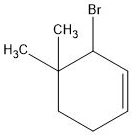
Figure

Answer options

Q11:

Biomolecules

Easy

Which structure of proteins gives rise to fibrous and globular proteins?

Answer options

Q13:

Aldehydes, Ketones & Carboxylic Acids

Easy

Match List-I with List-II

List-IList-II
(A) Gatterman-Koch reaction(I) CrO2Cl2/CS2\text{CrO}_2\text{Cl}_2/\text{CS}_2
(B) Rosenmund reduction(II) Acyl chloride and anhyd. AlCl3\text{AlCl}_3
(C) Etard reaction(III) CO, HCl, AlCl3/CuCl\text{AlCl}_3/\text{CuCl}
(D) Friedel Craft acylation(IV) H2/Pd-BaSO4\text{H}_2/\text{Pd-BaSO}_4
Answer options

Q14:

d & f Block Elements

Easy

Decide which of the following atomic numbers are the atomic numbers of the inner transition elements

(A) 59

(B) 95

(C) 102

(D) 74

Answer options

Q15:

Solutions

Medium

If the solubility of the given gases in water decreases in the order of formaldehyde, methane, vinyl chloride, argon. Match List-I with List-II.

List-IList-II
GasKHK_H /k bar
(A) Formaldehyde(I) 40.3
(B) Vinyl Chloride(II) 0.413
(C) Argon(III) 1.83×10−51.83 \times 10^{-5}
(D) Methane(IV) 0.611
Answer options

Q16:

Biomolecules

Medium

The correct sequence of attachment of sugar, base and phosphoric acid in a nucleic acid is

(A) Formation of phosphodiester linkage

(B) Attachment of base to 1' position of sugar

(C) Selection of appropriate base and sugar

(D) Attachment of phosphoric acid

Answer options

Q17:

Coordination Compounds

Easy

Write the IUPAC name for the coordination compound:

[Cr(NH3)3(H2O)3]Cl3[\text{Cr(NH}_3)_3(\text{H}_2\text{O})_3]\text{Cl}_3

Answer options

Q19:

Chemical Kinetics

Medium

The units of rate constant of four reactions are given below. Arrange them in the increasing order of reaction.

(A) s−1\text{s}^{-1}

(B) mol L−1\text{L}^{-1} s−1\text{s}^{-1}

(C) mol1/2\text{mol}^{1/2} L−1/2\text{L}^{-1/2} s−1\text{s}^{-1}

(D) L1/2\text{L}^{1/2} mol−1/2\text{mol}^{-1/2} s−1\text{s}^{-1}

Answer options

Q20:

d & f Block Elements

Hard

Match the properties given in list-I with the metals given in list-II

List-IList-II
PropertyMetal
(A) Element with highest second ionization enthalpy(I) Co
(B) Element with highest heat of atomisation(II) Cu
(C) M in M(CO)6\text{M(CO)}_6(III) Zn
(D) Element with highest third ionization enthalpy(IV) Cr
Answer options

Q21:

Haloalkanes & Haloarenes

Medium

Predict the order of decreasing reactivity of the following compounds towards SN1\text{S}_\text{N}1 reaction.

(A) C6H5CH2Br\text{C}_6\text{H}_5\text{CH}_2\text{Br}

(B) C6H5CH(C6H5)Br\text{C}_6\text{H}_5\text{CH(C}_6\text{H}_5)\text{Br}

(C) C6H5CH(CH3)Br\text{C}_6\text{H}_5\text{CH(CH}_3)\text{Br}

(D) C6H5C(CH3)(C6H5)Br\text{C}_6\text{H}_5\text{C(CH}_3)(\text{C}_6\text{H}_5)\text{Br}

Answer options

Q23:

Alcohols, Phenols & Ethers

Easy

Ethanoic acid can be converted into ethanol using reagent

Answer options

Q24:

Aldehydes, Ketones & Carboxylic Acids

Easy

Which of the following compound will form a cyclic product on reaction with ethylene glycol?

Answer options

Q25:

Chemical Kinetics

Medium

The order of a certain reaction with respect to Cl−\text{Cl}^- ion is -1. The Cl−\text{Cl}^- is

Answer options

Q26:

Solutions

Easy

The relative lowering of the vapor pressure is equal to the

Answer options

Q27:

Coordination Compounds

Medium

When 1 mol CrCl3.6H2O\text{CrCl}_3.6\text{H}_2\text{O} is treated with excess of AgNO3\text{AgNO}_3, 3 mol of AgCl are obtained. The conductivity of the solution will correspond to

Answer options

Q28:

Haloalkanes & Haloarenes

Easy

Match List-I with List-II

List-IList-II
(A) Wurtz-Fittig reaction(I) CH3COCl\text{CH}_3\text{COCl} and Anhyd. AlCl3\text{AlCl}_3
(B) Chiral(II) Swarts reaction
(C) Friedel-Crafts Acylation(III) Alkylarene
(D) Freons(IV) Non-superimposable mirror images
Answer options

Q29:

Biomolecules

Easy

Glucose reacts with Tollen's reagent (ammoniacal silver nitrate) due to the presence of

Answer options

Q30:

d & f Block Elements

Medium

What are the products of the following reaction in neutral solution?

MnO4−+S2O32−+H2O→?\text{MnO}^{4-} + \text{S}_2\text{O}_3^{2-} + \text{H}_2\text{O} \rightarrow ?

Answer options

Q31:

Aldehydes, Ketones & Carboxylic Acids

Medium

Which of the following reagents can be used to convert Ethanol to Ethanal?

(A) Chromium trioxide in Pyridine and HCl

(B) Heated Copper at 573 K

(C) Anhydrous Chromium trioxide

(D) Acidic KMnO4\text{KMnO}_4

Answer options

Q32:

Solutions

Easy

Calculate the molality of 25 g of ethanoic acid (CH3COOH\text{CH}_3\text{COOH}) in 250 g benzene

Answer options

Q34:

Solutions

Medium

50 g of ethylene glycol (C2H6O2\text{C}_2\text{H}_6\text{O}_2) is mixed with 900 g of water. The freezing point of the solution will be (KfK_f of water = 1.86 K kg mol−1\text{mol}^{-1})

Answer options

Q35:

Coordination Compounds

Easy

Arrange the following ligands in decreasing order of field strength in spectrochemical series.

(A) Br−\text{Br}^-

(B) H2O\text{H}_2\text{O}

(C) OH−\text{OH}^-

(D) CO

Answer options

Q36:

Haloalkanes & Haloarenes

Medium

The correct increasing reactivity order for SN2\text{S}_\text{N}2 reaction for the following compounds

(A) Benzyl Chloride

(B) Methyl Chloride,

(C) Isopropyl Chloride

(D) Tertiary butyl Chloride

Answer options

Q37:

Solutions

Medium

Which of the following statements, with reference to a solution are correct?

(A) The osmotic pressure of the solution is proportional to the molarity of the solute.

(B) The elevation of the boiling point (ΔTb\Delta T_b) is directly proportional to the molal concentration of the solute in a solution.

(C) The unit of KbK_b is K kg−1\text{kg}^{-1} mol−1\text{mol}^{-1}.

(D) ΔTb=Tb0−Tb\Delta T_b = T_b^0 - T_b.

Answer options

Q38:

Chemical Kinetics

Medium

For the reaction

2N2O5→4NO2+O22\text{N}_2\text{O}_5 \rightarrow 4\text{NO}_2 + \text{O}_2

at a given instant of time, the rate and rate constant are 1.02×10−41.02 \times 10^{-4} mol L−1\text{L}^{-1} s−1\text{s}^{-1} and 3.4×10−53.4 \times 10^{-5} s−1\text{s}^{-1}, respectively. The concentration of N2O5\text{N}_2\text{O}_5 at that time will be:

Answer options

Q39:

Alcohols, Phenols & Ethers

Easy

Match List-I with List-II

List-IList-II
ReactionPreparation
(A) Kolbe's Reaction(I) Salicylaldehyde
(B) Reimer-Tiemann Reaction(II) Salicylic acid
(C) Williamson synthesis(III) Ethyl methyl ether
(D) Cumene Process(IV) Phenol
Answer options

Q40:

Biomolecules

Easy

The function of the enzymes in various chemical reactions:

Answer options

Q41:

Amines

Easy

Amines are considered to be derivatives of ammonia obtained by replacement of hydrogen atoms with alkyl or aryl groups. They are usually prepared from nitro compounds, halides, amides, imides etc. The presence of hydrogen bonding influences its physical properties. In alkylamines, a combination of electron releasing steric and hydrogen bonding factors influences the stability of substituted ammonium cations in protic polar solvents and thus affects the basic nature of amines. Alkyl amines are found to be stronger bases than ammonia which is more basic than water. Primary and secondary amines are engaged in intermolecular association due to hydrogen bonding. This intermolecular association is more in primary amines than in secondary amines. Tertiary amines do not have intermoleulcar association due to the absence of hydrogen atom available for hydrogen bonding. Thus, the boiling point of amines depends on hydrogen bonding. In aromatic amines, electron releasing and withdrawing groups increase and decrease their basic character. Aryl diazonium salts usually obtained from arylamine undergo replacement of the diazonium group with a variety of nucleophile. Their coupling reaction of aryl diazonium salts with phenol or arylamine results in formation of dyes.

Carbylamine reaction is used as a test for

Answer options

Q42:

Amines

Easy

Amines are considered to be derivatives of ammonia obtained by replacement of hydrogen atoms with alkyl or aryl groups. They are usually prepared from nitro compounds, halides, amides, imides etc. The presence of hydrogen bonding influences its physical properties. In alkylamines, a combination of electron releasing steric and hydrogen bonding factors influences the stability of substituted ammonium cations in protic polar solvents and thus affects the basic nature of amines. Alkyl amines are found to be stronger bases than ammonia which is more basic than water. Primary and secondary amines are engaged in intermolecular association due to hydrogen bonding. This intermolecular association is more in primary amines than in secondary amines. Tertiary amines do not have intermoleulcar association due to the absence of hydrogen atom available for hydrogen bonding. Thus, the boiling point of amines depends on hydrogen bonding. In aromatic amines, electron releasing and withdrawing groups increase and decrease their basic character. Aryl diazonium salts usually obtained from arylamine undergo replacement of the diazonium group with a variety of nucleophile. Their coupling reaction of aryl diazonium salts with phenol or arylamine results in formation of dyes.

The most basic species in the following is

Answer options

Q43:

Amines

Medium

Amines are considered to be derivatives of ammonia obtained by replacement of hydrogen atoms with alkyl or aryl groups. They are usually prepared from nitro compounds, halides, amides, imides etc. The presence of hydrogen bonding influences its physical properties. In alkylamines, a combination of electron releasing steric and hydrogen bonding factors influences the stability of substituted ammonium cations in protic polar solvents and thus affects the basic nature of amines. Alkyl amines are found to be stronger bases than ammonia which is more basic than water. Primary and secondary amines are engaged in intermolecular association due to hydrogen bonding. This intermolecular association is more in primary amines than in secondary amines. Tertiary amines do not have intermoleulcar association due to the absence of hydrogen atom available for hydrogen bonding. Thus, the boiling point of amines depends on hydrogen bonding. In aromatic amines, electron releasing and withdrawing groups increase and decrease their basic character. Aryl diazonium salts usually obtained from arylamine undergo replacement of the diazonium group with a variety of nucleophile. Their coupling reaction of aryl diazonium salts with phenol or arylamine results in formation of dyes.

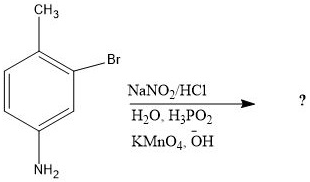
Complete the following reaction:

Figure

Answer options

Q44:

Amines

Easy

Amines are considered to be derivatives of ammonia obtained by replacement of hydrogen atoms with alkyl or aryl groups. They are usually prepared from nitro compounds, halides, amides, imides etc. The presence of hydrogen bonding influences its physical properties. In alkylamines, a combination of electron releasing steric and hydrogen bonding factors influences the stability of substituted ammonium cations in protic polar solvents and thus affects the basic nature of amines. Alkyl amines are found to be stronger bases than ammonia which is more basic than water. Primary and secondary amines are engaged in intermolecular association due to hydrogen bonding. This intermolecular association is more in primary amines than in secondary amines. Tertiary amines do not have intermoleulcar association due to the absence of hydrogen atom available for hydrogen bonding. Thus, the boiling point of amines depends on hydrogen bonding. In aromatic amines, electron releasing and withdrawing groups increase and decrease their basic character. Aryl diazonium salts usually obtained from arylamine undergo replacement of the diazonium group with a variety of nucleophile. Their coupling reaction of aryl diazonium salts with phenol or arylamine results in formation of dyes.

Complete the reaction by giving the final product:

Chloroethane + ethanolic (NaCN) + LiAlH4→?\text{LiAlH}_4 \rightarrow ?

Answer options

Q45:

Amines

Easy

Amines are considered to be derivatives of ammonia obtained by replacement of hydrogen atoms with alkyl or aryl groups. They are usually prepared from nitro compounds, halides, amides, imides etc. The presence of hydrogen bonding influences its physical properties. In alkylamines, a combination of electron releasing steric and hydrogen bonding factors influences the stability of substituted ammonium cations in protic polar solvents and thus affects the basic nature of amines. Alkyl amines are found to be stronger bases than ammonia which is more basic than water. Primary and secondary amines are engaged in intermolecular association due to hydrogen bonding. This intermolecular association is more in primary amines than in secondary amines. Tertiary amines do not have intermoleulcar association due to the absence of hydrogen atom available for hydrogen bonding. Thus, the boiling point of amines depends on hydrogen bonding. In aromatic amines, electron releasing and withdrawing groups increase and decrease their basic character. Aryl diazonium salts usually obtained from arylamine undergo replacement of the diazonium group with a variety of nucleophile. Their coupling reaction of aryl diazonium salts with phenol or arylamine results in formation of dyes.

Which of the following compounds will not undergo azo coupling with benzene diazonium chloride?

Answer options

Q46:

Electrochemistry

Easy

Electrochemistry is the study involving two types of processes. One type involves the production of electricity from the energy released during a spontaneous chemical reaction. Galvanic cells like Daniel cells are used to produce electricity from the redox reaction. Nernst equation of a galvanic cell gives the relation between the standard cell potential and the concentration of the species involved in the redox reaction. The second type of study involves the cells in which electrical energy is used to bring about the chemical reactions in a non-spontaneous process. The conductance of electrolytic solution depends on many factors including the nature of the electrolyte and the dimensions of the electrolytic cell.

What is the SI unit of conductivity?

Answer options

Q47:

Electrochemistry

Medium

Electrochemistry is the study involving two types of processes. One type involves the production of electricity from the energy released during a spontaneous chemical reaction. Galvanic cells like Daniel cells are used to produce electricity from the redox reaction. Nernst equation of a galvanic cell gives the relation between the standard cell potential and the concentration of the species involved in the redox reaction. The second type of study involves the cells in which electrical energy is used to bring about the chemical reactions in a non-spontaneous process. The conductance of electrolytic solution depends on many factors including the nature of the electrolyte and the dimensions of the electrolytic cell.

The following equation represents the reaction taking place in a Galvanic cell:

Mg(s)+2Ag+(0.001M)→Mg2+(0.01M)+2Ag (s)\text{Mg(s)} + 2\text{Ag}^+ (0.001\text{M}) \rightarrow \text{Mg}^{2+}(0.01\text{M}) + 2\text{Ag (s)}

Calculate its EcellE_{cell} at 298 K if Ecell∘E^\circ_{cell} = 2.91 V

Answer options

Q48:

Electrochemistry

Easy

Electrochemistry is the study involving two types of processes. One type involves the production of electricity from the energy released during a spontaneous chemical reaction. Galvanic cells like Daniel cells are used to produce electricity from the redox reaction. Nernst equation of a galvanic cell gives the relation between the standard cell potential and the concentration of the species involved in the redox reaction. The second type of study involves the cells in which electrical energy is used to bring about the chemical reactions in a non-spontaneous process. The conductance of electrolytic solution depends on many factors including the nature of the electrolyte and the dimensions of the electrolytic cell.

The conductivity of ionic electrolytic solutions does not depend on:

Answer options

Q49:

Electrochemistry

Easy

Electrochemistry is the study involving two types of processes. One type involves the production of electricity from the energy released during a spontaneous chemical reaction. Galvanic cells like Daniel cells are used to produce electricity from the redox reaction. Nernst equation of a galvanic cell gives the relation between the standard cell potential and the concentration of the species involved in the redox reaction. The second type of study involves the cells in which electrical energy is used to bring about the chemical reactions in a non-spontaneous process. The conductance of electrolytic solution depends on many factors including the nature of the electrolyte and the dimensions of the electrolytic cell.

When KCl is dissolved in water, the Potassium ion is;

Answer options

Q50:

Electrochemistry

Easy

Electrochemistry is the study involving two types of processes. One type involves the production of electricity from the energy released during a spontaneous chemical reaction. Galvanic cells like Daniel cells are used to produce electricity from the redox reaction. Nernst equation of a galvanic cell gives the relation between the standard cell potential and the concentration of the species involved in the redox reaction. The second type of study involves the cells in which electrical energy is used to bring about the chemical reactions in a non-spontaneous process. The conductance of electrolytic solution depends on many factors including the nature of the electrolyte and the dimensions of the electrolytic cell.

Faraday's laws of electrolysis are related to:

Answer options

CUET Chemistry 2025 23 May Shift 2 Past Year Question Paper

Every question from the CUET Chemistry 2025 23 May Shift 2 paper is here in full, with the correct answer and a step by step solution for each one. It is completely free, there is no login and no paywall, and you can read the whole paper online or download it to revise offline.

You can also attempt it instead of only reading it. Take the paper as a full length mock under exam conditions, or filter it by topic and attempt just that topic as a topic test. Both are free, and you get a breakdown of your accuracy, your timing and your weak areas once you submit.

CUET Chemistry past year questions (PYQs) are the closest thing to the real exam, so working through them is the quickest way to learn the paper pattern, the marking scheme and the level of difficulty to expect on the day.