Q2:

Amines

Easy

The correct IUPAC name for CH2=CHCH2NHCH3\text{CH}_2\text{=CHCH}_2\text{NHCH}_3.

Answer options
Option 4
Correct Answer
Explanation for 2025: 29 May Shift 1 CHE question 2

Q3:

Alcohols, Phenols & Ethers

Easy

Which of the following reagent is not used to convert aldehyde into alcohol?

Answer options
Option 4
Correct Answer
Explanation for 2025: 29 May Shift 1 CHE question 3

Q5:

Coordination Compounds

Medium

The nomenclature of the complex [CuCl2(CH3NH2)2][\text{CuCl}_2(\text{CH}_3\text{NH}_2)_2] is

Answer options
Option 4
Correct Answer
Explanation for 2025: 29 May Shift 1 CHE question 5

Q6:

Solutions

Medium

Match List-I with List-II

List-IList-II
SolutionProperties
(A) Phenol and aniline(I) Minimum boiling Azeotrope
(B) Nitric acid and water(II) Maximum boiling Azeotrope
(C) Ethanol and water(III) Hydrogen bonding
(D) Benzene and toluene(IV) Ideal solution
Answer options
Option 3
Correct Answer
Explanation for 2025: 29 May Shift 1 CHE question 6

Q7:

Haloalkanes & Haloarenes

Medium

Arrange the following in order of increasing boiling points.

(A) Bromomethane

(B) Bromoform

(C) Chloromethane

(D) Dibromomethane

Answer options
Option 1
Correct Answer
Explanation for 2025: 29 May Shift 1 CHE question 7

Q8:

Solutions

Medium

In the following diagram, to prevent osmosis, if excess pressure is applied on one side of the semipermeable membrane (SPM), then I, II, III and IV are, respectively,
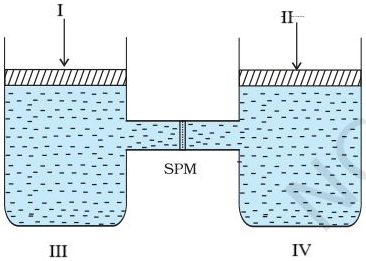
Figure

(A) Solution

(B) PatmP_{atm}

(C) Patm+ΠP_{atm} + \Pi

(D) Solvent

Answer options
Option 4
Correct Answer
Explanation for 2025: 29 May Shift 1 CHE question 8

Q10:

Amines

Medium

Among the following, which is the correct set of reducing agents for conversion of nitrobenzene into aniline ?

(A) H2/Pd\text{H}_2/\text{Pd}

(B) Sn+HCl

(C) Fe +HCl

(D) NaBH4\text{NaBH}_4

Answer options

Q11:

d & f Block Elements

Medium

Arrange the following transition metal ions in the increasing order of unpaired electrons.

(A) Cu2+\text{Cu}^{2+}

(B) Cr2+\text{Cr}^{2+}

(C) Ni2+\text{Ni}^{2+}

(D) Sc3+\text{Sc}^{3+}

Answer options

Q12:

Aldehydes, Ketones & Carboxylic Acids

Medium

Which of the following compounds will give Fehling's solution test ?

(A) CH3CHO\text{CH}_3\text{CHO}

(B) C6H5CHO\text{C}_6\text{H}_5\text{CHO}

(C) CH3CH2CHO\text{CH}_3\text{CH}_2\text{CHO}

(D) HCHO

Answer options

Q13:

Solutions

Easy

Which of the following statements are correct for dilute solutions?

(A). The elevation in boiling point is directly proportional to the molality of the solution.

(B). The elevation in boiling point is inversely proportional to the molality of the solution.

(C). The depression in freezing point is directly proportional to the molality of the solution.

(D). The depression in freezing point is inversely proportional to the molality of the solution.

Answer options

Q14:

Electrochemistry

Easy

The relation and units of cell constant are, respectively,

Answer options

Q15:

Solutions

Easy

Which one of the following correctly represents the concentration term 'ppm'?

Answer options

Q16:

Alcohols, Phenols & Ethers

Easy

Among the following compounds, which will not undergo oxidation reaction?

Answer options

Q17:

Amines

Medium

Nitration of aniline with nitric acid and sulphuric acid gives the major product as

Answer options

Q18:

Alcohols, Phenols & Ethers

Medium

Match List-I with List-II with their boiling points.

List-IList-II
Compound NameBoiling Point
(A) CH3CH2OH\text{CH}_3\text{CH}_2\text{OH}(I) 373K
(B) CH3OCH3\text{CH}_3\text{OCH}_3(II) 348K
(C) H2O\text{H}_2\text{O}(III) 351K
(D) CH3CH2OCH2CH3\text{CH}_3\text{CH}_2\text{OCH}_2\text{CH}_3(IV) 248K
Answer options

Q19:

Aldehydes, Ketones & Carboxylic Acids

Easy

What is the chemical composition of Tollen's reagent?

Answer options

Q20:

Aldehydes, Ketones & Carboxylic Acids

Easy

What is the product of nitration of Benzoic acid?

Answer options

Q21:

Haloalkanes & Haloarenes

Easy

Match List-I with List-II

List-IList-II
(A) SN1\text{S}_\text{N}1 Reaction(I) vic-dibromides
(B) Bromination of alkenes(II) gem-dihalides
(C) Alkylidene halides(III) racemisation
(D) Elimination of HX from alkylhalide(IV) Saytzeff rule
Answer options

Q22:

Haloalkanes & Haloarenes

Medium

Identify the correct statements for Ethylene dichloride and Ethylidene chloride

(A) They represent structural isomers.

(B) Both are formed by reaction of ethene with chlorine in presence of CCl4\text{CCl}_4

(C) Both the compounds belong to a class of dihalocompounds

(D) Both the compounds are optically inactive.

Answer options

Q23:

d & f Block Elements

Medium

In neutral or mild alkaline solutions, potassium permanganate oxidizes manganous salt (Mn2+\text{Mn}^{2+}) to ..........

Answer options

Q24:

d & f Block Elements

Easy

Zr and Hf (transition metals) occur together in nature and are difficult to separate. This can be attributed to

Answer options

Q25:

Coordination Compounds

Easy

Which of the following formula correctly represents the double salt "Carnallite"?

Answer options

Q26:

Coordination Compounds

Medium

Which of the following complexes are square planar?

(A) [Ni(CN)4]2−[\text{Ni(CN)}_4]^{2-}

(B) [NiCl4]2−[\text{NiCl}_4]^{2-}

(C) [PtCl4]2−[\text{PtCl}_4]^{2-}

(D) [PdCl4]2−[\text{PdCl}_4]^{2-}

Answer options

Q27:

d & f Block Elements

Easy

Which of the following statements is NOT correct regarding the catalytic ability of transition metals?

Answer options

Q28:

Electrochemistry

Medium

A cell is formed by combining given electrodes with Zn2+∣Zn(s)\text{Zn}^{2+} \mid \text{Zn(s)} (E∘=−0.76E^\circ = -0.76 V). Arrange the following in decreasing order of Ecell∘E^\circ_{cell}.

Zn(s)∣Zn2+∥\text{Zn(s)} \mid \text{Zn}^{2+} \parallel Given electrode

(A) Ag+∣Ag(s)\text{Ag}^{+} \mid \text{Ag(s)} E∘=0.80E^\circ = 0.80 V

(B) Na+∣Na(s)\text{Na}^{+} \mid \text{Na(s)} E∘=−2.71E^\circ = -2.71 V

(C) Fe2+∣Fe(s)\text{Fe}^{2+} \mid \text{Fe(s)} E∘=−0.44E^\circ = -0.44 V

(D) Cu+∣Cu(s)\text{Cu}^{+} \mid \text{Cu(s)} E∘=0.52E^\circ = 0.52 V

Answer options

Q30:

Alcohols, Phenols & Ethers

Medium

Choose the correct order of increasing acidic strength of following compounds

(A) 3-Nitrophenol

(B) Phenol

(C) Propan-1-ol

(D) 3,5 Dinitrophenol

Answer options

Q31:

Electrochemistry

Easy

Which of the following statements is correct for the galvanic cell?

Answer options

Q32:

Haloalkanes & Haloarenes

Easy

Complete the following analogy:

SN2\text{S}_\text{N}2: Inversion of configuration; SN1\text{S}_\text{N}1:______________

Answer options

Q33:

Aldehydes, Ketones & Carboxylic Acids

Easy

What is the reagent used in Clemmensen reduction?

Answer options

Q34:

Electrochemistry

Medium

The standard electrode potential for a Daniell cell is 1.1 V. Calculate the standard Gibbs energy for the reaction:

Zn(s)+Cu2+(aq)→Zn2+(aq)+Cu(s)\text{Zn(s)} + \text{Cu}^{2+}\text{(aq)} \rightarrow \text{Zn}^{2+}\text{(aq)} + \text{Cu(s)}

Answer options

Q35:

d & f Block Elements

Medium

Match the metal ion given in List-I with its property given in List-II

List-IList-II
Transition metal ionProperty
(A) Mn3+\text{Mn}^{3+}(I) 3d63d^6, green
(B) Fe2+\text{Fe}^{2+}(II) 3d43d^4, violet
(C) Ti4+\text{Ti}^{4+}(III) 3d03d^0, colorless
(D) V2+\text{V}^{2+}(IV) 3d33d^3, violet
Answer options

Q36:

Coordination Compounds

Medium

Un-decomposed silver bromide from developed film, in black and white photography, makes a complex with hypo. The formula of the complex is

Answer options

Q37:

Coordination Compounds

Medium

On heating, [Ti(H2O)6]Cl3[\text{Ti}(\text{H}_2\text{O})_6]\text{Cl}_3 becomes colorless because.......

Answer options

Q38:

Electrochemistry

Medium

Match List-I with List-II

List-IList-II
MaterialConductivity/S m−1\text{m}^{-1} at 298K
(A) Gold(I) 4.5×1034.5 \times 10^{3}
(B) Glass(II) 3.5×10−53.5 \times 10^{-5}
(C) Silicon(III) 1.0×10−161.0 \times 10^{-16}
(D) Pure water(IV) 1.5×10−21.5 \times 10^{-2}
Answer options

Q39:

Solutions

Easy

Which among the following shows positive deviation from Raoult's law?

Answer options

Q40:

Amines

Easy

What can be the product of Hoffmann bromamide degradation reaction?

Answer options

Q41:

Biomolecules

Easy

The term vitamin was coined from the word vital +amine since the earlier identified compounds had amino groups. Later work showed that most of them didn't contain amino groups, so the letter "e" was dropped and ther term vitamin is used these days.

Vitamins are classified into two groups depending upon their solubility in water or fat. Fat soluble vitamins are soluble in fat and oils but insoluble in water. They are stored in liver and adipose (fat storing) tissues.

Water-soluble vitamins are soluble in water. They must be supplied regularly in the diet as they are readily excreated in urine.

Among the following, water-soluble vitamin is

Answer options

Q42:

Biomolecules

Easy

The term vitamin was coined from the word vital +amine since the earlier identified compounds had amino groups. Later work showed that most of them didn't contain amino groups, so the letter "e" was dropped and ther term vitamin is used these days.

Vitamins are classified into two groups depending upon their solubility in water or fat. Fat soluble vitamins are soluble in fat and oils but insoluble in water. They are stored in liver and adipose (fat storing) tissues.

Water-soluble vitamins are soluble in water. They must be supplied regularly in the diet as they are readily excreated in urine.

Deficiency of which vitamin causes Scurvy?

Answer options

Q43:

Biomolecules

Easy

The term vitamin was coined from the word vital +amine since the earlier identified compounds had amino groups. Later work showed that most of them didn't contain amino groups, so the letter "e" was dropped and ther term vitamin is used these days.

Vitamins are classified into two groups depending upon their solubility in water or fat. Fat soluble vitamins are soluble in fat and oils but insoluble in water. They are stored in liver and adipose (fat storing) tissues.

Water-soluble vitamins are soluble in water. They must be supplied regularly in the diet as they are readily excreated in urine.

Which Vitamin is known as Pyridoxine?

Answer options

Q44:

Biomolecules

Easy

The term vitamin was coined from the word vital +amine since the earlier identified compounds had amino groups. Later work showed that most of them didn't contain amino groups, so the letter "e" was dropped and ther term vitamin is used these days.

Vitamins are classified into two groups depending upon their solubility in water or fat. Fat soluble vitamins are soluble in fat and oils but insoluble in water. They are stored in liver and adipose (fat storing) tissues.

Water-soluble vitamins are soluble in water. They must be supplied regularly in the diet as they are readily excreated in urine.

What is Xerophthalmia disease?

Answer options

Q45:

Biomolecules

Medium

The term vitamin was coined from the word vital +amine since the earlier identified compounds had amino groups. Later work showed that most of them didn't contain amino groups, so the letter "e" was dropped and ther term vitamin is used these days.

Vitamins are classified into two groups depending upon their solubility in water or fat. Fat soluble vitamins are soluble in fat and oils but insoluble in water. They are stored in liver and adipose (fat storing) tissues.

Water-soluble vitamins are soluble in water. They must be supplied regularly in the diet as they are readily excreated in urine.

What are the sources of Vitamin B12\text{B}_{12}?

Answer options

Q46:

Chemical Kinetics

Easy

The concentration dependence of the rate of a reaction is called the differential rate equation. It is not always convenient to determine the instantaneous rate, as it is measured by calculating the slope of the tangent at point 't' in the concentration vs time plot. This makes it difficult to determine the rate and hence the order of the reaction. This difficulty is overcome by integrating the differential rate equation. This integrated rate equation gives a direct relation between concentrations at different times and the rate constant. The integrated rate equations are different for the reactions having different reaction orders.

The rate constant of a reaction is 2.1 mol L−1s−1\text{L}^{-1}\text{s}^{-1}. What is the order of the reaction?

Answer options

Q47:

Chemical Kinetics

Medium

The concentration dependence of the rate of a reaction is called the differential rate equation. It is not always convenient to determine the instantaneous rate, as it is measured by calculating the slope of the tangent at point 't' in the concentration vs time plot. This makes it difficult to determine the rate and hence the order of the reaction. This difficulty is overcome by integrating the differential rate equation. This integrated rate equation gives a direct relation between concentrations at different times and the rate constant. The integrated rate equations are different for the reactions having different reaction orders.

A certain amount of N2O5\text{N}_2\text{O}_5 decomposes to half of its initial amount in 50 minutes. If the decomposition is a first order reaction, the rate constant of the reaction is.

Answer options

Q48:

Chemical Kinetics

Medium

The concentration dependence of the rate of a reaction is called the differential rate equation. It is not always convenient to determine the instantaneous rate, as it is measured by calculating the slope of the tangent at point 't' in the concentration vs time plot. This makes it difficult to determine the rate and hence the order of the reaction. This difficulty is overcome by integrating the differential rate equation. This integrated rate equation gives a direct relation between concentrations at different times and the rate constant. The integrated rate equations are different for the reactions having different reaction orders.

A reaction is first order in A and second order in B. If the concentration of B is doubled its initial concentration and A is reduced to 3/4th of its initial concentration, the new rate of the reaction is

Answer options

Q49:

Chemical Kinetics

Medium

The concentration dependence of the rate of a reaction is called the differential rate equation. It is not always convenient to determine the instantaneous rate, as it is measured by calculating the slope of the tangent at point 't' in the concentration vs time plot. This makes it difficult to determine the rate and hence the order of the reaction. This difficulty is overcome by integrating the differential rate equation. This integrated rate equation gives a direct relation between concentrations at different times and the rate constant. The integrated rate equations are different for the reactions having different reaction orders.

For an integrated first order reaction, a straight line graph is plotted. The incorrect co-ordinates and resulting slope of the graph are

Answer options

Q50:

Chemical Kinetics

Medium

The concentration dependence of the rate of a reaction is called the differential rate equation. It is not always convenient to determine the instantaneous rate, as it is measured by calculating the slope of the tangent at point 't' in the concentration vs time plot. This makes it difficult to determine the rate and hence the order of the reaction. This difficulty is overcome by integrating the differential rate equation. This integrated rate equation gives a direct relation between concentrations at different times and the rate constant. The integrated rate equations are different for the reactions having different reaction orders.

Choose the correct statement regarding kinetics of a chemical reaction.

Answer options

CUET Chemistry 2025 29 May Shift 1 Past Year Question Paper

Every question from the CUET Chemistry 2025 29 May Shift 1 paper is here in full, with the correct answer and a step by step solution for each one. It is completely free, there is no login and no paywall, and you can read the whole paper online or download it to revise offline.

You can also attempt it instead of only reading it. Take the paper as a full length mock under exam conditions, or filter it by topic and attempt just that topic as a topic test. Both are free, and you get a breakdown of your accuracy, your timing and your weak areas once you submit.

CUET Chemistry past year questions (PYQs) are the closest thing to the real exam, so working through them is the quickest way to learn the paper pattern, the marking scheme and the level of difficulty to expect on the day.