Q1:

Electrochemistry

Easy

Which of the following statements are correct?

(A) Solutions of acids, bases and salts are the examples of electrolytic conductors.

(B) Solutions of cane sugar, glycerin, alcohol are examples of non-electrolytes.

(C) Oxidation takes place at cathode while reduction takes place at anode in an electrolytic cell.

(D) Silicon and germanium are used in semiconductor devices.

Answer options
Option 3
Correct Answer
Explanation for 2025: 30 May Shift 1 CHE question 1

Q5:

Chemical Kinetics

Easy

Match List-I with List-II

List-IList-II
Order of reactionUnit
(A). Zero order reaction(I). L2 mol−2 s−1\mathrm{L^2\,mol^{-2}\,s^{-1}}
(B). First order reaction(II). mol−1 L s−1\mathrm{mol^{-1}\,L\,s^{-1}}
(C). Second order reaction(III). mol L−1s−1\mathrm{mol\,L^{-1}s^{-1}}
(D). Third order reaction(IV). s−1\mathrm{s^{-1}}
Answer options
Option 4
Correct Answer
Explanation for 2025: 30 May Shift 1 CHE question 5

Q6:

d & f Block Elements

Medium

Which of the following compounds will be colored in the solid state?

Answer options
Option 2
Correct Answer
Explanation for 2025: 30 May Shift 1 CHE question 6

Q7:

Aldehydes, Ketones & Carboxylic Acids

Easy

The product (Y) in the following reaction is

2 C6H5CHO→Heatconc. NaOHY+C6H5COONa2\ \mathrm{C_6H_5CHO} \xrightarrow[\text{Heat}]{\text{conc. NaOH}} \mathrm{Y + C_6H_5COONa}

Answer options
Option 4
Correct Answer
Explanation for 2025: 30 May Shift 1 CHE question 7

Q8:

d & f Block Elements

Medium

Which transition metal ion is most stable against oxidation to its +3 state?

Answer options
Option 1
Correct Answer
Explanation for 2025: 30 May Shift 1 CHE question 8

Q9:

Haloalkanes & Haloarenes

Easy

Alkyl halides react with sodium to give alkanes with double number of carbon atoms in

Answer options
Option 2
Correct Answer
Explanation for 2025: 30 May Shift 1 CHE question 9

Q10:

Solutions

Easy

Match List-I with List-II

List-IList-II
Laws/propertiesStatements
(A) Colligative properties(I) for a solution of volatile liquids, the partial vapour pressure of each component of the solution is directly proportional to its mole fraction present in the solution.
(B) Henry's law(II) the total pressure over the solution phase in the container will be the sum of the partial pressures of all the components of the solution.
(C) Raoult's law(III) depends on the number of solute particles, irrespective of their nature.
(D) Dalton's law of partial pressures(IV) at a constant temperature, the solubility of a gas in a liquid is directly proportional to the partial pressure of the gas present above the surface of a liquid or solution.
Answer options

Q11:

Chemical Kinetics

Easy

The rate of a chemical reaction doubled for every 10 °C rise in temperature. If the temperature is raised by 50 °C, the rate of reaction will be

Answer options

Q12:

d & f Block Elements

Medium

What is the correct order of following steps in the preparation of potassium permanganate?

(A) disproportionation in a neutral or acidic solution

(B) production of dark green K2MnO4\mathrm{K_2MnO_4}

(C) MnO2\mathrm{MnO_2}

(D) fusion with alkali metal hydroxide and KNO3\mathrm{KNO_3}

Answer options

Q14:

Electrochemistry

Medium

A cell is written as

Mg| Mg2+\mathrm{Mg^{2+}}(0.0001M)|| Ag+\mathrm{Ag^{+}} (0.01M) |Ag

Calculate its EcellE_{cell} if EcelloE^{o}_{cell} = 1.25 V at 298 K

Answer options

Q15:

Solutions

Medium

The increasing order of osmotic pressure of 0.1 M aqueous solution of the following is:

(A) MgCl2\mathrm{MgCl_2}

(B) NaCl

(C) NH2CONH2\mathrm{NH_2CONH_2}

(D) K3[Fe(CN)6]\mathrm{K_3[Fe(CN)_6]}

Answer options

Q16:

Haloalkanes & Haloarenes

Medium

Which of the following statements is correct for enantiomers?

(A) They exist as a pair of non-superimposable mirror images.

(B) They possess identical physical properties.

(C) They differ with respect to the rotation of plane polarized light.

(D) A mixture containing a 1:1 ratio of enantiomers is optically inactive.

Answer options

Q17:

Alcohols, Phenols & Ethers

Easy

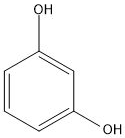
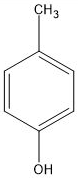
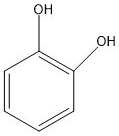
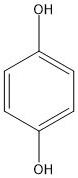
Match List-I with List-II

List-IList-II
Name of compoundStructure
(A). Resorcinol(I). Figure
(B). Catechol(II). Figure
(C). Hydroquinone(III). Figure
(D). p-Cresol(IV). Figure
Answer options

Q18:

Aldehydes, Ketones & Carboxylic Acids

Medium

Arrange the following compounds in increasing order towards Nucleophilic addition reactions:

(A) Propanal

(B) Benzaldehyde

(C) Acetone

(D) Di-tert-butyl ketone

Answer options

Q19:

Biomolecules

Easy

Choose the correct statements from the following related to glycine amino acid.

(A). Water soluble α\alpha-amino acid.

(B). It has both amino and carboxylic groups in its structure.

(C). It is optically inactive.

(D). It is a non-essential amino acid.

Answer options

Q20:

Biomolecules

Easy

Which of the following statement(s) is correct ?

(A). Keratin is an example of fibrous protein.

(B). Fibrous proteins are water-soluble, while globular proteins are water-insoluble.

(C). Polypeptide chains in fibrous proteins run parallel and are held together by hydrogen and disulphide bonds.

(D). Insulin and albumins are common examples of globular proteins.

Answer options

Q21:

Alcohols, Phenols & Ethers

Easy

In alcohols, carbon and oxygen atom are

Answer options

Q22:

Electrochemistry

Medium

Based on the standard electrode potential given in the table

Half-cell reaction(E°E°/V) at 25 °C
F2(g)+2e−→2F−\mathrm{F_2(g) + 2e^- \rightarrow 2F^-}2.87
NO3−+4H++3e−→NO(g)+2H2O\mathrm{NO_3^- + 4H^+ + 3e^- \rightarrow NO(g) + 2H_2O}0.97
Cu2++2e−→Cu(s)\mathrm{Cu^{2+} + 2e^- \rightarrow Cu(s)}0.34
2H++2e−→H2(g)\mathrm{2H^+ + 2e^- \rightarrow H_2(g)}0.00
Zn2++2e−→Zn(s)\mathrm{Zn^{2+} + 2e^- \rightarrow Zn(s)}-0.76
Li++e−→Li(s)\mathrm{Li^+ + e^- \rightarrow Li(s)}-3.05

Choose the wrong / incorrect statement from the options given below:

Answer options

Q23:

Alcohols, Phenols & Ethers

Easy

Catalytic hydrogenation of ketones with lithium aluminium hydride gives

Answer options

Q24:

Electrochemistry

Easy

Mercury cell used in hearing aid devices contains anode comprising of

Answer options

Q25:

Chemical Kinetics

Easy

Which of the following statements is not correct with reference to a catalyst?

Answer options

Q26:

Aldehydes, Ketones & Carboxylic Acids

Easy

The following reaction is known as

Figure

Answer options

Q27:

Aldehydes, Ketones & Carboxylic Acids

Medium

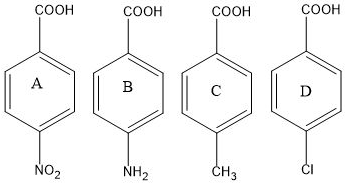
Arrange the following compounds in increasing order of their acidic strength ?

Figure

Answer options

Q28:

Biomolecules

Medium

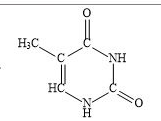
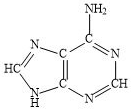
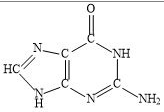
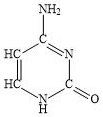
Match List-I (Name of the Base) with List-II (Structure)

List-IList-II
Name of the BaseStructure
(A). Adenine (A)(I). Figure
(B). Cytosine (C)(II). Figure
(C). Thymine (T)(III). Figure
(D). Guanine (G)(IV). Figure
Answer options

Q29:

Aldehydes, Ketones & Carboxylic Acids

Medium

Match List-I (reagent ) with List-II (Transformation)

List-IList-II
Reducing AgentTransformation
(A) Sodium Borohydride(I) Aldehyde to alkane
(B) SnCl2\mathrm{SnCl_2} and HCl(II) Primary alcohols to aldehydes
(C) Zn-Hg and conc. HCl(III) Nitriles to Imine
(D) DIBAL-H(IV) Ester to aldehyde
Answer options

Q30:

Haloalkanes & Haloarenes

Easy

The molecule with largest C-X bond length is

Answer options

Q33:

Biomolecules

Easy

The structure of the gluconic acid obtained from oxidation of glucose is

Answer options

Q34:

Chemical Kinetics

Easy

The half life of a radioactive element is 140 days. After 560 days, one gram of the element will be reduced to:

Answer options

Q35:

Alcohols, Phenols & Ethers

Medium

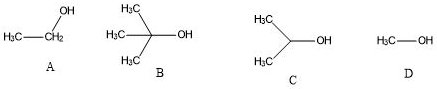
Arrange the following alcohols in decreasing order of acidity :

Figure

Answer options

Q36:

Solutions

Medium

Which of the following pairs of solutions are isotonic?

Answer options

Q37:

Electrochemistry

Easy

The standard potential of the cell (Ecell⊖E^{\ominus}_{cell}) is related to the equilibrium constant (KCK_C) as

Answer options

Q38:

Haloalkanes & Haloarenes

Easy

The compound which oxidizes slowly in the presence of air to give the extremely poisonous phosgene gas is

Answer options

Q39:

Solutions

Easy

Which of the following statements are correct:

(A). In ideal solutions, the enthalpy of mixing of the pure components to form the solution is zero.

(B). The volume of the solution is equal to the sum of the volumes of the two components.

(C). In binary ideal solutions, attractive forces between A-A and B-B are nearly equal to those between A-B.

(D). In negative Raoult's law deviation, attractions between A-B are weaker than those of A-A and B-B attractions.

Answer options

Q40:

Haloalkanes & Haloarenes

Easy

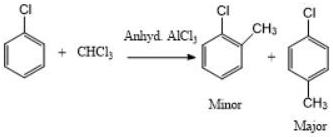
Friedel-Craft reaction as shown below is an example of

Figure

Answer options

Q41:

Amines

Easy

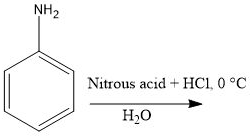
Amines are classified as primary (1°), secondary (2°) and tertiary (3°) depending upon the number of hydrogen atoms replaced by alkyl or aryl groups in ammonia molecules. Aliphatic amines are a stronger bases due to +I effect of an alkyl groups. Intermolecular hydrogen bonding in primary and secondary amines affects the boiling points of amines. The intermolecular association is more in primary amines than in secondary amines as there are more number of hydrogen atoms available for hydrogen bond formation. Nitro compounds are reduced to amines by passing hydrogen gas in the presence of finely divided nickel, palladium or platinum and also by reduction with metals in an acidic medium. Gabriel synthesis is used for the preparation of primary amines. Primary amines react with nitrous acid to give unstable diazonium-salts which can be used to synthesize a variety of compounds.

The product in the following reaction is

Figure

Answer options

Q42:

Amines

Easy

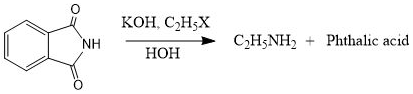
Amines are classified as primary (1°), secondary (2°) and tertiary (3°) depending upon the number of hydrogen atoms replaced by alkyl or aryl groups in ammonia molecules. Aliphatic amines are a stronger bases due to +I effect of an alkyl groups. Intermolecular hydrogen bonding in primary and secondary amines affects the boiling points of amines. The intermolecular association is more in primary amines than in secondary amines as there are more number of hydrogen atoms available for hydrogen bond formation. Nitro compounds are reduced to amines by passing hydrogen gas in the presence of finely divided nickel, palladium or platinum and also by reduction with metals in an acidic medium. Gabriel synthesis is used for the preparation of primary amines. Primary amines react with nitrous acid to give unstable diazonium-salts which can be used to synthesize a variety of compounds.

Identify the amine possessing least basic strength

Answer options

Q43:

Amines

Medium

Amines are classified as primary (1°), secondary (2°) and tertiary (3°) depending upon the number of hydrogen atoms replaced by alkyl or aryl groups in ammonia molecules. Aliphatic amines are a stronger bases due to +I effect of an alkyl groups. Intermolecular hydrogen bonding in primary and secondary amines affects the boiling points of amines. The intermolecular association is more in primary amines than in secondary amines as there are more number of hydrogen atoms available for hydrogen bond formation. Nitro compounds are reduced to amines by passing hydrogen gas in the presence of finely divided nickel, palladium or platinum and also by reduction with metals in an acidic medium. Gabriel synthesis is used for the preparation of primary amines. Primary amines react with nitrous acid to give unstable diazonium-salts which can be used to synthesize a variety of compounds.

The compound having the highest boiling point is

Answer options

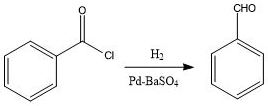
Q44:

Amines

Easy

Amines are classified as primary (1°), secondary (2°) and tertiary (3°) depending upon the number of hydrogen atoms replaced by alkyl or aryl groups in ammonia molecules. Aliphatic amines are a stronger bases due to +I effect of an alkyl groups. Intermolecular hydrogen bonding in primary and secondary amines affects the boiling points of amines. The intermolecular association is more in primary amines than in secondary amines as there are more number of hydrogen atoms available for hydrogen bond formation. Nitro compounds are reduced to amines by passing hydrogen gas in the presence of finely divided nickel, palladium or platinum and also by reduction with metals in an acidic medium. Gabriel synthesis is used for the preparation of primary amines. Primary amines react with nitrous acid to give unstable diazonium-salts which can be used to synthesize a variety of compounds.

The reaction is an example of

Figure

Answer options

Q45:

Amines

Easy

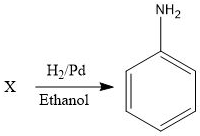
Amines are classified as primary (1°), secondary (2°) and tertiary (3°) depending upon the number of hydrogen atoms replaced by alkyl or aryl groups in ammonia molecules. Aliphatic amines are a stronger bases due to +I effect of an alkyl groups. Intermolecular hydrogen bonding in primary and secondary amines affects the boiling points of amines. The intermolecular association is more in primary amines than in secondary amines as there are more number of hydrogen atoms available for hydrogen bond formation. Nitro compounds are reduced to amines by passing hydrogen gas in the presence of finely divided nickel, palladium or platinum and also by reduction with metals in an acidic medium. Gabriel synthesis is used for the preparation of primary amines. Primary amines react with nitrous acid to give unstable diazonium-salts which can be used to synthesize a variety of compounds.

X in the following reaction is

Figure

Answer options

Q46:

Coordination Compounds

Easy

According to Valence Bond theory, the metal atom or ion under the influence of ligands can use its (n-1)dd, nsns, npnp or nsns, npnp, ndnd orbitals for hybridisation to yield a set of equivalent orbitals of definite geometry such as octahedral, tetrahedral, square planar and so on. These hybridised orbitals are allowed to overlap with ligand orbitals that can donate electron pairs for bonding. While the VB theory, to a larger extent, explains the formation, structures and magnetic behaviour of coordination compounds, it suffers from the many shortcomings. The crystal field theory (CFT) is an electrostatic model which considers the metal-ligand bond to be ionic arising purely from electrostatic interactions between the metal ion and the ligand. The five dd orbitals in an isolated gaseous metal atom/ion have same energy, i.e., they are degenerate. This degeneracy is maintained if a spherically symmetrical field of negative charges surrounds the metal atom/ion. However, when this negative field is due to ligands in a complex, it becomes asymmetrical and the degeneracy of the dd orbitals is lifted. It results in splitting of the dd orbitals. The pattern of splitting depends upon the nature of the crystal field.

Select the incorrect statement about the Crystal field splitting in octahedral complexes.

Answer options

Q47:

Coordination Compounds

Hard

According to Valence Bond theory, the metal atom or ion under the influence of ligands can use its (n-1)dd, nsns, npnp or nsns, npnp, ndnd orbitals for hybridisation to yield a set of equivalent orbitals of definite geometry such as octahedral, tetrahedral, square planar and so on. These hybridised orbitals are allowed to overlap with ligand orbitals that can donate electron pairs for bonding. While the VB theory, to a larger extent, explains the formation, structures and magnetic behaviour of coordination compounds, it suffers from the many shortcomings. The crystal field theory (CFT) is an electrostatic model which considers the metal-ligand bond to be ionic arising purely from electrostatic interactions between the metal ion and the ligand. The five dd orbitals in an isolated gaseous metal atom/ion have same energy, i.e., they are degenerate. This degeneracy is maintained if a spherically symmetrical field of negative charges surrounds the metal atom/ion. However, when this negative field is due to ligands in a complex, it becomes asymmetrical and the degeneracy of the dd orbitals is lifted. It results in splitting of the dd orbitals. The pattern of splitting depends upon the nature of the crystal field.

Which among the following are diamagnetic complexes?

[Ni(CN)4]2−\mathrm{[Ni(CN)_4]^{2-}}, [Co(C2O4)3]3−\mathrm{[Co(C_2O_4)_3]^{3-}}, [Fe(CN)6]4−\mathrm{[Fe(CN)_6]^{4-}}, [CoF6]3−\mathrm{[CoF_6]^{3-}}, [Mn(CN)6]3−\mathrm{[Mn(CN)_6]^{3-}}

Answer options

Q48:

Coordination Compounds

Easy

According to Valence Bond theory, the metal atom or ion under the influence of ligands can use its (n-1)dd, nsns, npnp or nsns, npnp, ndnd orbitals for hybridisation to yield a set of equivalent orbitals of definite geometry such as octahedral, tetrahedral, square planar and so on. These hybridised orbitals are allowed to overlap with ligand orbitals that can donate electron pairs for bonding. While the VB theory, to a larger extent, explains the formation, structures and magnetic behaviour of coordination compounds, it suffers from the many shortcomings. The crystal field theory (CFT) is an electrostatic model which considers the metal-ligand bond to be ionic arising purely from electrostatic interactions between the metal ion and the ligand. The five dd orbitals in an isolated gaseous metal atom/ion have same energy, i.e., they are degenerate. This degeneracy is maintained if a spherically symmetrical field of negative charges surrounds the metal atom/ion. However, when this negative field is due to ligands in a complex, it becomes asymmetrical and the degeneracy of the dd orbitals is lifted. It results in splitting of the dd orbitals. The pattern of splitting depends upon the nature of the crystal field.

Which of the following is not true about the limitations of VBT

Answer options

Q49:

Coordination Compounds

Easy

According to Valence Bond theory, the metal atom or ion under the influence of ligands can use its (n-1)dd, nsns, npnp or nsns, npnp, ndnd orbitals for hybridisation to yield a set of equivalent orbitals of definite geometry such as octahedral, tetrahedral, square planar and so on. These hybridised orbitals are allowed to overlap with ligand orbitals that can donate electron pairs for bonding. While the VB theory, to a larger extent, explains the formation, structures and magnetic behaviour of coordination compounds, it suffers from the many shortcomings. The crystal field theory (CFT) is an electrostatic model which considers the metal-ligand bond to be ionic arising purely from electrostatic interactions between the metal ion and the ligand. The five dd orbitals in an isolated gaseous metal atom/ion have same energy, i.e., they are degenerate. This degeneracy is maintained if a spherically symmetrical field of negative charges surrounds the metal atom/ion. However, when this negative field is due to ligands in a complex, it becomes asymmetrical and the degeneracy of the dd orbitals is lifted. It results in splitting of the dd orbitals. The pattern of splitting depends upon the nature of the crystal field.

Which of the following represents the correct pair?

Answer options

Q50:

Coordination Compounds

Medium

According to Valence Bond theory, the metal atom or ion under the influence of ligands can use its (n-1)dd, nsns, npnp or nsns, npnp, ndnd orbitals for hybridisation to yield a set of equivalent orbitals of definite geometry such as octahedral, tetrahedral, square planar and so on. These hybridised orbitals are allowed to overlap with ligand orbitals that can donate electron pairs for bonding. While the VB theory, to a larger extent, explains the formation, structures and magnetic behaviour of coordination compounds, it suffers from the many shortcomings. The crystal field theory (CFT) is an electrostatic model which considers the metal-ligand bond to be ionic arising purely from electrostatic interactions between the metal ion and the ligand. The five dd orbitals in an isolated gaseous metal atom/ion have same energy, i.e., they are degenerate. This degeneracy is maintained if a spherically symmetrical field of negative charges surrounds the metal atom/ion. However, when this negative field is due to ligands in a complex, it becomes asymmetrical and the degeneracy of the dd orbitals is lifted. It results in splitting of the dd orbitals. The pattern of splitting depends upon the nature of the crystal field.

The spin only magnetic moment of [MnBr4]2−\mathrm{[MnBr_4]^{2-}} is 5.9 BM. Predict the geometry of the complex ion?

Answer options

CUET Chemistry 2025 30 May Shift 1 Past Year Question Paper

Every question from the CUET Chemistry 2025 30 May Shift 1 paper is here in full, with the correct answer and a step by step solution for each one. It is completely free, there is no login and no paywall, and you can read the whole paper online or download it to revise offline.

You can also attempt it instead of only reading it. Take the paper as a full length mock under exam conditions, or filter it by topic and attempt just that topic as a topic test. Both are free, and you get a breakdown of your accuracy, your timing and your weak areas once you submit.

CUET Chemistry past year questions (PYQs) are the closest thing to the real exam, so working through them is the quickest way to learn the paper pattern, the marking scheme and the level of difficulty to expect on the day.